

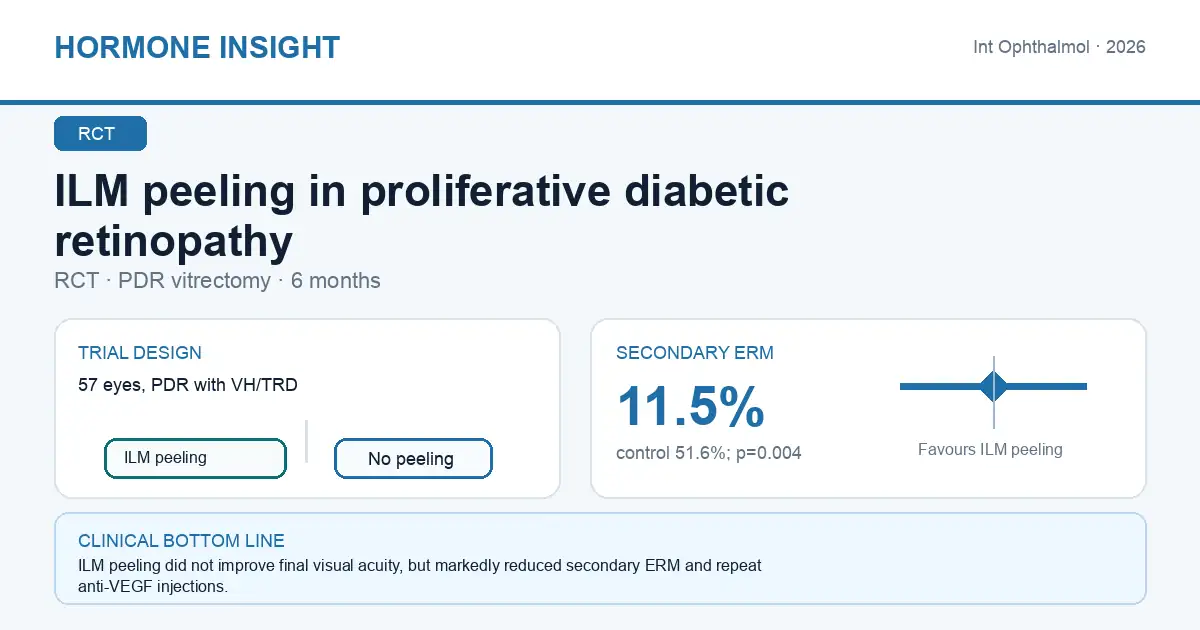
Summary: In a trial of vitrectomy for advanced proliferative diabetic retinopathy, adding internal limiting membrane peeling sharply reduced postoperative epiretinal membrane formation and repeat anti-VEGF injections, but did not improve final visual acuity over vitrectomy alone.
PICO Summary
| Element | Detail |
|---|---|
| Population | 57 eyes with proliferative diabetic retinopathy complicated by non-clearing vitreous haemorrhage and tractional retinal detachment; randomised controlled trial, Egypt. |
| Intervention | Pars plana vitrectomy with internal limiting membrane (ILM) peeling (n=26). |
| Comparison | Pars plana vitrectomy without ILM peeling (n=31). |
| Outcome | Best-corrected visual acuity improved in both groups with no between-group difference (p=0.846). ILM peeling reduced secondary epiretinal membrane formation (11.5% vs 51.6%; p=0.004) and the need for repeat anti-VEGF injections (7.7% vs 35.5%; p=0.030). Reoperations for ERM occurred only in the non-peeling group. No differences in central macular thickness, foveal avascular zone, or vessel density. |
ILM Peeling During Vitrectomy in Proliferative DR
RCT · proliferative diabetic retinopathy · 6 months
ILM peeling did not improve final visual acuity but markedly cut secondary epiretinal membrane formation and the need for repeat anti-VEGF injections.
Expert Commentary
This is a useful randomised contribution to a long-standing surgical controversy, and its value lies in distinguishing two different kinds of benefit. ILM peeling did not make vision better, with visual acuity improving similarly in both arms, so it should not be sold as a way to see more sharply. What it did do is prevent complications, markedly lowering secondary epiretinal membrane formation and the consequent need for repeat anti-VEGF injections and reoperation, which is a real reduction in downstream treatment burden. Reassuringly, the feared theoretical harms of removing the Muller-cell basement membrane did not materialise, with no adverse effect on macular thickness or perfusion measures. The limitations the post fairly notes temper firm conclusions: a small single-centre sample of 57 eyes, six-month follow-up that may miss late effects, and unreported peeling technique and dye use that affect reproducibility. Can I use this with my patients? This is a surgical decision rather than a medical one, but for counselling it is clear: in eyes undergoing vitrectomy for proliferative disease with traction or high membrane risk, ILM peeling is a reasonable prophylactic step that reduces future surgery and injections, and patients should be told it lowers complications rather than improving their eventual vision.
References
Hasan OA, Ghoneima MS, Awad AA, Eldaly ZH, Soliman WM. Outcome of pars plana vitrectomy with and without internal limiting membrane peeling in proliferative diabetic retinopathy. Int Ophthalmol. 2026;46(1):65. doi:10.1007/s10792-025-03924-5