

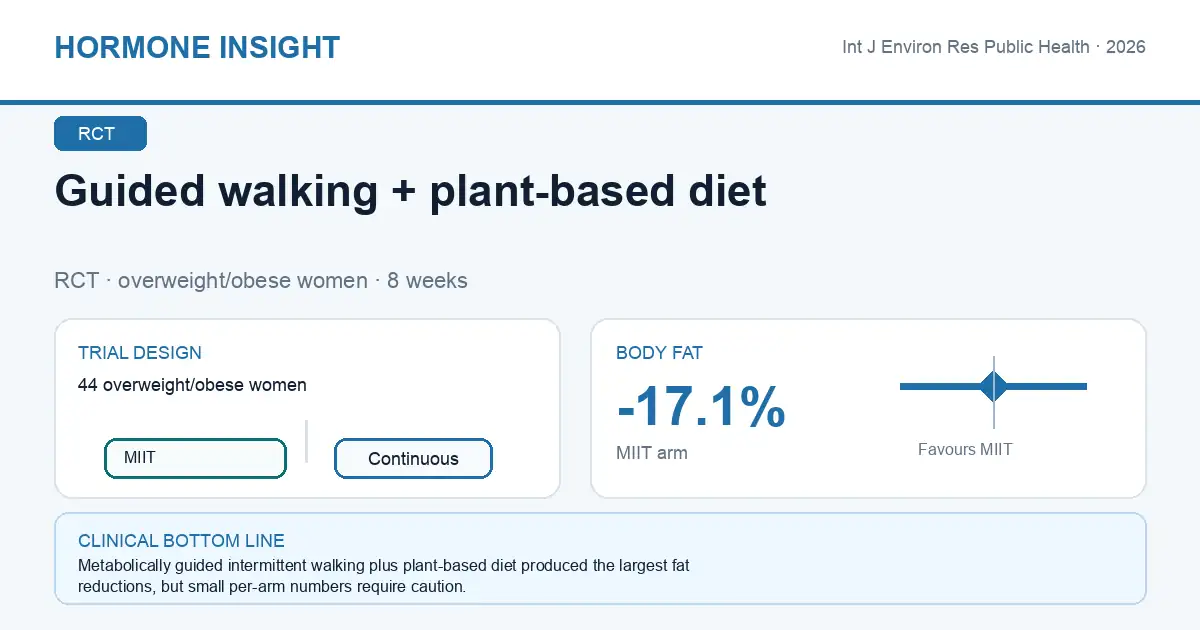
Summary: In a small 8-week trial in sedentary overweight and obese women, all combined with a plant-based diet, moderate-intensity intermittent walking guided by fuel-use metrics produced the largest improvements in body fat, fat oxidation, and submaximal fitness compared with low- or high-intensity continuous walking.
PICO Summary
| Element | Detail |
|---|---|
| Population | 44 sedentary overweight and obese women (mean age 43, BMI ~30); 8-week randomised controlled trial, USA. |
| Intervention | Metabolically guided moderate-intensity intermittent walking (respiratory exchange ratio ≈0.85), 5 sessions/week, plus a whole-food plant-based diet with a ~200 kcal/day deficit. |
| Comparison | Low-intensity continuous walking (RER ≈0.75) or high-intensity continuous walking (RER ≈0.95), each with the same diet. |
| Outcome | Percent body fat fell significantly across all participants (p<0.0001). The moderate-intensity intermittent group showed the largest reductions in total body mass (-11.2%), fat mass (-25.9%), and percent body fat (-17.1%) and improved oxygen uptake at the first ventilatory threshold (p=0.038). Resting respiratory quotient fell in the low- and moderate-intensity groups (more fat oxidation) but rose with high intensity, and its change correlated with fat loss (r=0.316; p=0.039). |
Metabolically guided walking + plant-based diet
RCT · overweight/obese women · 8 weeks
Moderate-intensity intermittent walking guided by fuel-use metrics, paired with a plant-based diet, gave the largest 8-week reductions in body fat in sedentary overweight women. The small per-arm numbers mean the eye-catching percentages should be read cautiously.
Expert Commentary
This is an interesting proof-of-concept that individualising walking intensity by substrate use, targeting a respiratory exchange ratio that favours fat oxidation, might outperform simply going harder, and the finding that the high-intensity group shifted toward carbohydrate burning while the moderate group maintained fat oxidation gives the result mechanistic coherence. The public-health appeal is real, since a substrate-informed walking prescription is community-deliverable. I would be cautious about the eye-catching percentages. With only 44 women split across three arms over eight weeks, the per-group numbers are very small, the fat-mass reduction of nearly 26% in two months is implausibly large for the timeframe and likely reflects small-sample variability and measurement noise, and a diet-induced deficit was applied to all groups so the between-arm differences rest on modest numbers. The endpoints are short-term body-composition and metabolic surrogates, not durable weight or health outcomes, and the population was women only. Can I use this with my patients? Loosely and encouragingly. It supports recommending regular moderate-intensity walking alongside dietary change and is a reminder that intensity is not simply better when higher, but I would not quote the specific percentages to patients and would treat the substrate-guided approach as promising rather than established, pending larger and longer trials.
References
Mayer HC, Valenca LG, Heath GW, Hansen CS, Hall KN, White CJ. Metabolically guided walking and plant-based nutrition enhance body composition and weight loss. Int J Environ Res Public Health. 2026;23(1):136. doi:10.3390/ijerph23010136