

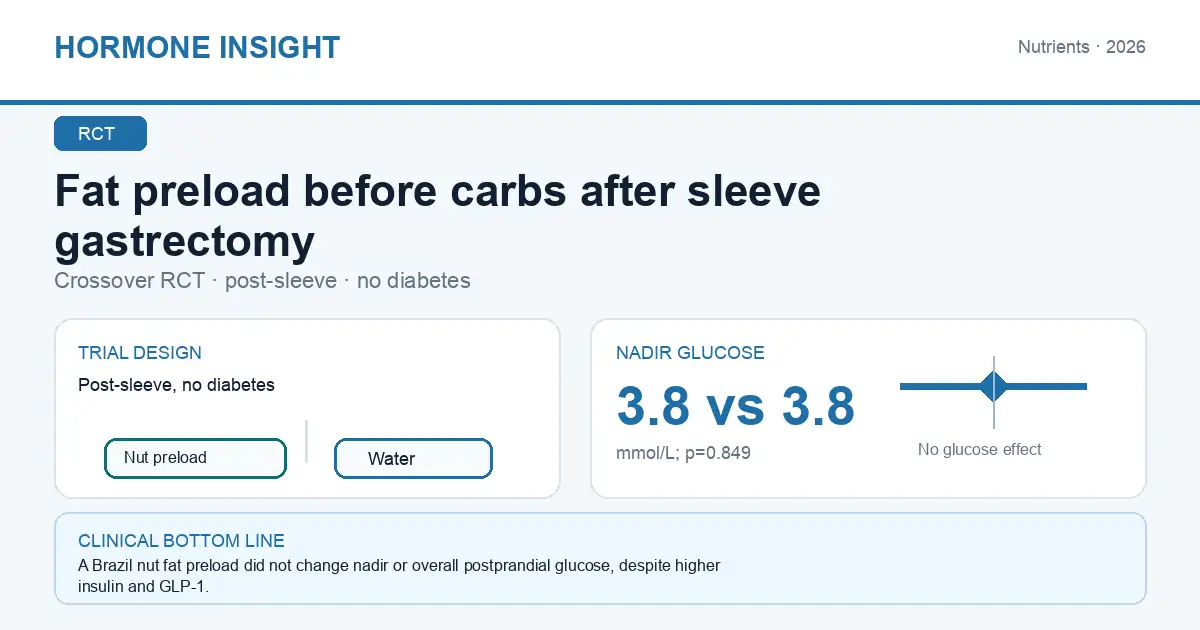
Summary: In a proof-of-concept crossover study in adults without diabetes after sleeve gastrectomy, a fat-dominant Brazil nut preload before a carbohydrate meal did not change nadir or overall postprandial glucose versus water, though it raised pre-meal and peak insulin and GLP-1.
PICO Summary
| Element | Detail |
|---|---|
| Population | 10 adults without diabetes, more than 1 year after sleeve gastrectomy (crossover). |
| Intervention | 28 g Brazil nuts (fat-dominant preload) 30 minutes before a mixed-meal tolerance test. |
| Comparison | 100 mL water 30 minutes before the same meal. |
| Outcome | Primary outcome (nadir glucose) identical: both 3.8 mmol/L (p=0.849); no difference in peak or overall glucose (iAUC). Pre-meal insulin, c-peptide, and GLP-1 higher after the preload, with higher post-meal peak insulin and c-peptide. Hypoglycaemia and dumping symptoms similar. |
Fat preload before carbs after sleeve gastrectomy
RCT crossover · post-sleeve · no diabetes
A fat-dominant Brazil nut preload did not change nadir or overall postprandial glucose versus water, though it raised pre-meal insulin and GLP-1. A negative proof-of-concept pilot.
Expert Commentary
The idea is mechanistically reasonable, fat preloads slow gastric emptying and blunt glucose spikes in non-surgical people, and post-sleeve patients with their accelerated emptying and risk of reactive hypoglycaemia are a logical group to try it in. The proof-of-concept answer here is negative on the endpoint that matters: nadir glucose was identical to the decimal, and neither the peak nor the overall glucose excursion budged. That nuts raised insulin and GLP-1 without lowering glucose is, if anything, a slightly concerning signal in patients prone to hyperinsulinaemic hypoglycaemia, though the authors rightly caution the study was not powered for these secondary outcomes. With only ten participants and an open-label design, I read this strictly as a well-conducted pilot that did not confirm the hypothesis. Can I use this with my patients? Not as advice. I would not tell a post-sleeve patient that a fat preload protects against post-meal glucose swings, because in this study it did not, and the insulin findings argue for caution rather than enthusiasm. The unusual physiology after sleeve gastrectomy clearly needs its own dedicated, adequately powered work rather than extrapolation from non-surgical preload studies.
References
Whelehan G, Herring LY, Tziannou A, et al. The impact of a fat-dominant preload before a carbohydrate-rich meal on glucose homeostasis in patients without diabetes after sleeve gastrectomy: a proof-of-concept, randomised, open-label, crossover study. Nutrients. 2026;18(3):469. doi:10.3390/nu18030469