

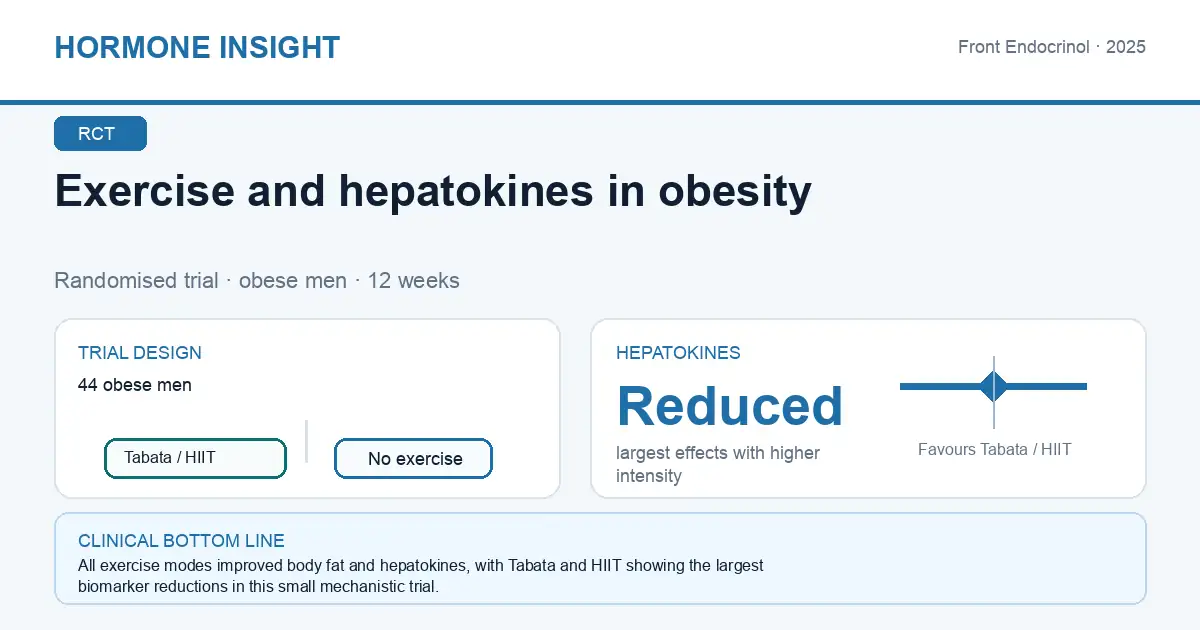
Summary: In a 12-week trial in obese men, continuous aerobic, Tabata, and high-intensity interval training all reduced body fat and circulating liver-derived hepatokines, with the higher-intensity Tabata and HIIT protocols producing the greatest reductions.
PICO Summary
| Element | Detail |
|---|---|
| Population | 44 obese men in four groups of 11; 12-week randomised trial, Iran. |
| Intervention | Endurance (continuous aerobic) training, Tabata, or HIIT, three 60-minute sessions weekly. |
| Comparison | Non-exercising control group maintaining usual lifestyle. |
| Outcome | Significant group-by-time effects were seen for fetuin-B, FGF-21, FGL-1, selenoprotein P, weight, BMI, and body-fat percentage. Reductions in fetuin-B were greater in HIIT and Tabata versus control, and reductions in FGF-21 and FGL-1 were greater in all three exercise groups versus control, with the largest effects in the higher-intensity Tabata and HIIT arms. No adverse effects reported. |
Exercise and liver hepatokines in obese men
RCT · obese men · 12 weeks
All exercise modalities lowered liver-derived hepatokines alongside fat loss, with HIIT and Tabata producing the largest FGF-21, fetuin-B, and FGL-1 reductions versus a non-exercising control.
Expert Commentary
This is a mechanistically oriented trial exploring a fashionable and biologically plausible target, the hepatokines, liver-secreted proteins such as fetuin-B, FGF-21, and selenoprotein P that are elevated in obesity and fatty liver and linked to insulin resistance. The coherent finding is that exercise of any modality lowered these markers alongside fat loss, with the higher-intensity Tabata and HIIT protocols doing so most, which fits the broader pattern that intensity drives metabolic adaptation and offers time-efficient options for patients short on time. I would, however, keep the interpretation cautious and resist over-reading the biomarkers. This is a small study of 44 men over 12 weeks, hepatokine levels were not linked to actual liver fat or histology, diet was uncontrolled, and the reductions tracked body-composition change, so it is unclear how much reflects a specific hepatic adaptation versus simple fat loss. The FGF-21 result is also nuanced, since FGF-21 biology is complex and lower circulating levels are not straightforwardly good. Can I use this with my patients? As supportive reinforcement of exercise rather than a biomarker strategy. It backs recommending higher-intensity interval training, where tolerated and appropriately screened, as a time-efficient way to improve obesity-related metabolic signalling, while the best exercise remains the one a patient will sustain.
References
Ataeinosrat A, Abednatanzi H, Hajesfandiari S, et al. Hepatokines modulation in obesity: which exercise training model is better in men with obesity? Front Endocrinol (Lausanne). 2025;16:1560453. doi:10.3389/fendo.2025.1560453