

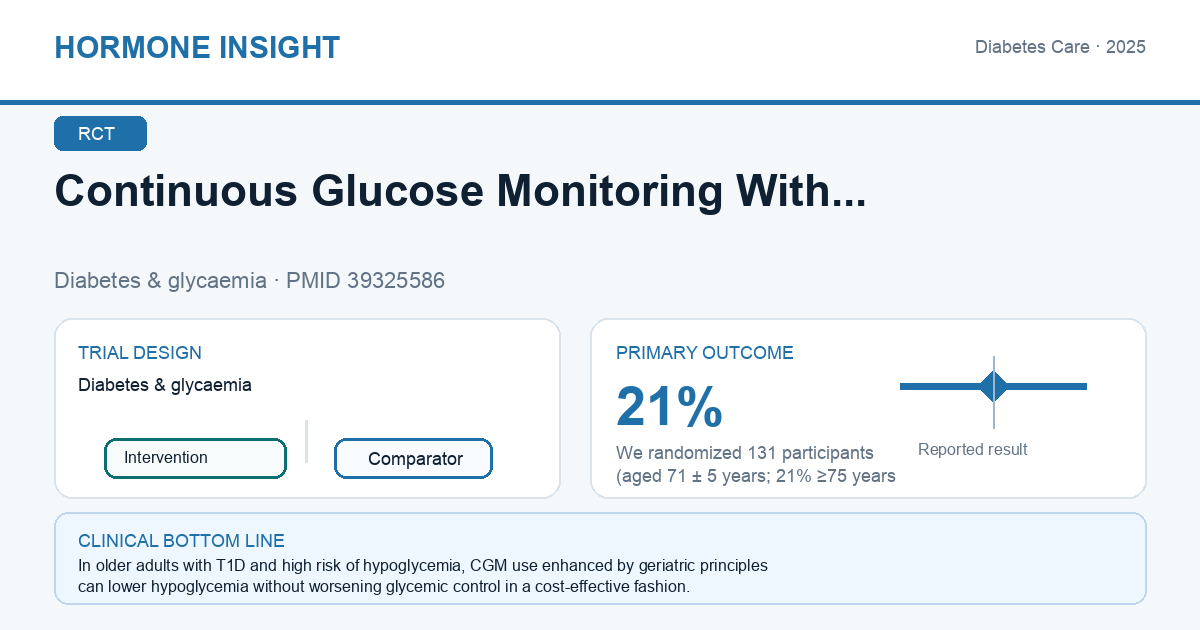
Summary: In a Diabetes Care randomized trial, In older adults with T1D and high risk of hypoglycemia, CGM use enhanced by geriatric principles can lower hypoglycemia without worsening glycemic control in a cost-effective fashion. Key reported results included We randomized 131 participants (aged 71 ± 5 years; 21% ≥75 years old) to the intervention (n = 68; CGM users = 33) or the control (n = 63; CGM users = 40) group.
PICO Summary
| Element | Detail |
|---|---|
| Population | Older adults (≥65 years) with T1D with hypoglycemia (two or more episodes of hypoglycemia [blood glucose <70 mg/dL for ≥20 min over 2 weeks]) who were CGM naive or CGM users were randomized to intervention and control groups. The intervention consisted of the combined use of CGM with geriatric principles (i.e., adjusting goals based on overall health, and simplification of regimens based on CGM patterns and clinical… |
| Intervention | Older adults (≥65 years) with T1D with hypoglycemia (two or more episodes of hypoglycemia [blood glucose <70 mg/dL for ≥20 min over 2 weeks]) who were CGM naive or CGM users were randomized to intervention and control groups. |
| Comparison | Older adults (≥65 years) with T1D with hypoglycemia (two or more episodes of hypoglycemia [blood glucose <70 mg/dL for ≥20 min over 2 weeks]) who were CGM naive or CGM users were randomized to intervention and control groups. |
| Outcome | We randomized 131 participants (aged 71 ± 5 years; 21% ≥75 years old) to the intervention (n = 68; CGM users = 33) or the control (n = 63; CGM users = 40) group. The median change in hypoglycemia from baseline to 6 months was -2.6% in the intervention group and -0.3% in the control group (median difference, -2.3% [95% CI -3.7%, -1.3%]; P < 0.001). This improvement was seen in both CGM naive (-2.8%; 95% CI -5.6%, -0.8%) and CGM users (-1.2%; 95% CI -2.7%, -0.1%). The HbA1c did not differ between the groups (7.5%… |
Continuous Glucose Monitoring With Geriatric Principles...
Primary RCT · Diabetes & glycaemia
In older adults with T1D and high risk of hypoglycemia, CGM use enhanced by geriatric principles can lower hypoglycemia without worsening glycemic control in a cost-effective fashion.
Expert Commentary
This Diabetes Care randomized trial evaluated Continuous Glucose Monitoring With Geriatric Principles in Older Adults With Type 1 Diabetes and Hypoglycemia: A Randomized Controlled Trial. The abstract describes the study as follows: Older adults (≥65 years) with T1D with hypoglycemia (two or more episodes of hypoglycemia [blood glucose <70 mg/dL for ≥20 min over 2 weeks]) who were CGM naive or CGM users were randomized to intervention and control groups. The intervention consisted of the combined use of CGM with geriatric… The main reported results were: We randomized 131 participants (aged 71 ± 5 years; 21% ≥75 years old) to the intervention (n = 68; CGM users = 33) or the control (n = 63; CGM users = 40) group. The median change in hypoglycemia from baseline to 6 months was -2.6% in the intervention group and -0.3% in the control group (median difference, -2.3% [95% CI -3.7%, -1.3%]; P < 0.001). This improvement was seen in both CGM naive (-2.8%; 95% CI… The authors conclude: In older adults with T1D and high risk of hypoglycemia, CGM use enhanced by geriatric principles can lower hypoglycemia without worsening glycemic control in a cost-effective fashion. The clinical value of the result depends on whether the trial population..
References
Munshi MN, Slyne C, Adam A, et al.. Continuous Glucose Monitoring With Geriatric Principles in Older Adults With Type 1 Diabetes and Hypoglycemia: A Randomized Controlled Trial.. Diabetes Care. 2025-May-01. doi:10.2337/dc24-1069. PMID: 39325586.