

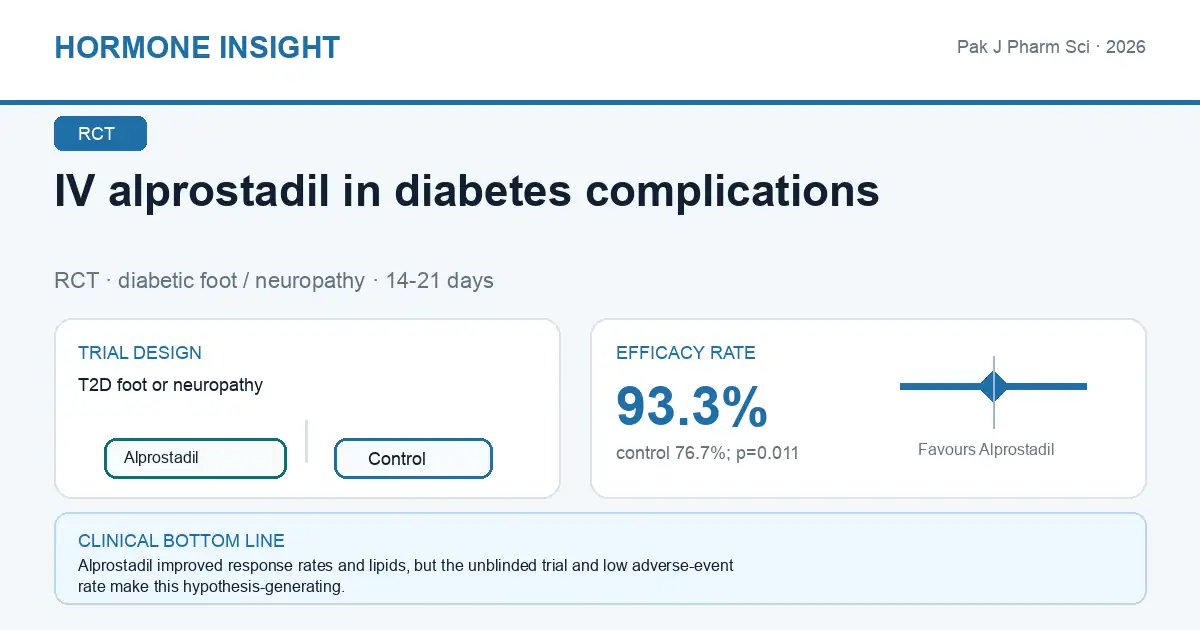
Summary: In a trial in type 2 diabetes with diabetic foot or peripheral neuropathy, adding a two-to-three-week course of intravenous alprostadil to standard care improved the overall clinical response rate and lipid profile, with a low rate of adverse events.
PICO Summary
| Element | Detail |
|---|---|
| Population | 120 patients with type 2 diabetes and either diabetic foot (62) or diabetic peripheral neuropathy (58); prospective randomised controlled trial, China. |
| Intervention | Alprostadil (prostaglandin E1) 40 µg intravenously daily for 14–21 days, added to standard care (n=60). |
| Comparison | Standard care alone, including glucose control and symptom management (n=60). |
| Outcome | The alprostadil group had a higher total efficacy rate (93.33% vs 76.67%; p=0.011), greater lipid improvements (total cholesterol -1.24, triglycerides -0.86, LDL-C -0.92, HDL-C +0.35 mmol/L; all p<0.05), and a lower adverse-event rate (3.33% vs 18.83%; p=0.008). |
IV alprostadil in type 2 diabetes complications
RCT · diabetic foot / neuropathy · 14–21 days
Adding a 2-3 week IV alprostadil course raised the clinical response rate and improved lipids, but the trial was unblinded with an implausibly low adverse-event rate, so treat as hypothesis-generating.
Expert Commentary
This trial supports a plausible adjunctive role for alprostadil in diabetic microvascular complications, where impaired perfusion and endothelial dysfunction contribute to tissue damage, and a prostaglandin E1 analogue with vasodilatory and antiplatelet actions could improve local blood flow. The efficacy and lipid findings are favourable, and prostaglandin E1 does have recognised effects on hepatic lipid handling. I would read it with several reservations the post fairly raises. The composite of diabetic foot and peripheral neuropathy mixes overlapping but distinct conditions and may obscure where benefit actually lies, the definition of clinical efficacy was not detailed, follow-up beyond the infusion course is unknown, and crucially blinding was not described, so unblinded efficacy judgements are open to bias. The lower adverse-event rate in the treated group than in controls is genuinely unusual and more likely reflects baseline or reporting differences than a protective effect, which itself signals caution about the trial’s rigour. Can I use this with my patients? As a considered adjunct rather than routine practice. Where perfusion impairment is prominent and standard care is insufficient, a time-limited alprostadil course is reasonable to consider in settings equipped for intravenous therapy, always alongside the foundations of debridement, infection control, offloading, and glycaemic management, and with awareness that the evidence base is methodologically mixed.
References
Liu Y, Li S, Wang L. Effectiveness and safety of alprostadil injection in the treatment of patients with type 2 diabetes complications. Pak J Pharm Sci. 2026;39(1):97–101. doi:10.36721/PJPS.2026.39.1.REG.13294.1