

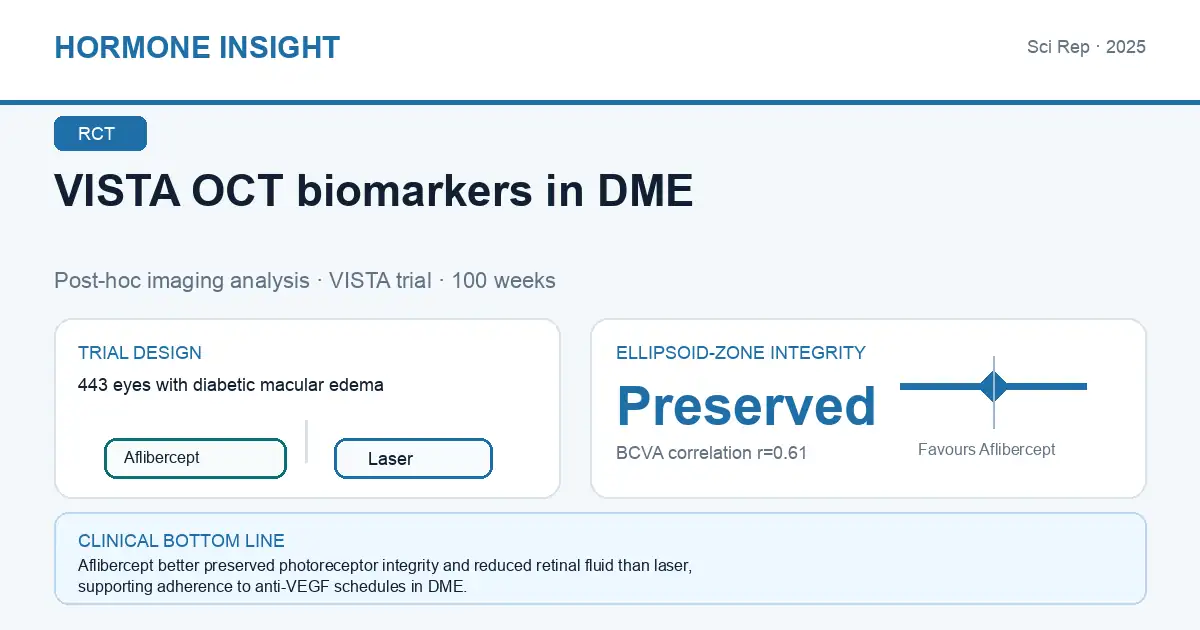
Summary: In a machine-learning imaging analysis of the phase III VISTA trial in diabetic macular edema, aflibercept injections better preserved photoreceptor ellipsoid-zone integrity and reduced retinal fluid more than laser over 100 weeks, with ellipsoid-zone integrity strongly correlating with vision.
PICO Summary
| Element | Detail |
|---|---|
| Population | 443 eyes with diabetic macular edema; post-hoc machine-learning OCT analysis of the phase III VISTA trial, USA. |
| Intervention | Intravitreal aflibercept injections (including every-4-week and every-8-week regimens). |
| Comparison | Laser photocoagulation. |
| Outcome | Aflibercept gave greater reduction in intraretinal fluid volume (-0.933 vs -0.386 mm³; p<0.0001) and better preservation of ellipsoid-zone integrity (-24.6% vs +125.6% disruption; p<0.0001). The every-4-week regimen gave the most sustained fluid control, while greater fluid volatility on every-8-week dosing was linked to poorer vision. At week 100, ellipsoid-zone integrity correlated with best-corrected visual acuity (r=0.61). No differences across racial or ethnic groups. |
VISTA: ellipsoid zone & fluid dynamics
Post-hoc RCT analysis · DME · 100 weeks
Aflibercept reduced intraretinal fluid more than 2-fold versus laser and preserved ellipsoid-zone integrity, which correlated with visual acuity at 100 weeks.
Expert Commentary
This is a sophisticated imaging-biomarker analysis that adds mechanistic texture to an already-settled clinical question, explaining why anti-VEGF therapy outperforms laser for diabetic macular edema rather than re-establishing that it does. The interesting contribution is the ellipsoid zone, a marker of photoreceptor integrity, which aflibercept preserved while laser was associated with its disruption, and which correlated meaningfully with visual acuity at two years, offering a structural rationale for the functional advantage. The volumetric fluid finding is also practically suggestive, since fluid volatility on less frequent dosing tracked worse vision, hinting that consistency of fluid control matters, not just average thickness. The appropriate caveats are clear, and the post states them: this is a post-hoc analysis rather than a prespecified endpoint, the machine-learning segmentation may differ systematically from manual grading, and the imaging focus means safety and patient-reported function were not the point here. Can I use this with my patients? This is primarily an ophthalmology matter, but as a physician co-managing diabetic eye disease it reinforces the message I give patients, that anti-VEGF injections protect photoreceptor structure underlying vision, which can support adherence to a demanding injection schedule, while retinal specialists individualise the regimen.
References
Matar K, Indurkar A, Yordi S, Cetin H, Reese JL, Srivastava SK, Ehlers JP. Expanding insights from the VISTA phase III trial: longitudinal comparative assessment of ellipsoid zone integrity and volumetric fluid dynamics. Sci Rep. 2025;15(1):43222. doi:10.1038/s41598-025-27350-w