

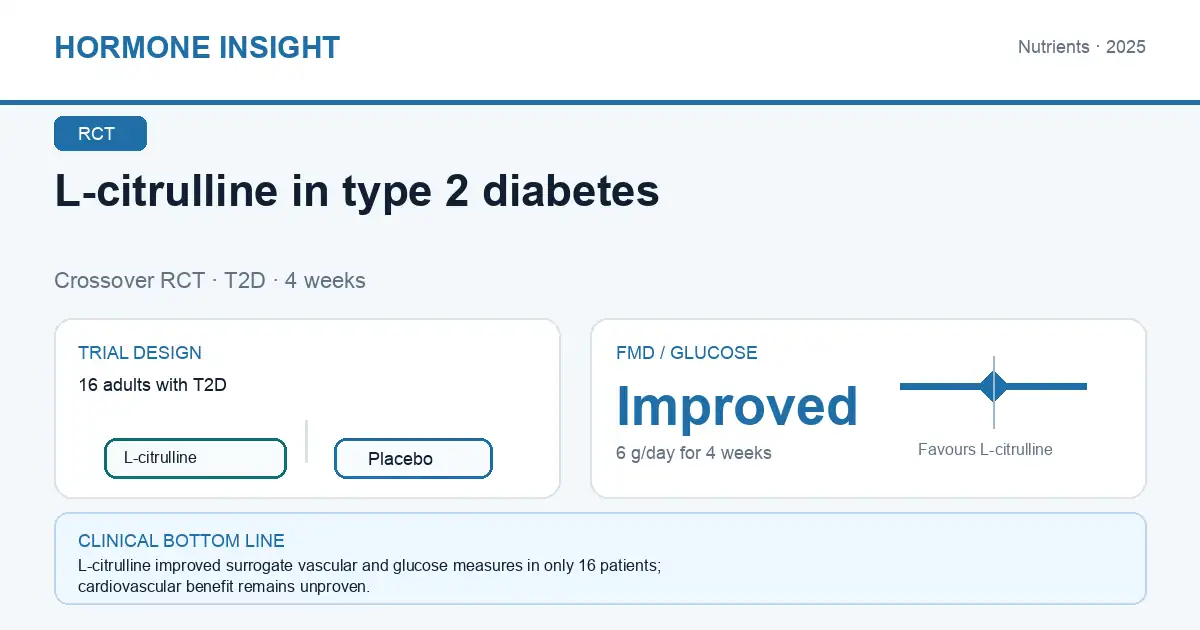
Summary: In a small 4-week trial in middle-aged and older adults with type 2 diabetes, L-citrulline supplementation improved endothelial function, reduced leg arterial stiffness and aortic systolic pressure, and lowered glucose in both the fasted state and during acute hyperglycaemia.
PICO Summary
| Element | Detail |
|---|---|
| Population | 16 patients with type 2 diabetes (mean age 62); randomised, double-blind, placebo-controlled trial, USA. |
| Intervention | L-citrulline 6 g/day for 4 weeks. |
| Comparison | Placebo, assessed fasted and 60 minutes after glucose ingestion. |
| Outcome | Versus placebo, L-citrulline improved brachial flow-mediated dilation, femoral-ankle pulse wave velocity, aortic systolic blood pressure, and blood glucose in the fasted state (all p<0.05). During acute hyperglycaemia it likewise increased flow-mediated dilation and reduced leg arterial stiffness, aortic systolic pressure, and glucose (all p<0.05). |
L-Citrulline in type 2 diabetes
RCT crossover · T2DM · 4 weeks
Over 4 weeks, L-citrulline 6 g/day improved endothelial function and lowered glucose, leg arterial stiffness, and aortic systolic pressure versus placebo, fasted and during acute hyperglycaemia. Surrogate endpoints in only 16 patients, so a promising signal, not proof of cardiovascular benefit.
Expert Commentary
This is a mechanistically coherent small trial with a sound rationale, since L-citrulline is converted to L-arginine and bypasses hepatic metabolism, raising substrate for endothelial nitric oxide synthase, and improved nitric oxide bioavailability plausibly explains both the vascular and the glucose findings, the latter perhaps via nitric-oxide-mediated glucose uptake. The demonstration that benefits held during an acute glucose challenge, not just fasting, is the more interesting part, since post-meal hyperglycaemic spikes are repeated vascular insults in diabetes. The decisive limitation, which the post should foreground, is size and duration: just 16 participants over four weeks, with surrogate endpoints, flow-mediated dilation, pulse wave velocity, and blood pressure, rather than cardiovascular events, so this is a promising signal rather than evidence of outcome benefit, and possible interactions with glucose-lowering medication were not examined. Can I use this with my patients? Cautiously, as a low-risk adjunct. For a diabetic patient at vascular risk interested in a well-tolerated supplement, L-citrulline is reasonable to consider alongside, never instead of, proven therapy, with honest acknowledgement that the evidence rests on a very small short study of surrogate markers and that blood-glucose monitoring is sensible if combined with glucose-lowering drugs.
References
Kang Y, Dillon KN, Levitt DE, Figueroa A. Effects of L-citrulline supplementation on endothelial function, arterial stiffness, and blood glucose level in the fasted and acute hyperglycemic states in middle-aged and older adults with type 2 diabetes. Nutrients. 2025;17(23):3739. doi:10.3390/nu17233739