

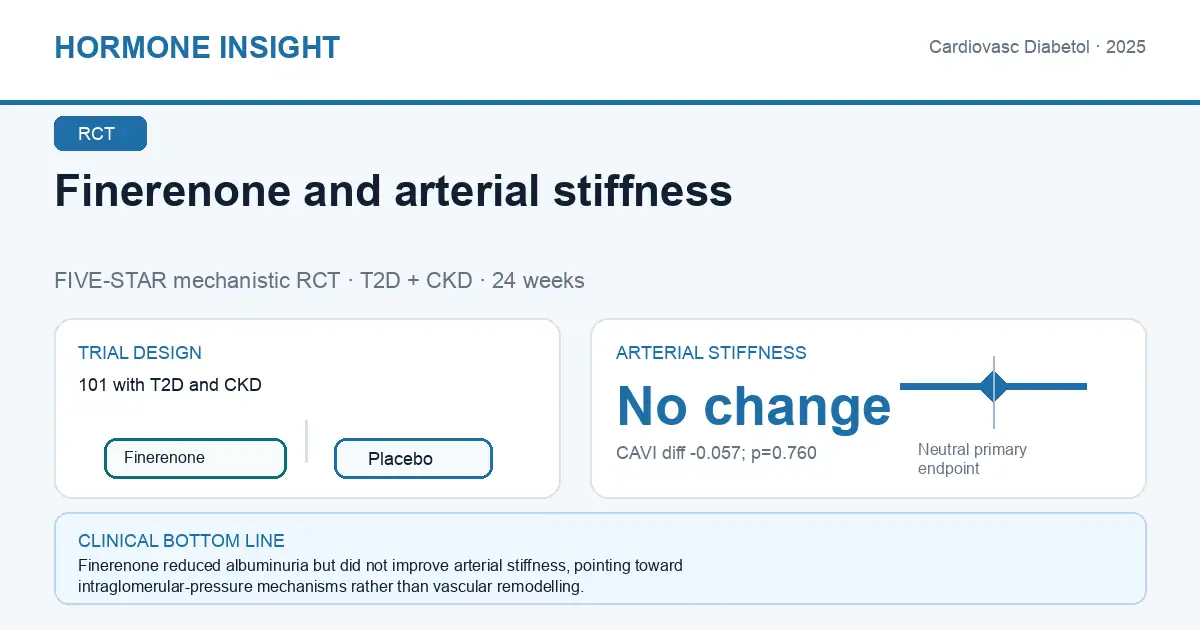
Summary: In the FIVE-STAR mechanistic trial in type 2 diabetes with chronic kidney disease, finerenone did not change arterial stiffness (its primary endpoint) but significantly reduced albuminuria, indicating its kidney benefit comes from lowering intraglomerular pressure rather than from vascular effects.
PICO Summary
| Element | Detail |
|---|---|
| Population | 101 patients with type 2 diabetes and chronic kidney disease (eGFR 25 to <90; UACR 30 to <3500 mg/g); multicentre, double-blind, placebo-controlled mechanistic trial, Japan. |
| Intervention | Dose-adjusted finerenone for 24 weeks. |
| Comparison | Matching placebo. |
| Outcome | The primary endpoint, change in arterial stiffness by cardio-ankle vascular index at 24 weeks, did not differ (group difference -0.057; 95% CI -0.428 to 0.314; p=0.760). Finerenone reduced albuminuria by 29% at weeks 12 and 24 (p=0.043 and 0.046) and caused an early, sustained eGFR decline without raising acute tubular-injury markers. The authors attribute the benefit to lowering intraglomerular pressure rather than vascular stiffness. |
FIVE-STAR
RCT · T2D + CKD · 24 weeks
Finerenone did not change arterial stiffness (CAVI group difference -0.057, p=0.76) but cut albuminuria by 29% at 24 weeks (p=0.046). The kidney benefit reflects lower intraglomerular pressure, not reduced vascular stiffness.
Expert Commentary
This is an elegant mechanistic trial whose value lies precisely in its negative primary result, since it tests and rejects a specific hypothesis about how finerenone works. The drug’s established cardiorenal benefit, proven in FIDELIO-DKD and FIGARO-DKD, could in principle have arisen from reducing arterial stiffness, but here it did not move the cardio-ankle vascular index at all, with a p-value of 0.76, while it reproduced the familiar albuminuria reduction. The honest interpretation, which the post captures well, is a dissociation: finerenone protects the kidney through haemodynamic and anti-inflammatory or anti-fibrotic routes, including the telltale early eGFR dip without tubular-injury markers that signals reduced intraglomerular pressure, rather than through vascular remodelling. The limitations are appropriate to a mechanistic study, namely a sample sized for biomarkers rather than outcomes, only 24 weeks which may be too short for structural vascular change, a single vascular measure, and a Japanese population. Can I use this with my patients? It does not change practice, and it should not. Finerenone remains indicated for diabetic kidney disease with persistent albuminuria alongside RAS blockade and SGLT2 inhibitors, and I would continue standard potassium and eGFR monitoring, using this study only to understand the mechanism better.
References
Tanaka A, Vaduganathan M, Imai T, et al. Effects of finerenone on arterial stiffness and cardiorenal biomarkers in patients with type 2 diabetes and chronic kidney disease: a randomised placebo-controlled mechanistic trial (FIVE-STAR). Cardiovasc Diabetol. 2025;24(1):454. doi:10.1186/s12933-025-03014-x