

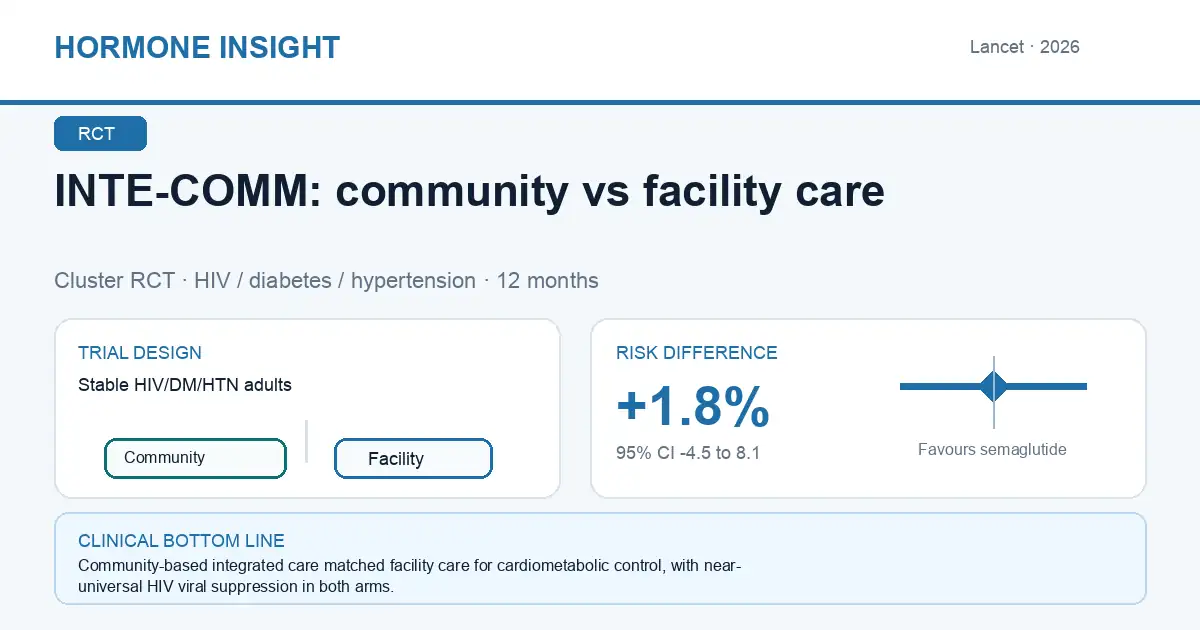
Summary: In the INTE-COMM trial across Tanzania and Uganda, integrated community-based care for stable HIV, diabetes, and hypertension matched facility-based care: the blood-pressure or glucose control composite did not differ significantly (55.2% vs 53.2%), and HIV viral suppression was around 99% in both arms.
PICO Summary
| Element | Detail |
|---|---|
| Population | 1,864 stable adults with HIV, type 2 diabetes, or hypertension (or combinations) at 14 primary care facilities in Tanzania and Uganda (cluster RCT). |
| Intervention | Integrated community-based care: a nurse and trained lay worker supporting groups at community focal points, meeting monthly (62 groups). |
| Comparison | Integrated facility-based care with shared registration, clinicians, pharmacy, and laboratory (62 groups). Follow-up 12 months. |
| Outcome | BP or fasting glucose control composite 55.2% vs 53.2% (adjusted risk difference 1.80; 95% CI -4.52 to 8.12; p=0.58, not significant). HIV viral suppression 99.1% vs 98.7% (adjusted difference 0.44; -1.12 to 1.99). Seven deaths in each arm. |
INTE-COMM: community vs facility care
Cluster RCT · HIV / diabetes / hypertension · 12 months
Integrated community-based care matched facility-based care for cardiometabolic control, with no significant difference and near-universal HIV viral suppression in both arms.
Expert Commentary
The right way to read this large, well-conducted Lancet trial is as a non-inferiority result, not a victory for one model over another. Community-based care did not beat facility care on the cardiometabolic composite, the difference was small and clearly non-significant, and viral suppression was near-universal in both arms. That is precisely why the finding matters: moving stable, integrated chronic-disease care out of overstretched facilities and into the community, supported by a nurse and a trained lay worker, achieved the same control while plausibly easing the travel and time burden that drives loss to follow-up in these settings. I value that it builds on the established African experience of task-shifting in HIV and extends it horizontally to diabetes and hypertension. The honest caveats are an open-label design with attendant performance bias, possible contamination between arms in shared regions, and no long-term or cost-effectiveness data yet. Can I use this with my patients? Not directly in my own setting, but it is genuinely informative for health-system design, supporting community delivery for selected stable patients while facilities retain newly diagnosed and complex cases. I would want the cost and durability data before wholesale rollout.
References
Kasujja FX, Aikaeli F, Garrib A, et al. Integrated community-based versus facility-based care for people with HIV, diabetes, and hypertension in sub-Saharan Africa (INTE-COMM): an open-label, multicountry, cluster-randomised trial. Lancet. 2026;407(10533):1084–1094. doi:10.1016/S0140-6736(25)02641-8