

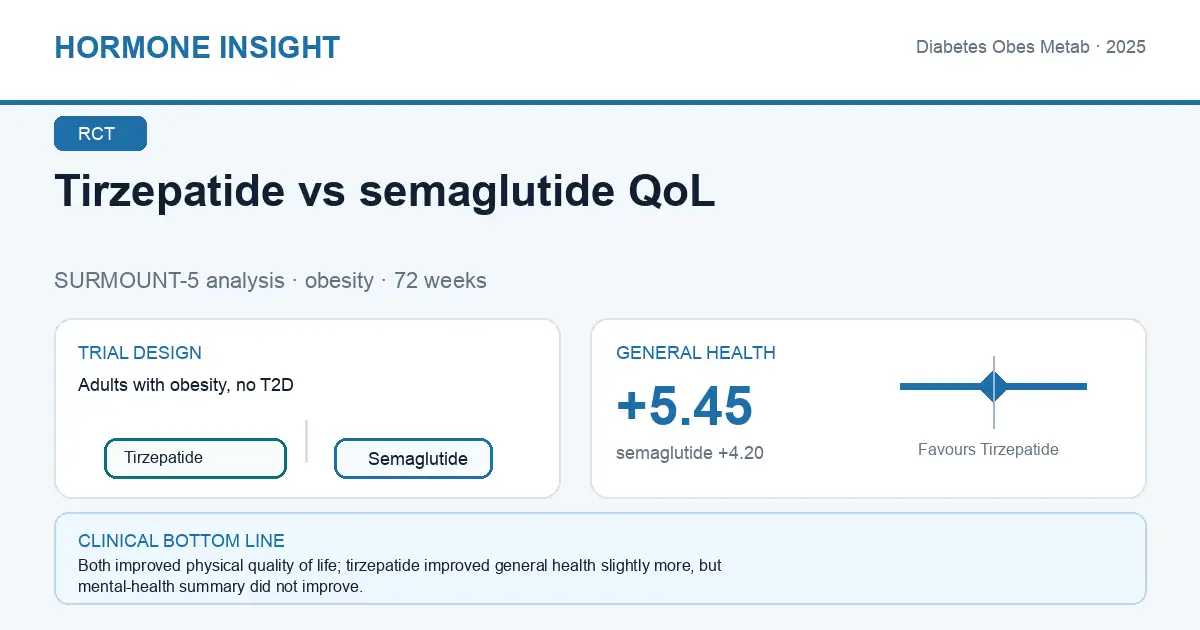
Summary: In a quality-of-life analysis of the SURMOUNT-5 head-to-head trial, both tirzepatide and semaglutide improved physical health-related quality of life in adults with obesity, with tirzepatide showing greater general-health improvement, while neither improved mental-health summary scores.
PICO Summary
| Element | Detail |
|---|---|
| Population | Adults with obesity or overweight without type 2 diabetes from SURMOUNT-5 who received at least one dose at maximum tolerated dose. |
| Intervention | Tirzepatide at maximum tolerated dose for 72 weeks. |
| Comparison | Semaglutide at maximum tolerated dose for 72 weeks. |
| Outcome | SF-36v2 Physical Component Summary improved with both (p<0.001); Mental Component Summary did not improve in either arm (p>0.05). All domains improved (p≤0.008), with greater General Health gain for tirzepatide (5.45 vs 4.20; p=0.003). In limited-physical-function participants, tirzepatide superior for PCS, Physical Functioning, and General Health (p≤0.025). Greater weight loss tracked with better physical outcomes. |
Tirzepatide vs semaglutide: quality of life in obesity
RCT (SURMOUNT-5 analysis) · obesity · 72 weeks
Both agents improved physical quality of life over 72 weeks, with tirzepatide gaining more on general health. Neither improved the mental-health summary score.
Expert Commentary
Patient-reported quality of life is the outcome patients actually feel, so I value that SURMOUNT-5 looked beyond the scale, and the headline is believable: both drugs lifted physical wellbeing, with tirzepatide edging ahead on general health in step with its greater weight loss. The finding I would not let slip past, and which the analysis is commendably honest about, is that neither agent improved the mental component summary. That matters clinically, because patients and prescribers often expect mood and emotional wellbeing to rise automatically with weight loss, and here they did not, which is a useful corrective against overselling. My caveats are the standard ones for a secondary analysis: on-treatment data can be biased by differential dropout, the limited-physical-function subgroup result is post hoc, and SF-36 is a generic instrument that may miss obesity-specific concerns. Can I use this with my patients? Yes, in counselling: I can tell a patient that either drug is likely to improve physical functioning, that tirzepatide may do a little more, and crucially that mental-health benefit is not guaranteed and should be supported separately. I would weight the choice on efficacy and tolerability, not these QoL nuances alone.
References
Shukla AP, Dunn JP, Gomez Valderas E, et al. Improved health-related quality of life with tirzepatide versus semaglutide in adults with obesity or overweight from the SURMOUNT-5 trial. Diabetes Obes Metab. 2025;28(1):452–462. doi:10.1111/dom.70215