

| PICO | Description |
|---|---|
| Population | Older adults diagnosed with type 2 diabetes and mild cognitive impairment (MCI). |
| Intervention | Hyperbaric oxygen therapy (HBOT) administered over the study period (specific dosing regimen not detailed). |
| Comparison | Sham treatment serving as placebo control. |
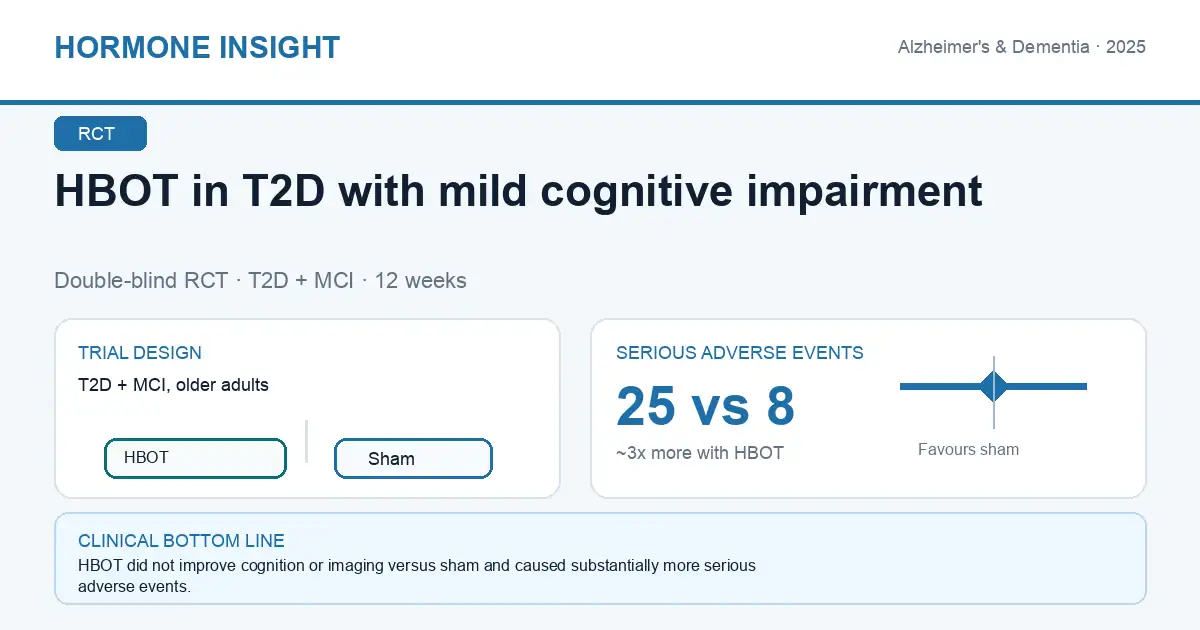
| Outcome | No significant improvement in cognitive function or brain imaging outcomes with HBOT compared to sham; transient cognitive improvements observed in sham group immediately post-intervention. HBOT group experienced a higher incidence of serious adverse events, highlighting safety concerns in this population. |
RCT
Alzheimer's & Dementia · 2025
HBOT vs sham in T2D with mild cognitive impairment
Double-blind RCT · T2D + MCI · 60 sessions over 12 weeks
Trial design
Proportion reaching endpoint
Cognition (z-score)
No benefit
Favoured sham at 3 mo (p<0.05)
Cerebral blood flow
No difference
ASL-MRI, between groups
FDG-PET SUVR
No difference
Lower in HBOT per-protocol
Serious adverse events
25 vs 8
~3x more with HBOT
⬡ Bottom Line
HBOT did not improve cognition or brain imaging versus sham and produced roughly three times more serious adverse events. It should not be used for cognitive enhancement in this population.
P
Population
Older adults with type 2 diabetes and mild cognitive impairment
I
Intervention
Hyperbaric oxygen therapy, 60 daily sessions at 2 ATA over 12 weeks
C
Comparator
Sham (1.1 ATA)
O
Outcome
Global cognition composite z-score, cerebral blood flow, FDG-PET, serious adverse events
Clinical Context
Mild cognitive impairment in the setting of type 2 diabetes represents a growing clinical challenge as the overlap between metabolic and neurodegenerative diseases becomes increasingly recognized. Diabetes-associated cognitive decline involves multiple mechanisms including cerebral microvascular disease, impaired brain insulin signaling, neuroinflammation, and oxidative stress. Hyperbaric oxygen therapy has been proposed as an intervention that could address several of these pathophysiological processes by increasing oxygen delivery to hypoxic brain tissue, promoting angiogenesis, and reducing inflammation. Preliminary studies in other populations with cognitive impairment or brain injury generated enthusiasm for HBOT as a potential neuroprotective intervention. The theoretical rationale appeared particularly compelling in diabetes, where microvascular compromise likely contributes to brain hypoperfusion. This randomized sham-controlled trial rigorously evaluated whether HBOT could improve cognitive outcomes and brain imaging measures in older adults with the dual burden of type 2 diabetes and mild cognitive impairment.Clinical Pearls
- Hyperbaric oxygen therapy failed to demonstrate significant improvement in cognitive outcomes compared to sham treatment in older adults with type 2 diabetes and mild cognitive impairment.
- Brain imaging outcomes showed no meaningful differences between HBOT and sham groups, failing to support neuroplasticity or structural brain benefits from the intervention.
- The sham group exhibited transient cognitive improvements immediately post-intervention, highlighting the importance of placebo-controlled designs in cognitive intervention trials and suggesting significant placebo effects.
- Serious adverse events occurred at higher rates in the HBOT group, raising safety concerns about this intervention in older diabetic patients with cognitive impairment.
Practical Application
Clinicians should not recommend hyperbaric oxygen therapy for cognitive improvement in older adults with type 2 diabetes and mild cognitive impairment based on this evidence. Patients or families inquiring about HBOT for cognitive benefits should be counseled about the lack of demonstrated efficacy and the increased risk of serious adverse events observed in this population. The higher adverse event rate warrants particular caution given that these patients already face elevated cardiovascular and other health risks. Resources and efforts should be directed toward evidence-based cognitive interventions including optimization of cardiovascular risk factors, glycemic control, physical exercise, cognitive stimulation, and social engagement. While HBOT has established indications for specific conditions such as decompression sickness and certain wound healing applications, cognitive enhancement in diabetic mild cognitive impairment should not be considered a supported use.Broader Evidence Context
This negative trial provides important counterbalance to earlier enthusiasm about HBOT for cognitive conditions. While some uncontrolled studies and case series suggested cognitive benefits with HBOT, rigorous randomized controlled trials have generally failed to replicate these findings. The results align with growing recognition that many complementary and alternative interventions showing promise in preliminary studies fail to demonstrate efficacy when subjected to proper placebo-controlled evaluation. The placebo response observed in the sham group underscores why rigorous trial design is essential for evaluating cognitive interventions. This study adds to evidence cautioning against premature adoption of HBOT for neurocognitive indications outside established uses.Study Limitations
- The specific HBOT dosing regimen including pressure, duration, and number of sessions was not detailed in the summary, limiting protocol comparison with other HBOT studies.
- Sample size was not specified, and the study may have been underpowered to detect modest cognitive benefits.
- The nature and severity of serious adverse events in the HBOT group were not characterized, limiting risk-benefit assessment.
- Follow-up duration may have been insufficient to detect delayed cognitive benefits or harms.
- Whether particular subgroups might benefit from HBOT was not explored.