

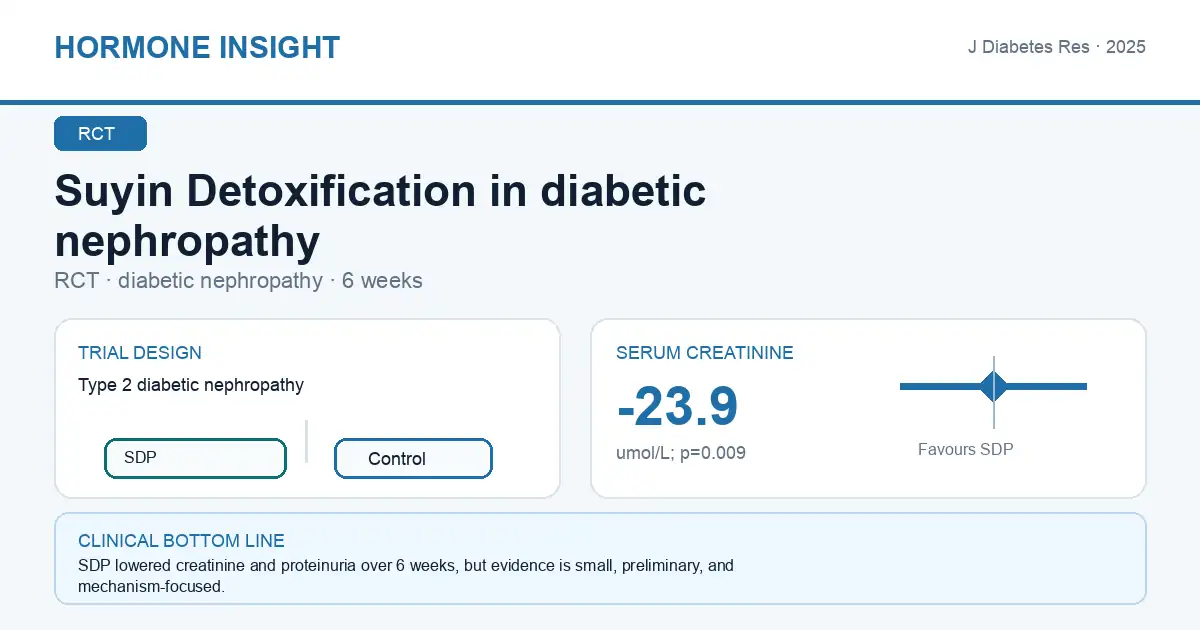
Summary: In a combined clinical and laboratory study in diabetic nephropathy, a traditional Chinese medicine formula (Suyin Detoxification Prescription) reduced serum creatinine and proteinuria, with mouse experiments pointing to a farnesoid X receptor mechanism that disappeared when the receptor was knocked out.
PICO Summary
| Element | Detail |
|---|---|
| Population | Patients with diabetic nephropathy (clinical arm) plus a diabetic-nephropathy mouse model; randomised controlled trial integrated with network pharmacology and molecular validation, China. |
| Intervention | Suyin Detoxification Prescription (SDP), a multi-herb traditional Chinese medicine formula. |
| Comparison | Standard care (clinical) or untreated model mice, including farnesoid X receptor (FXR) knockout mice to test pathway specificity. |
| Outcome | SDP significantly reduced serum creatinine (p=0.009) and proteinuria (p=0.03), and downregulated TNF-α, gp91, and P-MLK1 in renal tissue. Renoprotection was abolished in FXR-knockout mice, indicating FXR activation is required for the effect. |
Suyin Detoxification Prescription in diabetic nephropathy
RCT · diabetic nephropathy · 6 weeks
SDP added to standard care lowered serum creatinine and proteinuria over 6 weeks, while control patients worsened. Clinical evidence is small and preliminary; mechanism traces to FXR activation.
Expert Commentary
This study illustrates the modern, mechanism-led approach to evaluating traditional medicine, pairing a clinical signal with network pharmacology and, most persuasively, knockout-mouse validation that ties the benefit to a specific target. The mechanistic thread is its real strength: the loss of renoprotection in FXR-knockout animals is genuine evidence that the formula acts through farnesoid X receptor activation, a pathway of independent pharmaceutical interest in metabolic and renal disease, lending biological plausibility to the modest reductions in creatinine and proteinuria. I would read the clinical component with real caution, as the post itself urges. The trial’s sample size, randomisation, and blinding need scrutiny, hard outcomes such as progression to end-stage renal disease and mortality were not assessed, herbal-preparation standardisation varies and limits reproducibility, the population was Chinese, and interactions with conventional therapy were not examined. The wider literature on traditional formulas in diabetic kidney disease is also methodologically heterogeneous. Can I use this with my patients? Not as standard care, and not outside settings where traditional Chinese medicine is properly integrated and dispensed by qualified practitioners using standardised preparations. Even there it should complement, never replace, proven treatment, glycaemic and blood-pressure control, RAS blockade, and SGLT2 inhibitors, while larger, longer, independent trials are awaited.
References
Wei T, Huang J, Wan B, et al. Unveiling the therapeutic potential of Suyin Detoxification Prescription in diabetic nephropathy: a comprehensive study integrating clinical efficacy, network pharmacology, and molecular mechanisms. J Diabetes Res. 2025;2025:4566357. doi:10.1155/jdr/4566357