

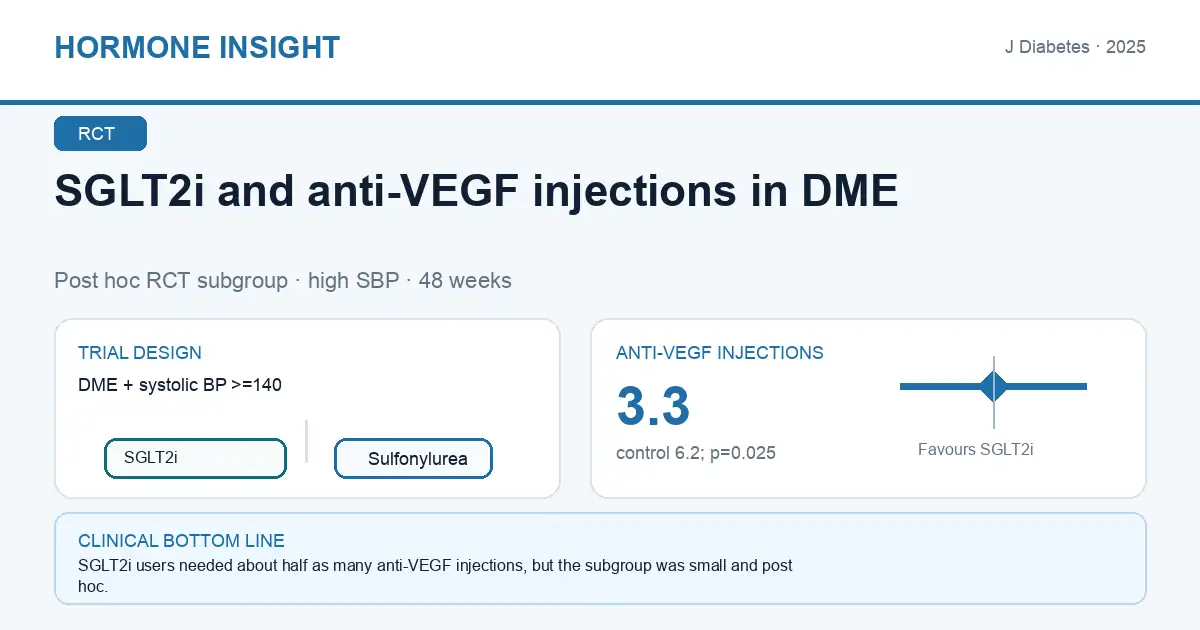
Summary: In a small post hoc subgroup of the COMET trial, patients with diabetic macular edema and elevated systolic blood pressure who took an SGLT2 inhibitor needed roughly half as many eye injections over 48 weeks as those on a sulfonylurea, an exploratory finding from just 29 patients.
PICO Summary
| Element | Detail |
|---|---|
| Population | Patients with diabetic macular edema and hypertension (office systolic BP ≥140 mmHg); post hoc subgroup of the COMET randomised trial, Japan. The key subgroup was small: 14 on SGLT2i versus 15 on sulfonylurea. |
| Intervention | SGLT2 inhibitor (luseogliflozin) alongside intravitreal ranibizumab over 48 weeks. |
| Comparison | Sulfonylurea (glimepiride) alongside the same injection therapy. |
| Outcome | In the elevated-systolic-BP subgroup, the SGLT2i group received fewer injections (adjusted 3.3 ± 1.1 vs 6.2 ± 1.0; p=0.025), with consistently lower office diastolic BP. No significant difference in injection frequency was seen in other subgroups. Visual acuity and anatomic edema measures were not reported. |
SGLT2i and anti-VEGF eye injections in DME
Post hoc RCT subgroup · DME + high SBP · 48 wk
In a post hoc subgroup of 29 hypertensive DME patients, SGLT2i users needed about half as many anti-VEGF injections over 48 weeks. Hypothesis-generating only: visual and anatomic outcomes were not reported.
Expert Commentary
This is an intriguing but firmly hypothesis-generating analysis, and the honest framing is everything here. The idea is biologically plausible, that SGLT2 inhibitors, through blood-pressure lowering and osmotic and anti-inflammatory effects, might reduce macular fluid and hence the need for anti-VEGF injections, and the signal that benefit was concentrated in hypertensive patients fits that haemodynamic rationale. But the result rests on a post hoc subgroup of just 14 versus 15 patients, which is very small and prone to spurious findings, the comparison was against a sulfonylurea rather than placebo or another modern agent, and crucially visual acuity and anatomic edema outcomes were not reported, so we cannot confirm that fewer injections maintained equal disease control rather than reflecting undertreatment. Can I use this with my patients? Not as a reason to choose an eye-sparing diabetes drug. Where an SGLT2 inhibitor is already indicated for cardiorenal protection, this offers a speculative additional hope worth mentioning, but I would not select glucose-lowering therapy to reduce injections on this evidence, and would await prospective confirmation with visual and anatomic endpoints before changing practice.
References
Ishibashi R, Koshizaka M, Takatsuna Y, et al. Blood pressure status modulates the therapeutic response to sodium-glucose cotransporter 2 inhibitors in diabetic macular edema: a post hoc subgroup analysis of the COMET trial. J Diabetes. 2025;17(12):e70184. doi:10.1111/1753-0407.70184