

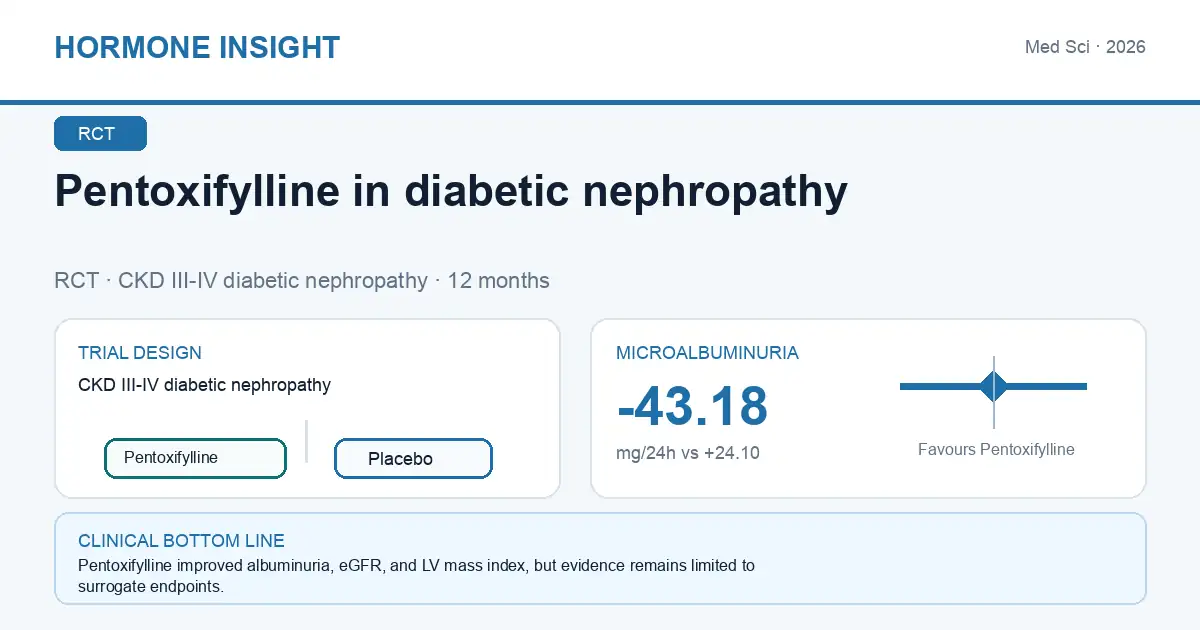
Summary: In a trial in advanced diabetic nephropathy, adding pentoxifylline to standard care reduced microalbuminuria, preserved kidney function, and improved a marker of cardiac structure over 12 months, with no significant adverse events.
PICO Summary
| Element | Detail |
|---|---|
| Population | 93 adults with CKD stages III–IV due to diabetic nephropathy (52 pentoxifylline, 41 placebo); randomised controlled trial, Mexico. |
| Intervention | Pentoxifylline 400 mg orally every 8 hours for 12 months. |
| Comparison | Matching placebo over the same period. |
| Outcome | At 12 months, microalbuminuria fell with pentoxifylline and rose with placebo (-43.18 vs +24.10 mg/24h; p<0.001), eGFR was preserved versus a decline on placebo (+0.98 vs -6.55 mL/min/1.73m²; p=0.008), and left ventricular mass index improved versus a rise on placebo (-0.82 vs +20.79 g/m²; p=0.028). No significant adverse events occurred. |
Pentoxifylline in diabetic nephropathy
RCT · CKD III–IV diabetic nephropathy · 12 months
Over 12 months, pentoxifylline lowered microalbuminuria, preserved eGFR, and improved LV mass index versus placebo. Surrogate endpoints only, single-centre, no hard outcomes.
Expert Commentary
This is an encouraging trial of an inexpensive, widely available agent in a high-risk group, and its design is appealing because it captures both organs that decline together in diabetic kidney disease, showing nephroprotection and a parallel improvement in cardiac structure rather than treating them separately. The reductions in microalbuminuria and the preservation of eGFR against a clear placebo decline are clinically meaningful directions of effect, and the favourable left ventricular mass change adds a plausible cardioprotective dimension consistent with pentoxifylline’s anti-inflammatory and haemorheological actions. I would temper enthusiasm with the obvious limitations: this is a single-centre trial of modest size, 93 patients over 12 months, using surrogate endpoints, albuminuria, eGFR change, and an echocardiographic mass index, rather than hard outcomes such as progression to dialysis, cardiovascular events, or mortality, and the durability beyond a year is unknown. It sits within a broader, mixed literature on pentoxifylline in diabetic nephropathy where larger trials have given inconsistent results. Can I use this with my patients? Cautiously and as an adjunct. For selected patients with advancing diabetic nephropathy already on optimal therapy, pentoxifylline is a reasonable low-cost consideration, but it should complement, not replace, RAS blockade and SGLT2 inhibitors, and I would not present its benefits as established outcomes pending larger confirmatory trials.
References
Mejía-Rodríguez O, Ávila-Díaz M, Prado-Uribe C, et al. Short- and middle-term nephroprotective and cardioprotective effects of pentoxifylline in patients with diabetic nephropathy: a randomized controlled trial. Med Sci (Basel). 2026;14(1):26. doi:10.3390/medsci14010026