

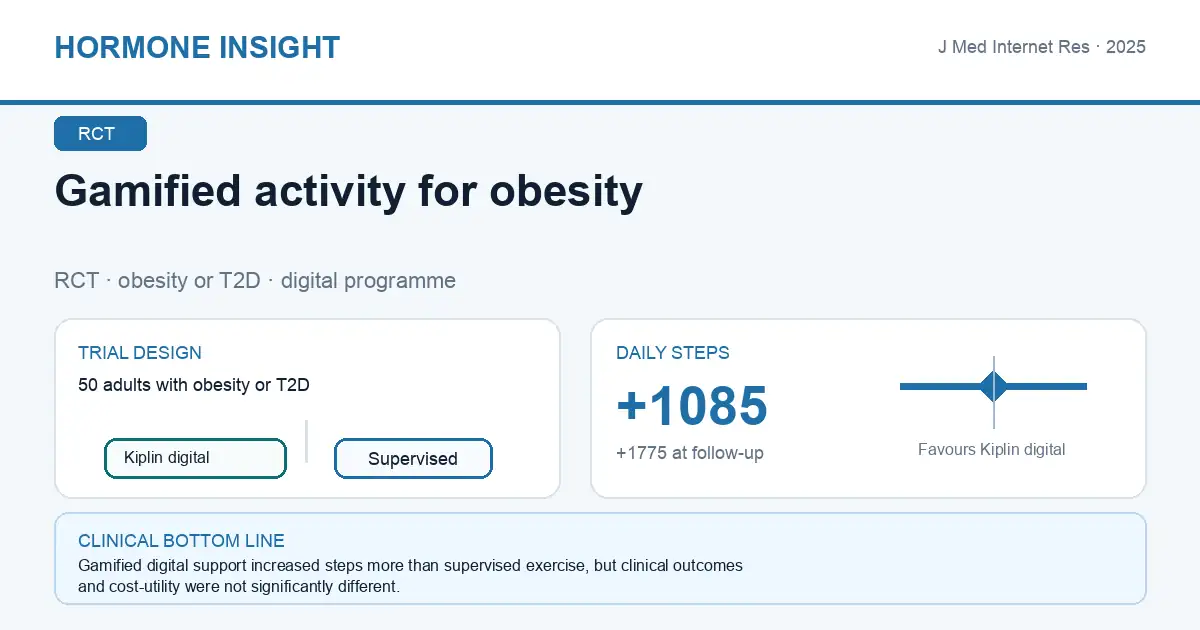
Summary: In a trial in adults with obesity or type 2 diabetes, a gamified digital physical-activity programme increased daily steps more than a supervised face-to-face exercise programme, but with marked individual variability and no significant difference in clinical outcomes or cost-utility.
PICO Summary
| Element | Detail |
|---|---|
| Population | 50 adults with obesity or type 2 diabetes (mean age 47.9; 74% female); 2-arm RCT with embedded N-of-1 analyses, France. |
| Intervention | Kiplin digital programme with gamification and telecoaching (2 face-to-face and 20 online sessions plus 3 mobile games) over 3 months. |
| Comparison | Supervised, hospital-based, face-to-face adapted physical activity programme (36 sessions). |
| Outcome | Kiplin participants increased daily steps more during the 3-month intervention (+1085 steps/day) and at follow-up (+1775), with sustained effects. There were no significant differences in secondary clinical outcomes except moderate-to-vigorous physical activity favouring Kiplin, and no cost-utility difference. Idiographic analyses showed marked heterogeneity, with some participants not improving. |
Gamified digital activity programme for obesity
RCT · obesity / type 2 diabetes · 3 months
A scalable gamified app raised daily steps more than a 36-session supervised programme, but gains were limited to activity metrics with marked individual variability and no clinical-outcome or cost advantage.
Expert Commentary
This is a methodologically interesting trial whose embedded N-of-1 analysis is its real contribution, because it exposes what group means usually hide, that a behavioural intervention which looks effective on average actually helps some people substantially and others not at all. The headline is encouraging in one specific respect: a scalable digital gamified programme increased walking more than a resource-intensive supervised programme requiring 36 in-person sessions, which matters for reach and cost. But the honest reading must hold two caveats together. First, the benefit was essentially confined to activity metrics, with no significant differences in secondary clinical outcomes or cost-utility, so more steps did not translate into demonstrated metabolic gain over this period. Second, the heterogeneity means gamification is not universally motivating, and predicting who responds, by competitiveness, social motivation, or baseline activity, remains unsolved. The small sample of 50 and short follow-up limit subgroup characterisation and durability claims. Can I use this with my patients? Yes, as one option among several. I would offer a gamified app as a low-cost, scalable way to build activity, framed as a time-limited trial to see if it suits the individual, and pivot to group classes, walking partners, or other strategies for those it does not engage.
References
Mazéas A, Chalabaev A, Blond M, Mourgues C, Pereira B, Duclos M. Effect of a digital health physical activity program integrating gamification for obesity management in comparison with usual care: randomized controlled trial with an ideographic approach. J Med Internet Res. 2025;27:e78376. doi:10.2196/78376