

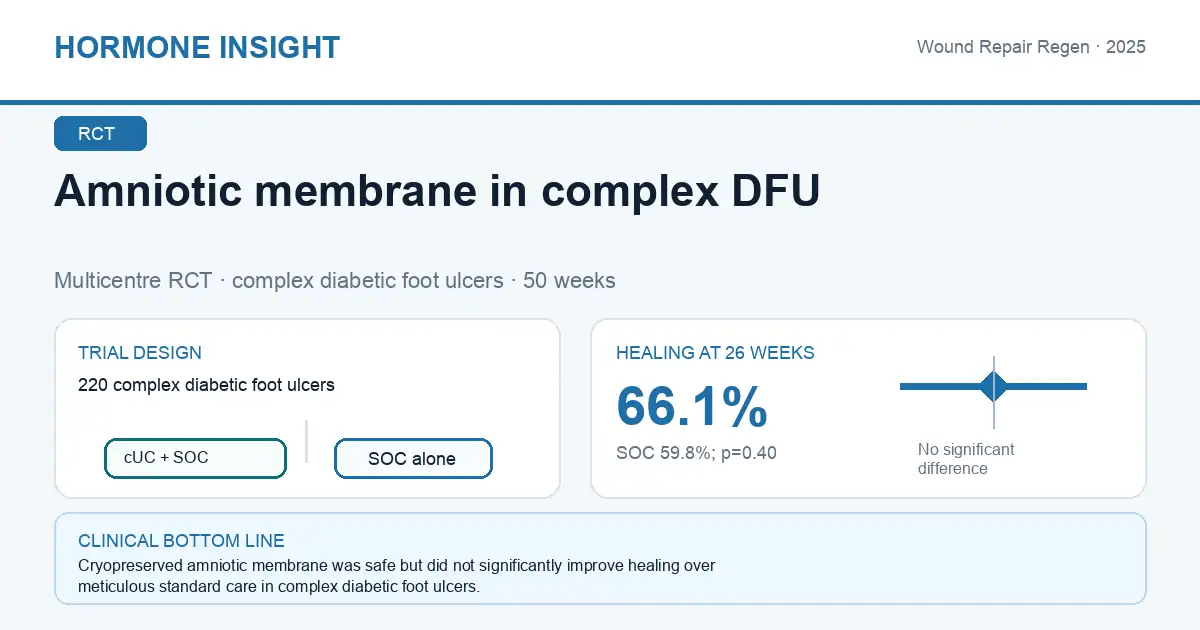
Summary: In a multicentre trial in complex diabetic foot ulcers with exposed deep structures and controlled osteomyelitis, adding cryopreserved ultra-thick amniotic membrane to standard care did not significantly improve healing over standard care alone, though both achieved high healing rates and the membrane was safe.
PICO Summary
| Element | Detail |
|---|---|
| Population | 220 patients with complex diabetic foot ulcers (exposed bone, tendon, muscle, or joint capsule) and controlled osteomyelitis; multicentre randomised controlled trial, USA. |
| Intervention | Cryopreserved ultra-thick umbilical-cord amniotic membrane (cUC) plus standard of care, reapplied at ≥4-week intervals if stalled, up to 4 applications (n=118). |
| Comparison | Standard of care alone: debridement, bone resection, dressings, offloading, and 6 weeks of systemic antibiotics (n=102). |
| Outcome | Complete healing at 26 weeks was 66.1% (cUC) versus 59.8% (SOC), not significant (p=0.40); at 50 weeks 77.1% versus 71.6% (p=0.29). Adverse-event rates were comparable (89.8% vs 87.3%). Wound closure in the cUC arm took on average 1.67 applications. No significant differences at any timepoint. |
Amniotic membrane for complex diabetic foot ulcers
RCT · complex DFU · 26 weeks
Adding cryopreserved amniotic membrane to standard care did not significantly improve healing in complex diabetic foot ulcers; both arms healed well and the membrane was safe.
Expert Commentary
This is a rigorous and honestly reported trial whose central result is a non-significant difference, and that result is genuinely informative rather than disappointing. The numerically higher healing with the amniotic membrane did not reach significance at either 26 or 50 weeks, so on this evidence the product cannot be said to outperform standard care in complex ulcers. Two findings deserve emphasis. First, both arms achieved high healing rates, around 60% by 26 weeks and over 70% by 50 weeks, in wounds with exposed deep structures and osteomyelitis that are usually excluded from trials, which is a hopeful message that meticulous standard care, debridement, offloading, infection control, and perfusion, can heal the majority even here. Second, the strong standard-care arm suggests the enrolling centres had exceptional wound expertise, which may both explain the narrow gap and limit generalisability, and the trial may have been underpowered for a modest true effect. Can I use this with my patients? Selectively. This does not support routine use of the membrane for all complex ulcers, and reinforces optimising standard care first, while a safe adjunct with a favourable application burden remains a reasonable option for wounds clearly failing adequate standard treatment, with honest cost-benefit discussion.
References
Caporusso J, Motley T, Lantis JC, et al. A multi-centre, randomised, controlled clinical trial assessing cryopreserved ultra-thick human amniotic membrane in the treatment of complex diabetic foot ulcers. Wound Repair Regen. 2025;33(6):e70110. doi:10.1111/wrr.70110