

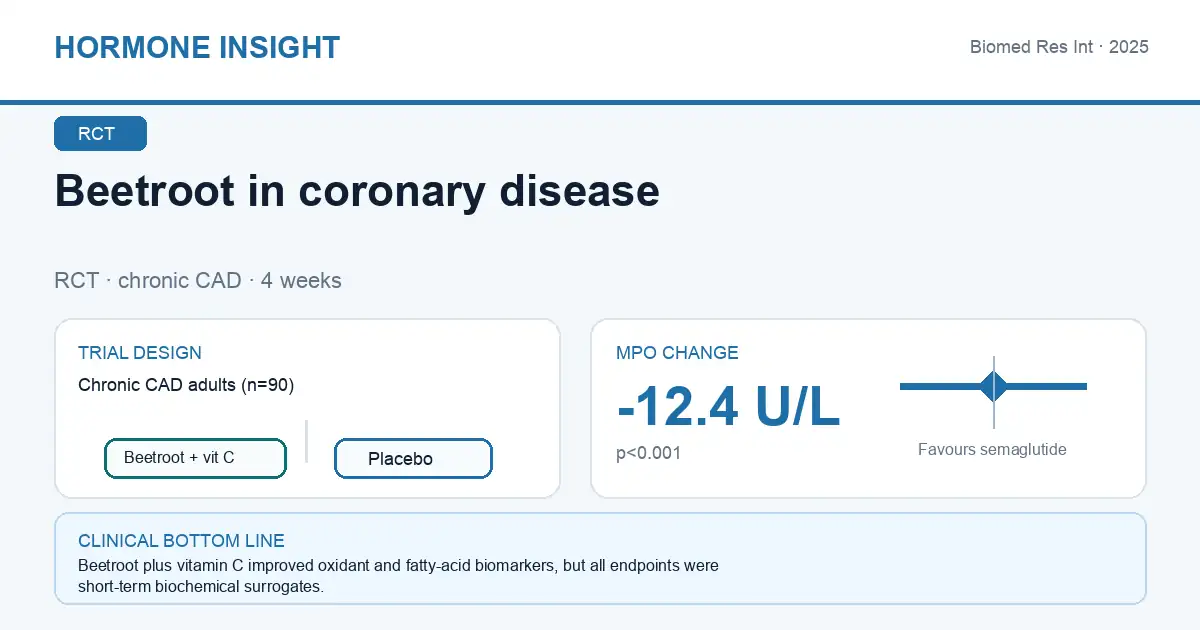
Summary: In a secondary analysis of a trial in chronic coronary artery disease, four weeks of beetroot capsules raised serum omega-3 fatty acids and lowered atherogenic fatty acid ratios and oxidant markers (total oxidant status, myeloperoxidase), though all endpoints were short-term biochemical surrogates.
PICO Summary
| Element | Detail |
|---|---|
| Population | 90 adults with chronic coronary artery disease (67.8% male), over 4 weeks. |
| Intervention | Beetroot capsules alone or with vitamin C. |
| Comparison | Placebo with standard care. |
| Outcome | Beetroot lowered SFAs/PUFAs (p=0.04), PA/OA (p=0.02), and MPO (p<0.01). Beetroot plus vitamin C raised DHA, omega-3, and EPA+DHA and lowered SFAs/PUFAs, PA/OA, TOS, and MPO (all significant). No adverse events. |
Beetroot in coronary disease
RCT · chronic CAD · 4 weeks
Beetroot plus vitamin C lowered oxidant markers (MPO, TOS) and raised omega-3 fatty acids versus placebo. All endpoints are 4-week biochemical surrogates from a secondary analysis, not clinical events.
Expert Commentary
Beetroot has a plausible cardiovascular story, dietary nitrate to nitric oxide plus antioxidant betalains and polyphenols, so a favourable shift in fatty acid and oxidant markers is not implausible. My verdict is nonetheless guarded, and the design tells me why. This is a secondary analysis, so these fatty acid and oxidative-stress endpoints were not the prespecified primary outcomes, which raises the chance of spurious positives, and everything measured is a four-week biochemical surrogate, not an event, a symptom, or an image. The history of this field is sobering: antioxidant supplements have repeatedly improved markers and then failed to reduce cardiovascular events, and even omega-3 trials are split. The report also gives directions of effect without clear effect sizes, and pooling a beetroot-alone arm with a beetroot-plus-vitamin-C arm muddies attribution. Can I use this with my patients? Only as a benign adjunct for someone already on optimal therapy who wants to add a dietary nitrate source, with honest framing that it is unproven for outcomes, plus practical notes about harmless red urine, additive blood-pressure effects, and oxalate-stone caution. It is no substitute for statins, antiplatelets, and risk-factor control. I would want a hard-endpoint trial before claiming benefit.
References
Mansouri-Baseri A, Moohebati M, Bahrami LS, et al. Effect of beetroot extract supplementation on serum fatty acid profiles and oxidative stress markers in chronic coronary artery disease patients: a secondary analysis of a randomized controlled trial. Biomed Res Int. 2025;2025:6654492. doi:10.1155/bmri/6654492