

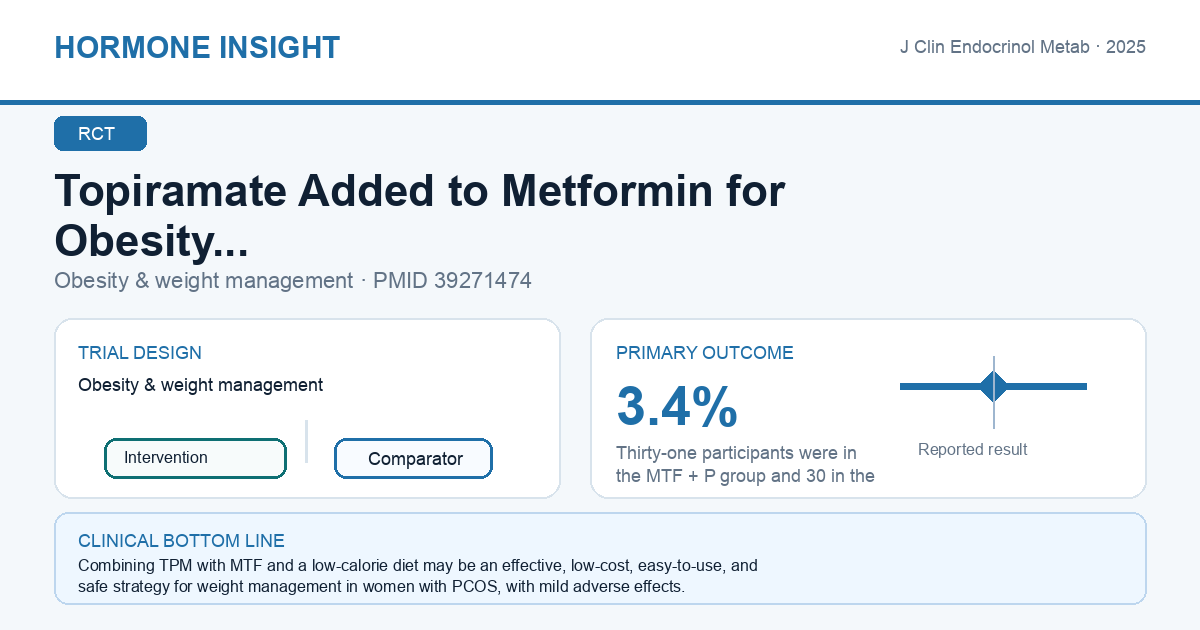
Summary: In women with PCOS and obesity or overweight plus cardiometabolic risk, adding topiramate to metformin and diet improved 6-month mean weight loss versus placebo (-4.5% vs -1.4%; P=.03), but paresthesia was more common (23.3% vs 3.2%; P=.026).
PICO Summary
| Element | Detail |
|---|---|
| Population | 61 women with PCOS and BMI ≥30 kg/m2, or BMI ≥27 kg/m2 with hypertension, type 2 diabetes, or dyslipidemia; randomized, double-blind, placebo-controlled trial over 6 months. |
| Intervention | Topiramate added to metformin plus a 20 kcal/kg diet. |
| Comparison | Placebo added to metformin plus the same 20 kcal/kg diet. |
| Outcome | Mean weight change at 6 months was -4.5% with topiramate versus -1.4% with placebo (P=.03); paresthesia occurred in 23.3% versus 3.2% (P=.026). |
Topiramate + Metformin in PCOS
Primary RCT · 6-month weight loss
Topiramate added to metformin improved 6-month weight loss in PCOS, but the benefit was modest and paresthesia was more common.
Expert Commentary
This randomized double-blind trial gives a clinically familiar but still niche answer: topiramate can add some short-term weight loss to metformin and diet in women with PCOS, but the effect is modest and the tolerability trade-off is real. The absolute separation in mean weight change at 6 months was 3.1 percentage points, and both groups improved across several metabolic and psychosocial measures, so this is not a rescue therapy for severe obesity. The signal is still useful because many patients with PCOS need lower-cost options when preferred anti-obesity agents are unavailable, unaffordable, or poorly tolerated. Can I use this with my patients? Possibly, but selectively and usually in specialist care. The trial enrolled only 61 women, follow-up lasted 6 months, confidence intervals were not provided in the abstract, and there was no active comparator against a modern obesity medicine. Safety also matters: paresthesia was clearly more frequent with topiramate, and real-world counseling must include cognition, mood, and pregnancy-prevention issues before prescribing. For a woman with PCOS already taking metformin who cannot access standard obesity pharmacotherapy, this study supports an off-label discussion rather than a routine first-line switch. It should change awareness of an option, not displace preferred guideline-based therapies.
References
Marchesan LB, da Silva TR, Spritzer PM. Topiramate added to metformin for obesity control in women with polycystic ovary syndrome. J Clin Endocrinol Metab. 2025;110(6):e1892-e1901. doi:10.1210/clinem/dgae637. PMID: 39271474.