

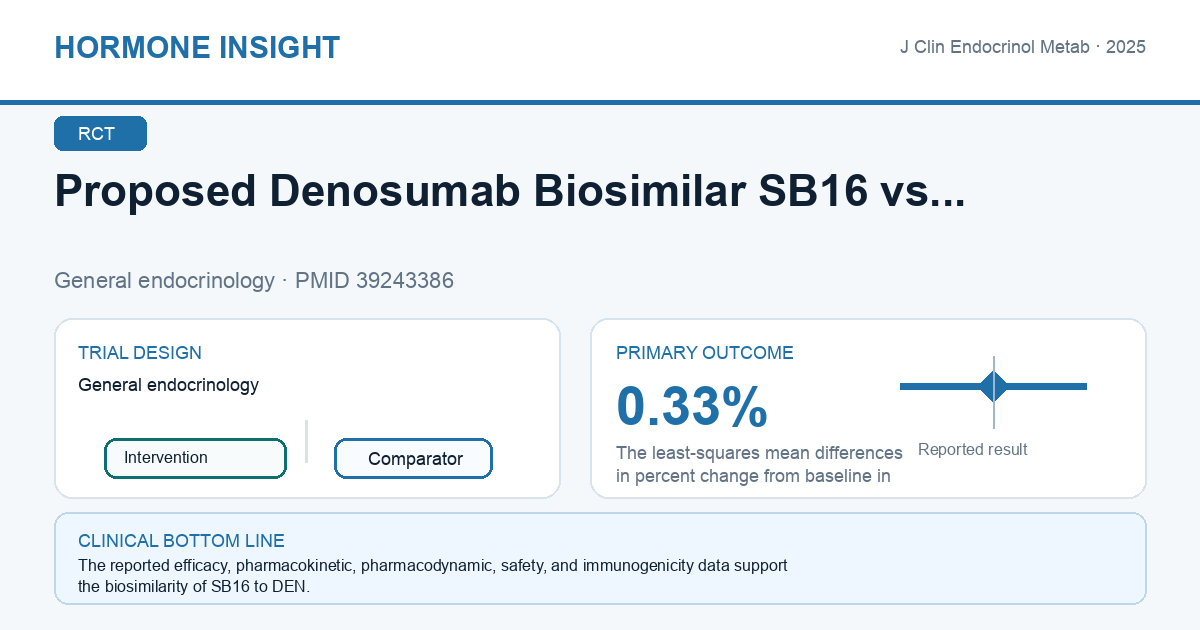
Summary: In a J Clin Endocrinol Metab randomized trial, The reported efficacy, pharmacokinetic, pharmacodynamic, safety, and immunogenicity data support the biosimilarity of SB16 to DEN. Key reported results included The least-squares mean differences in percent change from baseline in lumbar spine BMD at month 12 were 0.33% (90% CI, -0.25 to 0.91) in the full analysis set and 0.39% (95% CI, -0.36 to 1.13) in the per-protocol set; both within the predefined equivalence margin.
PICO Summary
| Element | Detail |
|---|---|
| Population | The primary endpoint was the percent change from baseline in lumbar spine bone mineral density (BMD) at month 12. Secondary endpoints including the percent change from baseline in BMD of the lumbar spine (except for month 12), total hip, and femoral neck; pharmacokinetic, pharmacodynamic (serum C-telopeptide of type I collagen, and procollagen type I N-terminal propeptide), safety, and immunogenicity profiles were measured… |
| Intervention | The primary endpoint was the percent change from baseline in lumbar spine bone mineral density (BMD) at month 12. Secondary endpoints including the percent change from baseline in BMD of the lumbar spine (except for month 12), total hip, and femoral neck; pharmacokinetic, pharmacodynamic (serum C-telopeptide of type I collagen, and procollagen type I N-terminal propeptide)… |
| Comparison | Comparator details are reported in the abstract methods. |
| Outcome | The least-squares mean differences in percent change from baseline in lumbar spine BMD at month 12 were 0.33% (90% CI, -0.25 to 0.91) in the full analysis set and 0.39% (95% CI, -0.36 to 1.13) in the per-protocol set; both within the predefined equivalence margin. The secondary endpoints were comparable between the 2 treatment groups. The reported efficacy, pharmacokinetic, pharmacodynamic, safety, and immunogenicity data support the biosimilarity of SB16 to DEN. |
Proposed Denosumab Biosimilar SB16 vs Reference...
Primary RCT · General endocrinology
The reported efficacy, pharmacokinetic, pharmacodynamic, safety, and immunogenicity data support the biosimilarity of SB16 to DEN.
Expert Commentary
This J Clin Endocrinol Metab randomized trial evaluated Proposed Denosumab Biosimilar SB16 vs Reference Denosumab in Postmenopausal Osteoporosis: Phase 3 Results Up to Month 12. The abstract describes the study as follows: The primary endpoint was the percent change from baseline in lumbar spine bone mineral density (BMD) at month 12. Secondary endpoints including the percent change from baseline in BMD of the lumbar spine (except for month 12), total hip, and femoral neck; pharmacokinetic, pharmacodynamic (serum… The main reported results were: The least-squares mean differences in percent change from baseline in lumbar spine BMD at month 12 were 0.33% (90% CI, -0.25 to 0.91) in the full analysis set and 0.39% (95% CI, -0.36 to 1.13) in the per-protocol set; both within the predefined equivalence margin. The secondary endpoints were comparable between the 2 treatment groups. The authors conclude: The reported efficacy, pharmacokinetic, pharmacodynamic, safety, and immunogenicity data support the biosimilarity of SB16 to DEN. The clinical value of the result depends on whether the trial population, comparator, follow-up and outcome match the decision in front of the clinician. Can I use this with my patients? The findings can inform discussion when a patient resembles the enrolled population, but they should be interpreted alongside..
References
Langdahl B, Chung YS, Plebanski R, et al.. Proposed Denosumab Biosimilar SB16 vs Reference Denosumab in Postmenopausal Osteoporosis: Phase 3 Results Up to Month 12.. J Clin Endocrinol Metab. 2025-May-19. doi:10.1210/clinem/dgae611. PMID: 39243386.