

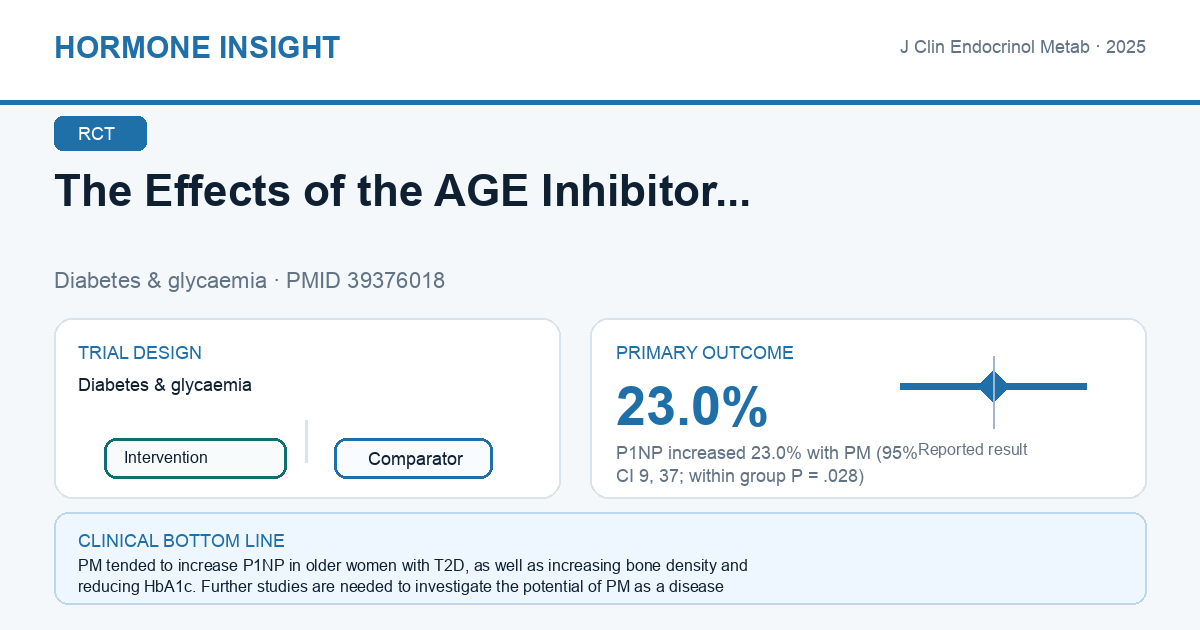
Summary: In a J Clin Endocrinol Metab randomized trial, PM tended to increase P1NP in older women with T2D, as well as increasing bone density and reducing HbA1c. Key reported results included P1NP increased 23.0% with PM (95% CI 9, 37; within group P = .028) vs 4.1% with placebo (-9, 17; within group P = .576; between groups P = .056).
PICO Summary
| Element | Detail |
|---|---|
| Population | This was a double-blind randomized controlled trial at an academic center. Older women with T2D were included (n = 55). Oral PM 200 mg twice daily for 1 year was given. The primary outcome was the change in the bone formation marker P1NP. Other outcomes were changes in bone resorption, bone mineral density (BMD), HbA1c, and skin autofluorescence (SAF), and in a bone biopsy subgroup, the correlation between bone fluorescent… |
| Intervention | This was a double-blind randomized controlled trial at an academic center. |
| Comparison | This was a double-blind randomized controlled trial at an academic center. |
| Outcome | P1NP increased 23.0% with PM (95% CI 9, 37; within group P = .028) vs 4.1% with placebo (-9, 17; within group P = .576; between groups P = .056). BMD increased at the femoral neck (PM 2.6 ± 5% vs placebo -0.9 ± 4%; between groups P = .007). Bone resorption markers and SAF did not change. HbA1c decreased (PM -0.38 ± 0.7% vs placebo 0.05 ± 1.7%; between groups P = .04). Within the PM group, the HbA1c change correlated inversely with the % P1NP change (r = -0.50, P = .034). Cortical bone biopsy fAGEs correlated with… |
The Effects of the AGE Inhibitor Pyridoxamine on Bone in...
Primary RCT · Diabetes & glycaemia
PM tended to increase P1NP in older women with T2D, as well as increasing bone density and reducing HbA1c. Further studies are needed to investigate the potential of PM as a disease mechanism-directed approach to reduce fractures in T2D.
Expert Commentary
This J Clin Endocrinol Metab randomized trial evaluated The Effects of the AGE Inhibitor Pyridoxamine on Bone in Older Women With Type 2 Diabetes: A Randomized Clinical Trial. The abstract describes the study as follows: This was a double-blind randomized controlled trial at an academic center. Older women with T2D were included (n = 55). Oral PM 200 mg twice daily for 1 year was given. The primary outcome was the change in the bone formation marker P1NP. Other outcomes were changes in bone resorption, bone… The main reported results were: P1NP increased 23.0% with PM (95% CI 9, 37; within group P = .028) vs 4.1% with placebo (-9, 17; within group P = .576; between groups P = .056). BMD increased at the femoral neck (PM 2.6 ± 5% vs placebo -0.9 ± 4%; between groups P = .007). Bone resorption markers and SAF did not change. HbA1c decreased (PM -0.38 ± 0.7% vs placebo 0.05 ± 1.7%; between groups P = .04). Within the PM group, the HbA1c change… The authors conclude: PM tended to increase P1NP in older women with T2D, as well as increasing bone density and reducing HbA1c. Further studies are needed to investigate the potential of PM as..
References
Brossfield AV, McMahon DJ, Fernando J, et al.. The Effects of the AGE Inhibitor Pyridoxamine on Bone in Older Women With Type 2 Diabetes: A Randomized Clinical Trial.. J Clin Endocrinol Metab. 2025-Mar-17. doi:10.1210/clinem/dgae700. PMID: 39376018.