

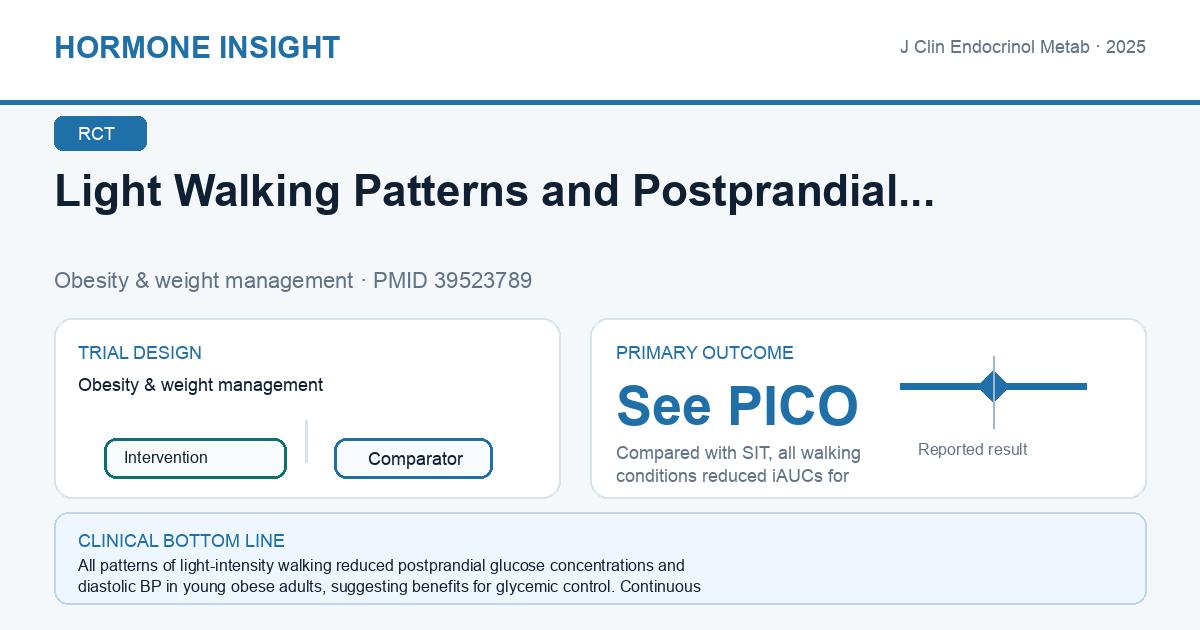
Summary: In a J Clin Endocrinol Metab randomized trial, All patterns of light-intensity walking reduced postprandial glucose concentrations and diastolic BP in young obese adults, suggesting benefits for glycemic control. Key reported results included Compared with SIT, all walking conditions reduced iAUCs for glucose and average diastolic BP (all P < .05).
PICO Summary
| Element | Detail |
|---|---|
| Population | A randomized crossover trial was conducted. SETTING: The study was conducted in the laboratory. PARTICIPANTS: The study analyzed baseline (fasting) and 6-hour postprandial concentrations of glucose, insulin, triglycerides, and blood pressure (BP) in 16 young obese adults. INTERVENTIONS: Participants underwent 4 7-hour experimental conditions with a 7- to 20-day washout period: uninterrupted sitting (SIT), 30-minute… |
| Intervention | A randomized crossover trial was conducted. |
| Comparison | Comparator details are reported in the abstract methods. |
| Outcome | Compared with SIT, all walking conditions reduced iAUCs for glucose and average diastolic BP (all P < .05). Only EX + SIT and EX + BR reduced iAUCs for insulin (P < .05). No significant differences were found for triglycerides iAUC and systolic BP between the 4 conditions (all P > .05). All patterns of light-intensity walking reduced postprandial glucose concentrations and diastolic BP in young obese adults, suggesting benefits for glycemic control. Continuous 30-minute light-intensity walking alone or combined… |
Light Walking Patterns and Postprandial Cardiometabolic...
Primary RCT · Obesity & weight management
All patterns of light-intensity walking reduced postprandial glucose concentrations and diastolic BP in young obese adults, suggesting benefits for glycemic control. Continuous 30-minute light-intensity walking alone or combined with brief 3-minute bouts also attenuated...
Expert Commentary
This J Clin Endocrinol Metab randomized trial evaluated Light Walking Patterns and Postprandial Cardiometabolic Responses in Young Obese Adults: A Randomized Crossover Study. The abstract describes the study as follows: A randomized crossover trial was conducted. SETTING: The study was conducted in the laboratory. PARTICIPANTS: The study analyzed baseline (fasting) and 6-hour postprandial concentrations of glucose, insulin, triglycerides, and blood pressure (BP) in 16 young obese adults. INTERVENTIONS… The main reported results were: Compared with SIT, all walking conditions reduced iAUCs for glucose and average diastolic BP (all P < .05). Only EX + SIT and EX + BR reduced iAUCs for insulin (P < .05). No significant differences were found for triglycerides iAUC and systolic BP between the 4 conditions (all P > .05). The authors conclude: All patterns of light-intensity walking reduced postprandial glucose concentrations and diastolic BP in young obese adults, suggesting benefits for glycemic control. Continuous 30-minute light-intensity walking alone or combined with brief 3-minute bouts… The clinical value of the result depends on whether the trial population, comparator, follow-up and outcome match the decision in front of the clinician. Can I use this with my patients? The findings can inform discussion when a patient resembles the enrolled population, but they..
References
Wongpipit W, Dempsey PC, Zhang X, et al.. Light Walking Patterns and Postprandial Cardiometabolic Responses in Young Obese Adults: A Randomized Crossover Study.. J Clin Endocrinol Metab. 2025-Jul-15. doi:10.1210/clinem/dgae789. PMID: 39523789.