

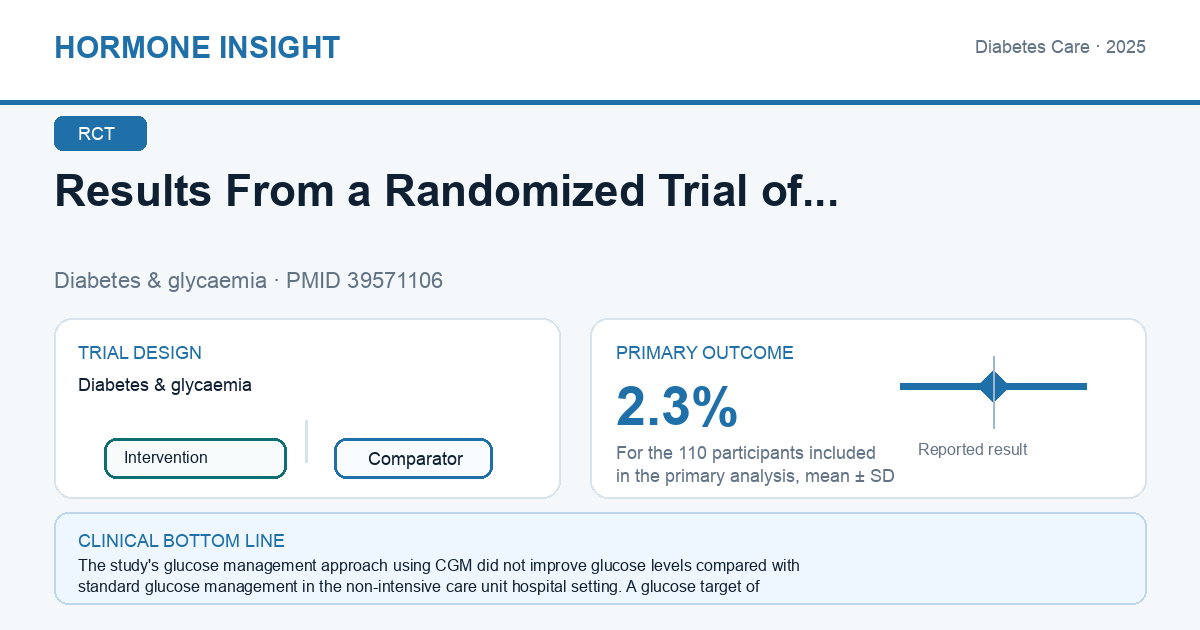
Summary: In a Diabetes Care randomized trial, The study's glucose management approach using CGM did not improve glucose levels compared with standard glucose management in the non-intensive care unit hospital setting. Key reported results included For the 110 participants included in the primary analysis, mean ± SD age was 61 ± 12 years and mean HbA1c was 8.9 ± 2.3% (73.8 ± 1.6 mmol/mol).
PICO Summary
| Element | Detail |
|---|---|
| Population | At six academic hospitals, adults with type 2 diabetes hospitalized in a non-intensive care setting were randomly assigned to either standard therapy with glucose target 140-180 mg/dL (standard group) or intensive therapy with glucose target 90-130 mg/dL guided by CGM (intensive group). The primary outcome was mean glucose measured with CGM (blinded in standard group), and the key secondary outcome was CGM glucose <54 mg/dL. |
| Intervention | At six academic hospitals, adults with type 2 diabetes hospitalized in a non-intensive care setting were randomly assigned to either standard therapy with glucose target 140-180 mg/dL (standard group) or intensive therapy with glucose target 90-130 mg/dL guided by CGM (intensive group). |
| Comparison | At six academic hospitals, adults with type 2 diabetes hospitalized in a non-intensive care setting were randomly assigned to either standard therapy with glucose target 140-180 mg/dL (standard group) or intensive therapy with glucose target 90-130 mg/dL guided by CGM (intensive group). |
| Outcome | For the 110 participants included in the primary analysis, mean ± SD age was 61 ± 12 years and mean HbA1c was 8.9 ± 2.3% (73.8 ± 1.6 mmol/mol). During the study, CGM-measured mean glucose was 170 mg/dL for the intensive group (n = 60) vs. 175 mg/dL for the standard group (n = 50; risk-adjusted difference -7 mg/dL, 95% CI -19 to 5; P = 0.25). Only 7% of the intensive group achieved the mean glucose target range of 90-130 mg/dL. CGM readings <54 mg/dL were infrequent (0.2% for intensive and 0.4% for standard… |
Results From a Randomized Trial of Intensive Glucose...
Primary RCT · Diabetes & glycaemia
The study's glucose management approach using CGM did not improve glucose levels compared with standard glucose management in the non-intensive care unit hospital setting. A glucose target of 90-130 mg/dL may not be realistic in the current environment of insulin management in...
Expert Commentary
This Diabetes Care randomized trial evaluated Results From a Randomized Trial of Intensive Glucose Management Using CGM Versus Usual Care in Hospitalized Adults With Type 2 Diabetes: The TIGHT Study. The abstract describes the study as follows: At six academic hospitals, adults with type 2 diabetes hospitalized in a non-intensive care setting were randomly assigned to either standard therapy with glucose target 140-180 mg/dL (standard group) or intensive therapy with glucose target 90-130 mg/dL guided by CGM (intensive group). The… The main reported results were: For the 110 participants included in the primary analysis, mean ± SD age was 61 ± 12 years and mean HbA1c was 8.9 ± 2.3% (73.8 ± 1.6 mmol/mol). During the study, CGM-measured mean glucose was 170 mg/dL for the intensive group (n = 60) vs. 175 mg/dL for the standard group (n = 50; risk-adjusted difference -7 mg/dL, 95% CI -19 to 5; P = 0.25). Only 7% of the intensive group achieved the mean glucose target… The authors conclude: The study's glucose management approach using CGM did not improve glucose levels compared with standard glucose management in the non-intensive care unit hospital setting. A glucose target of 90-130 mg/dL may not be realistic in the current environment of…..
References
Hirsch IB, Draznin B, Buse JB, et al.. Results From a Randomized Trial of Intensive Glucose Management Using CGM Versus Usual Care in Hospitalized Adults With Type 2 Diabetes: The TIGHT Study.. Diabetes Care. 2025-Jan-01. doi:10.2337/dc24-1779. PMID: 39571106.