

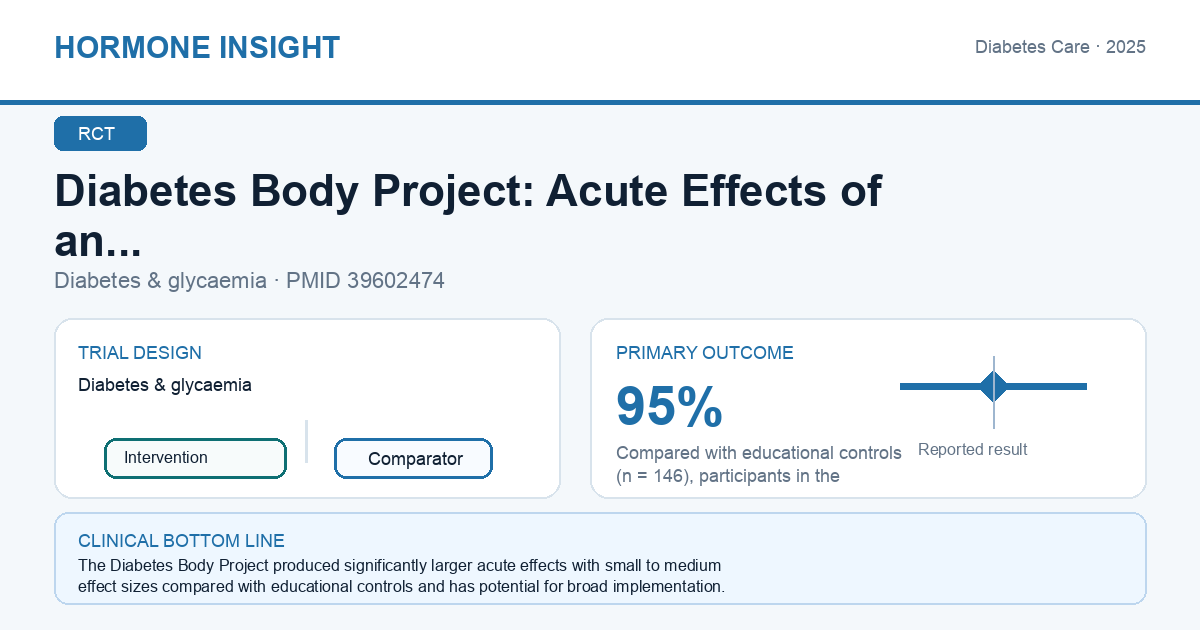
Summary: In a Diabetes Care randomized trial, The Diabetes Body Project produced significantly larger acute effects with small to medium effect sizes compared with educational controls and has potential for broad implementation. Key reported results included Compared with educational controls (n = 146), participants in the Diabetes Body Project (n = 147) showed significant improvements (all P < 0.05), with small Cohen's d effect sizes for ED symptoms (d = -0.30, 95% CI -0.06, -0.69) (primary outcome), diabetes distress (d…
PICO Summary
| Element | Detail |
|---|---|
| Population | Women (14-35 years old) with type 1 diabetes were randomized to virtual Diabetes Body Project groups or educational control. Outcomes were assessed at pretest and posttest (1-2 weeks after intervention). |
| Intervention | Women (14-35 years old) with type 1 diabetes were randomized to virtual Diabetes Body Project groups or educational control. |
| Comparison | Women (14-35 years old) with type 1 diabetes were randomized to virtual Diabetes Body Project groups or educational control. |
| Outcome | Compared with educational controls (n = 146), participants in the Diabetes Body Project (n = 147) showed significant improvements (all P < 0.05), with small Cohen's d effect sizes for ED symptoms (d = -0.30, 95% CI -0.06, -0.69) (primary outcome), diabetes distress (d = -0.42), quality of life (d = 0.39) and dietary restraint (d = -0.31), and medium effect sizes for diabetes-specific disordered eating behaviors (d = -0.70), body dissatisfaction (d = -0.59), and pursuit of thin appearance ideal (d = -0.56). The… |
Diabetes Body Project: Acute Effects of an Eating...
Primary RCT · Diabetes & glycaemia
The Diabetes Body Project produced significantly larger acute effects with small to medium effect sizes compared with educational controls and has potential for broad implementation.
Expert Commentary
This Diabetes Care randomized trial evaluated Diabetes Body Project: Acute Effects of an Eating Disorder Prevention Program for Young Women With Type 1 Diabetes. A Multinational Randomized Controlled Trial. The abstract describes the study as follows: Women (14-35 years old) with type 1 diabetes were randomized to virtual Diabetes Body Project groups or educational control. Outcomes were assessed at pretest and posttest (1-2 weeks after intervention). The main reported results were: Compared with educational controls (n = 146), participants in the Diabetes Body Project (n = 147) showed significant improvements (all P < 0.05), with small Cohen's d effect sizes for ED symptoms (d = -0.30, 95% CI -0.06, -0.69) (primary outcome), diabetes distress (d = -0.42), quality of life (d = 0.39) and dietary restraint (d = -0.31), and medium effect sizes for diabetes-specific disordered eating… The authors conclude: The Diabetes Body Project produced significantly larger acute effects with small to medium effect sizes compared with educational controls and has potential for broad implementation. The clinical value of the result depends on whether the trial population, comparator, follow-up and outcome match the decision in front of the clinician. Can I use this with my patients? The findings can inform discussion when a patient resembles..
References
Hennekes MHCL, Haugvik S, de Wit M, et al.. Diabetes Body Project: Acute Effects of an Eating Disorder Prevention Program for Young Women With Type 1 Diabetes. A Multinational Randomized Controlled Trial.. Diabetes Care. 2025-Feb-01. doi:10.2337/dc24-1599. PMID: 39602474.