

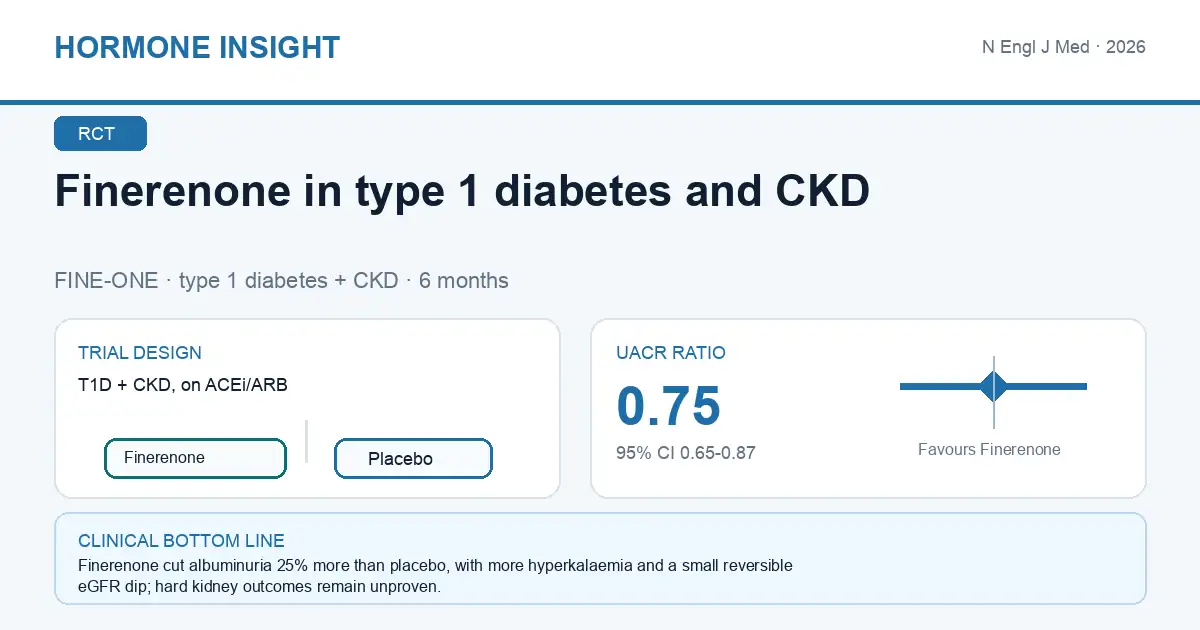
Summary: In the FINE-ONE phase 3 trial in adults with type 1 diabetes and chronic kidney disease, finerenone reduced the urinary albumin-to-creatinine ratio by 25% more than placebo over 6 months, at the cost of more hyperkalaemia and a small reversible eGFR dip.
PICO Summary
| Element | Detail |
|---|---|
| Population | 242 adults with type 1 diabetes, CKD (eGFR 25 to <90), and albuminuria (UACR 200 to <5000), on an ACE inhibitor or ARB. |
| Intervention | Finerenone 10 or 20 mg daily (eGFR-dependent). |
| Comparison | Matching placebo. |
| Outcome | UACR fell 34% with finerenone vs 12% with placebo, a 25% greater reduction (geometric mean ratio 0.75; 95% CI 0.65–0.87; p<0.001). Hyperkalaemia 10.1% vs 3.3% (1.7% discontinued). eGFR change at 6 months -5.6 vs -2.7 mL/min/1.73m² (difference -2.9; 95% CI -5.1 to -0.7), approaching baseline after washout. |
Finerenone in type 1 diabetes and CKD (FINE-ONE)
RCT · type 1 diabetes + CKD · 6 months
Finerenone cut albuminuria 25% more than placebo in type 1 diabetes with CKD, with more hyperkalaemia and a small reversible eGFR dip. The endpoint is a surrogate, so longer trials are needed for hard kidney outcomes.
Expert Commentary
This is an important trial simply because it exists: finerenone’s kidney benefits are well established in type 2 diabetes, but type 1 patients with CKD have been left to inference, and FINE-ONE finally provides direct randomised evidence. The 25% greater fall in albuminuria is a clean, statistically robust result, and the hyperkalaemia rate and the small early eGFR dip that reverses on washout are entirely in keeping with mineralocorticoid receptor antagonism and reassure me that the drug behaves as expected in this population. My honest caveat is the one the trialists would concede: the primary outcome is albuminuria, a validated surrogate, not hard kidney or cardiovascular endpoints, and six months cannot tell us whether this translates into slower progression to kidney failure as it did in the type 2 outcome trials. Can I use this with my patients? Cautiously yes, in a type 1 patient with persistent albuminuria already on a maximally tolerated ACE inhibitor or ARB, with vigilant potassium monitoring and appropriate selection. But I would frame it as a surrogate-based extension of the type 2 story and await longer outcome data before promising preserved kidney function.
References
Heerspink HJL, Birkenfeld AL, Cherney DZI, et al. Finerenone in type 1 diabetes and chronic kidney disease. N Engl J Med. 2026;394(10):947–957. doi:10.1056/NEJMoa2512854