

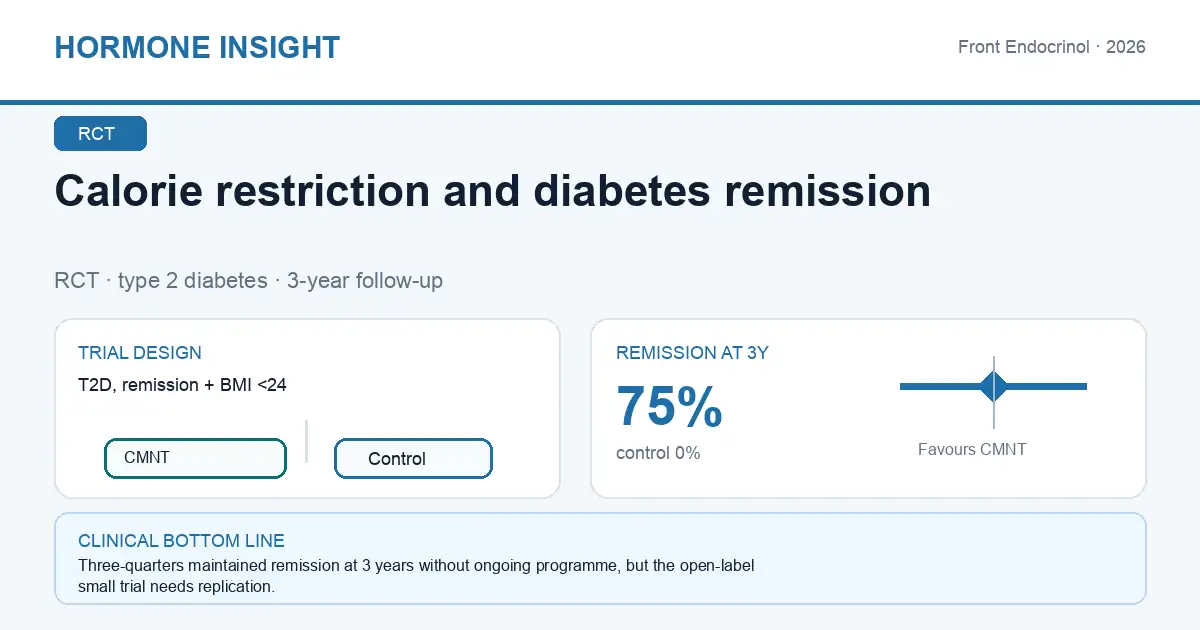
Summary: In a three-year follow-up of a trial in type 2 diabetes, 75% of those who reached remission and normal BMI through a three-month intermittent calorie-restriction programme maintained remission without ongoing structured intervention, versus none in the control group.
PICO Summary
| Element | Detail |
|---|---|
| Population | Adults with type 2 diabetes who reached remission and BMI below 24 through an initial dietary intervention. |
| Intervention | Three-month Chinese Medical Nutrition Therapy: six cycles of 5 days at 840 kcal/day then 10 days ad libitum, then 3 years of self-guided guideline-based eating. |
| Comparison | Control group with no dietary intervention beyond standard care. |
| Outcome | At 3 years, 75% of the CMNT group maintained remission versus 0% control. Remission correlated with withdrawal of insulin/insulinotropic agents. Below BMI 24, weight regain did not affect remission. Fewer complications, hospitalisations, and deaths; better quality of life. |
Intermittent calorie restriction and durable diabetes remission
RCT · type 2 diabetes · 3-year follow-up
Three-quarters of normal-BMI patients held diabetes remission at three years with no ongoing programme, versus none in control. Striking but open-label, small, and culturally specific, so it needs replication with an active comparator.
Expert Commentary
Durable remission is the prize in type 2 diabetes, and the headline here, three-quarters still in remission at three years with no ongoing structured programme, is genuinely striking, especially the intriguing observation that in those below a BMI of 24 weight regain did not break remission. That hints remission may be more about a metabolic reset than about sustained weight suppression, which would be important if it holds. I read it as cautiously positive while flagging real limits. This is follow-up data, and the contrast of 75% against a flat 0% in controls is so stark that I suspect the control group was never offered an equivalent attempt, which inflates the apparent effect. The programme is also a specific culturally embedded protocol in a particular population, the numbers are modest, and the open-label dietary design cannot be blinded. Can I use this with my patients? In principle yes, it strengthens my confidence that structured intermittent restriction can produce lasting remission in selected motivated patients, with the welcome message that perfect weight maintenance may not be required. I would want replication in a Western cohort with an active comparator before quoting the 75% figure.
References
Wu R, Yang X, Zhou X, et al. Maintained diabetes remission among normal BMI individuals achieved without ongoing intervention: a three-year follow-up study of intermittent calorie restriction. Front Endocrinol (Lausanne). 2026;16:1733840. doi:10.3389/fendo.2025.1733840