

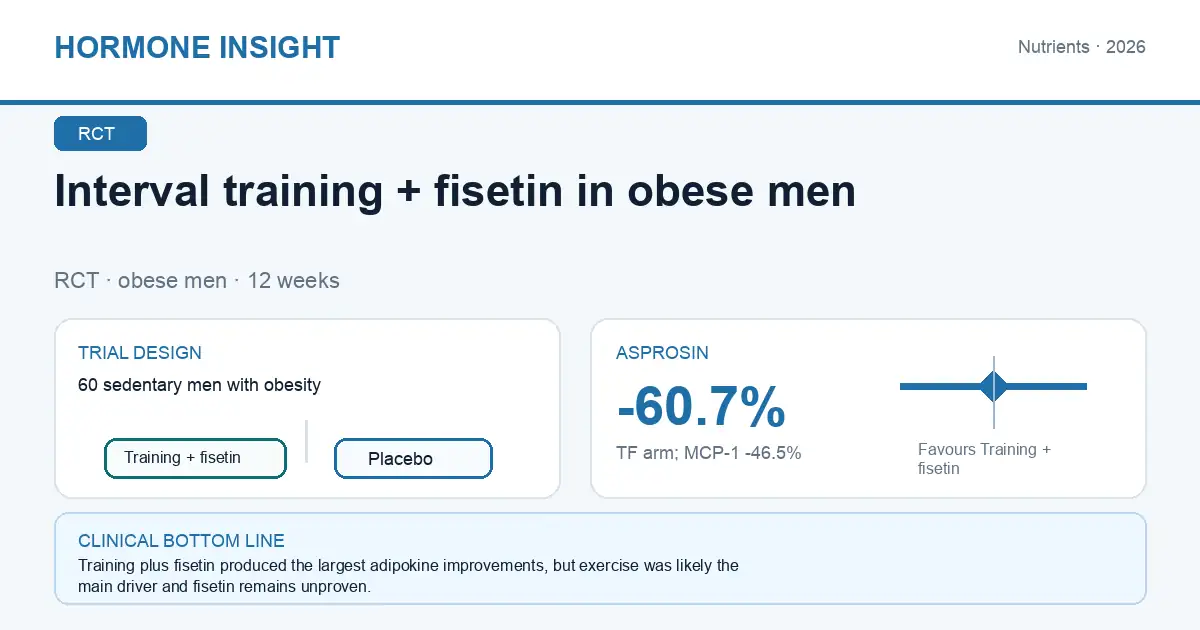
Summary: In a four-arm trial in sedentary men with obesity, 12 weeks of combined interval resistance-aerobic training plus fisetin produced the largest reductions in pro-inflammatory adipokines (asprosin, MCP-1) and the best lipid and adiponectin changes, with exercise as the main driver.
PICO Summary
| Element | Detail |
|---|---|
| Population | 60 sedentary men with obesity (four arms, double-blind). |
| Intervention | Combined interval resistance plus progressive aerobic training (3x/week) with fisetin 200 mg/day for 12 weeks (TF). |
| Comparison | Placebo, fisetin alone (F), or training plus placebo (TP). |
| Outcome | TF group: asprosin -60.71%, MCP-1 -46.50%, adiponectin +27.67%, improved LDL-C, triglycerides, total cholesterol, and HDL-C (all significant), and the only significant BMI reduction (p=0.024). Both training arms improved lipids; placebo worsened. No adverse events. |
Interval training + fisetin in obese men
RCT · obese men · 12 weeks
Combined training plus fisetin gave the largest drop in pro-inflammatory adipokines and the best lipid and adiponectin changes, but exercise was the main driver and fisetin remains an unproven add-on.
Expert Commentary
As with other combination trials, the four-arm design is what makes this informative, because it lets me see whether the fashionable ingredient, here the senolytic flavonoid fisetin, adds anything beyond the exercise. The pattern is familiar and reassuring in its honesty: both training arms improved lipids and adipokines while the placebo group actually deteriorated, confirming that the exercise is doing the real work, with fisetin layering on an extra increment in the combined arm. The adipokine shifts are large, but I hold them at arm’s length, asprosin and MCP-1 are mechanistic biomarkers, not outcomes, the authors did no direct mechanistic assays, and the trial is small at sixty men over twelve weeks with a proprietary supplement. Can I use this with my patients? The exercise message, yes and emphatically, structured resistance plus aerobic training improves the metabolic and inflammatory profile of men with obesity. Fisetin I would treat as an unproven add-on, not something I recommend or expect a patient to replicate from a supplement bottle. I would want a larger, longer trial with clinical endpoints and actual mechanistic readouts before crediting the flavonoid with anything.
References
Alipour M, Saeidi A, Hejazi K, Supriya R, Zouhal H. The effects of interval resistance-aerobic training and fisetin supplementation on asprosin and selected adipokines in obese men: a double-blind randomized control trial. Nutrients. 2026;18(3):433. doi:10.3390/nu18030433