

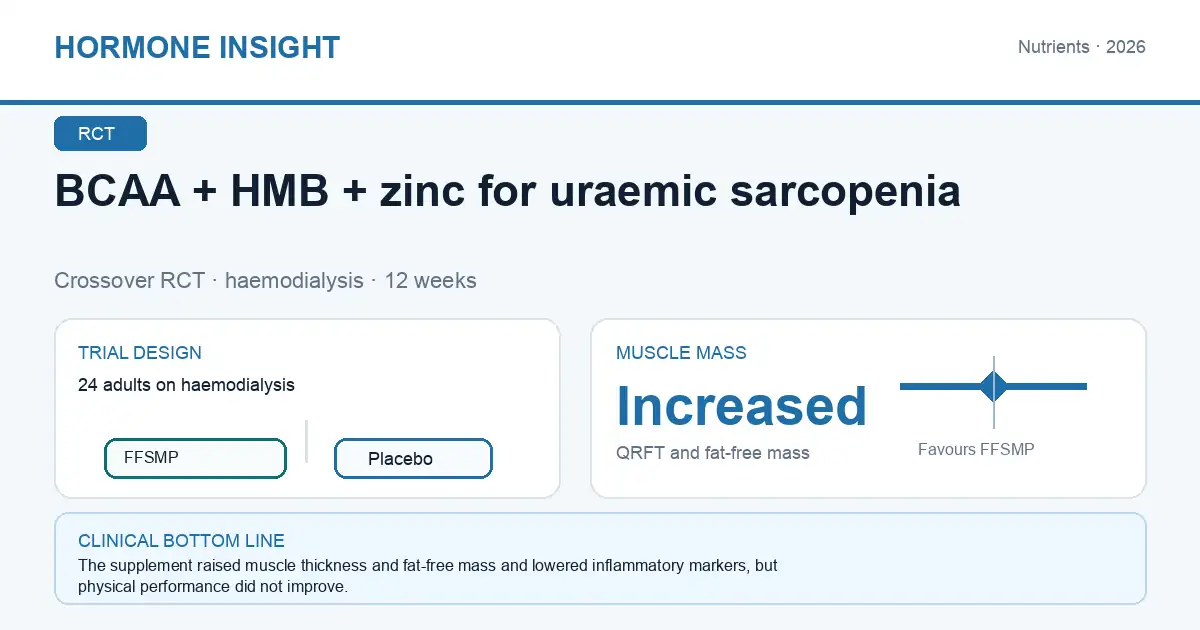
Summary: In a small crossover trial in haemodialysis patients, a supplement of branched-chain amino acids, beta-hydroxy-beta-methylbutyrate, and zinc increased muscle thickness and fat-free mass and lowered inflammatory and oxidative markers over 12 weeks, but did not improve physical performance.
PICO Summary
| Element | Detail |
|---|---|
| Population | 24 adults on maintenance haemodialysis with muscle wasting and chronic inflammation (crossover). |
| Intervention | Food for special medical purposes: free-form BCAAs, beta-hydroxy-beta-methylbutyrate (HMB), and zinc, 10 g/day for 12 weeks. |
| Comparison | Placebo for 12 weeks, with an 8-week washout between arms. |
| Outcome | Increased quadriceps rectus femoris thickness and fat-free mass percentage; reduced oxidative stress and inflammatory biomarkers; stable routine labs except lower pre-dialysis urea; improved SF-36 energy/fatigue and general health. No change in physical performance. No major adverse events. |
BCAA + HMB + zinc for uraemic sarcopenia
Crossover RCT · haemodialysis · 12 weeks
Over 12 weeks the supplement raised muscle thickness and fat-free mass and lowered inflammatory and oxidative markers versus placebo, but physical performance did not improve. Surrogate gains in a 24-patient crossover trial.
Expert Commentary
Uraemic sarcopenia is a real and miserable problem, and a supplement that adds anabolic support without a heavy nitrogen load is a sensible idea for dialysis patients, so I welcome the attempt and the crossover design that lets each patient act as their own control. The signals are encouraging: more muscle thickness, more fat-free mass, lower inflammatory and oxidative markers. But my verdict is tempered by the gap that matters most to patients, which the study is honest about. Physical performance did not change. Ultrasound thickness and body-composition percentages are surrogates, and what a frail dialysis patient actually wants is to walk further and fall less, which this did not demonstrate over twelve weeks in only twenty-four people. The quality-of-life gains in energy and general health are nice but soft and unblindable to expectation. Can I use this with my patients? Tentatively, as a low-risk option for a dialysis patient with evident muscle loss, in partnership with renal dietetics and alongside resistance exercise, while being honest that the functional payoff is unproven. I would want a larger, longer trial with performance and outcome endpoints.
References
Marrone G, Di Lauro M, Cornali K, et al. The combined use of hydroxymethylbutyrate and branched-chain amino acids to counteract uremic sarcopenia. Nutrients. 2026;18(3):483. doi:10.3390/nu18030483