

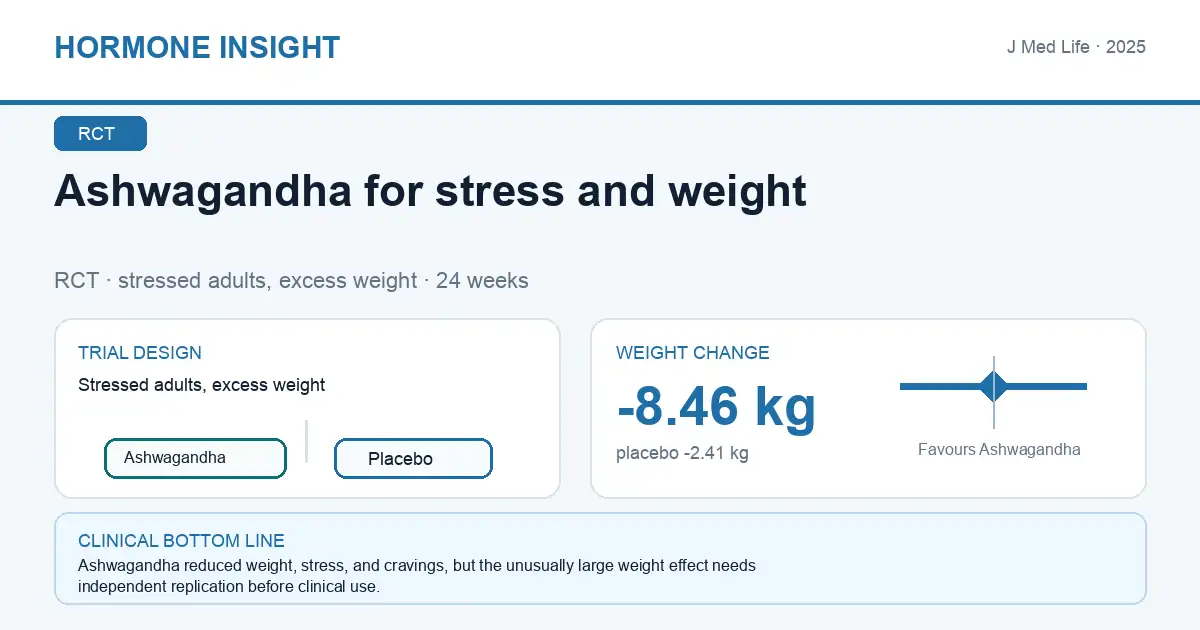
Summary: In a 24-week trial in stressed adults with excess weight, ashwagandha root extract reduced body weight, BMI, perceived stress, and food cravings and improved quality of life compared with placebo; the weight-loss magnitude is large for an adaptogen supplement and warrants cautious interpretation.
PICO Summary
| Element | Detail |
|---|---|
| Population | 100 adults aged 19–65 with elevated stress and excess body weight (91 analysed); prospective, randomised, double-blind, placebo-controlled study, India. |
| Intervention | Ashwagandha (Withania somnifera) root extract 300 mg twice daily for 24 weeks (n=50). |
| Comparison | Identical placebo twice daily for 24 weeks (n=50). |
| Outcome | Ashwagandha reduced body weight (-8.46 vs -2.41 kg with placebo; p<0.0001) and BMI (-3.31 vs -0.93 kg/m²; p<0.0001), and significantly improved perceived stress (PSS), quality of life (SF-12), subjective satisfaction, and food cravings (all p<0.05). Mild adverse events (nausea, abdominal pain, drowsiness) occurred in 7 on ashwagandha and 6 on placebo and resolved without intervention. |
Ashwagandha for stress and weight
RCT · stressed adults, excess weight · 24 weeks
Ashwagandha produced an 8.46 kg weight loss versus 2.41 kg with placebo over 24 weeks, alongside lower stress and cravings. The weight effect is unusually large for an adaptogen and needs independent replication before clinical use.
Expert Commentary
The premise is plausible, that reducing stress and the cortisol-driven, craving-laden eating it provokes might support weight management, and the trial’s improvements in perceived stress and food cravings fit that mechanism. What gives me pause is the size of the weight effect: an 8.5 kg loss over 24 weeks from a root-extract adaptogen is large, approaching the range of established pharmacotherapy, and that magnitude from a supplement should prompt caution rather than acceptance, since extraordinary effects need careful scrutiny and independent replication. Several contextual features reinforce that caution, including a single-centre Indian study run with a contract research organisation in a supplement evaluation setting, a modest sample of 100 with 91 analysed, surrogate and self-reported endpoints such as stress, satisfaction, and cravings that are susceptible to expectation despite blinding, and the general lack of standardisation across commercial ashwagandha products. The stress findings are consistent with a broader, more established literature on ashwagandha and anxiety; the weight findings are the outlier. Can I use this with my patients? Not as a weight-loss treatment. I would not present ashwagandha as a means to lose weight on this evidence, and where a patient asks, I would note possible modest stress benefits, the unverified and surprisingly large weight claim, product-quality variability, and that it should not displace proven approaches.
References
Pakhale K, Pakhale R, Srivathsan M, Langade J, Langade D. Efficacy and safety of Ashwagandha (Withania somnifera) root extract on stress and weight management in adults: a prospective, randomized, double-blind, placebo-controlled study. J Med Life. 2025;18(12):1140–1154. doi:10.25122/jml-2025-0147