

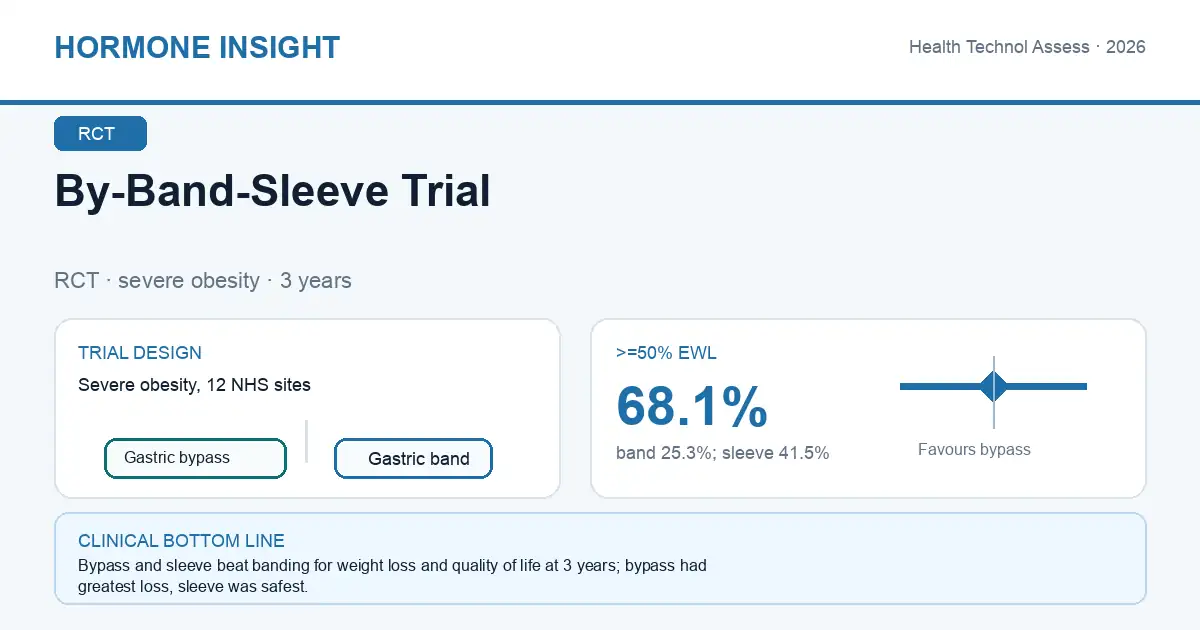
Summary: In the large UK By-Band-Sleeve trial in severe obesity, gastric bypass and sleeve gastrectomy both outperformed adjustable gastric banding for weight loss and quality of life at 3 years, while bypass gave greater excess weight loss than sleeve and was the most cost-effective; sleeve had the fewest adverse events.
PICO Summary
| Element | Detail |
|---|---|
| Population | 1346 adults with severe obesity (BMI ≥35 with comorbidity or ≥40 without); multicentre randomised controlled trial across 12 NHS hospitals, UK. |
| Intervention | Roux-en-Y gastric bypass (n=462). |
| Comparison | Adjustable gastric banding (n=464) or sleeve gastrectomy (n=420). |
| Outcome | At 3 years, at least 50% excess weight loss was achieved by 68.1% with bypass, 41.5% with sleeve, and 25.3% with band (adjusted risk differences: bypass vs band +40.7%; sleeve vs band +14.7%; sleeve vs bypass -26.0%). Mean EQ-5D quality-of-life scores were 0.72 (bypass), 0.68 (sleeve), and 0.62 (band). Adverse events were highest with band and lowest with sleeve; bypass was the most cost-effective procedure. |
By-Band-Sleeve Trial
RCT · severe obesity · 3 years
Bypass and sleeve both beat banding for weight loss and quality of life at 3 years; bypass gave the greatest excess weight loss and was most cost-effective, sleeve the safest.
Expert Commentary
This is a landmark pragmatic trial and among the highest-quality comparative evidence available on bariatric procedures, with over 1300 patients randomised across 12 NHS hospitals and three years of follow-up, so its conclusions carry real weight. The hierarchy is clear and clinically actionable: both bypass and sleeve clearly outperformed gastric banding on weight loss and quality of life, which, alongside band’s highest adverse-event rate, supports the decline of banding in practice. Between the two stapling procedures, bypass produced substantially greater excess weight loss than sleeve and was the most cost-effective, while sleeve offered the best safety profile, framing a genuine efficacy-versus-tolerability trade-off rather than a single winner. The honest limitations the report notes include disruption from the COVID-19 pandemic affecting surgery timing and follow-up completeness, and that three years cannot capture longer-term durability or late complications. Can I use this with my patients? Yes, directly and usefully. It supports steering eligible patients toward bypass or sleeve over banding, discussing bypass for maximal weight loss and cost-effectiveness against sleeve for fewer adverse events, individualised to the patient. The authors rightly flag that the next question is bypass versus modern medical therapy, which will increasingly shape these conversations.
References
By-Band-Sleeve Collaborative Group. Roux-en-Y gastric bypass, adjustable gastric banding or sleeve gastrectomy for severe obesity: the By-Band-Sleeve randomised controlled trial. Health Technol Assess. 2026;30(6):1–224. doi:10.3310/CXSE2951