

Summary: In a 16-week trial in overweight and obese adults, two African and Asian botanical extracts raised GLP-1, lowered DPP-4 activity, and reduced weight and fat, with the authors reporting effects comparable to semaglutide; several features of the trial, including manufacturer affiliation and implausibly strong correlations, warrant caution.
PICO Summary
| Element | Detail |
|---|---|
| Population | 248 overweight or obese adults (BMI 25–34.9; mean age 41); 16-week randomised, double-blind, placebo-controlled trial, Cameroon. |
| Intervention | Daily 400 mg Dichrostachys glomerata extract (DGE) or 300 mg Cissus quadrangularis extract (CQE). |
| Comparison | Placebo, or dose-escalated semaglutide (3 mg to 14 mg daily). |
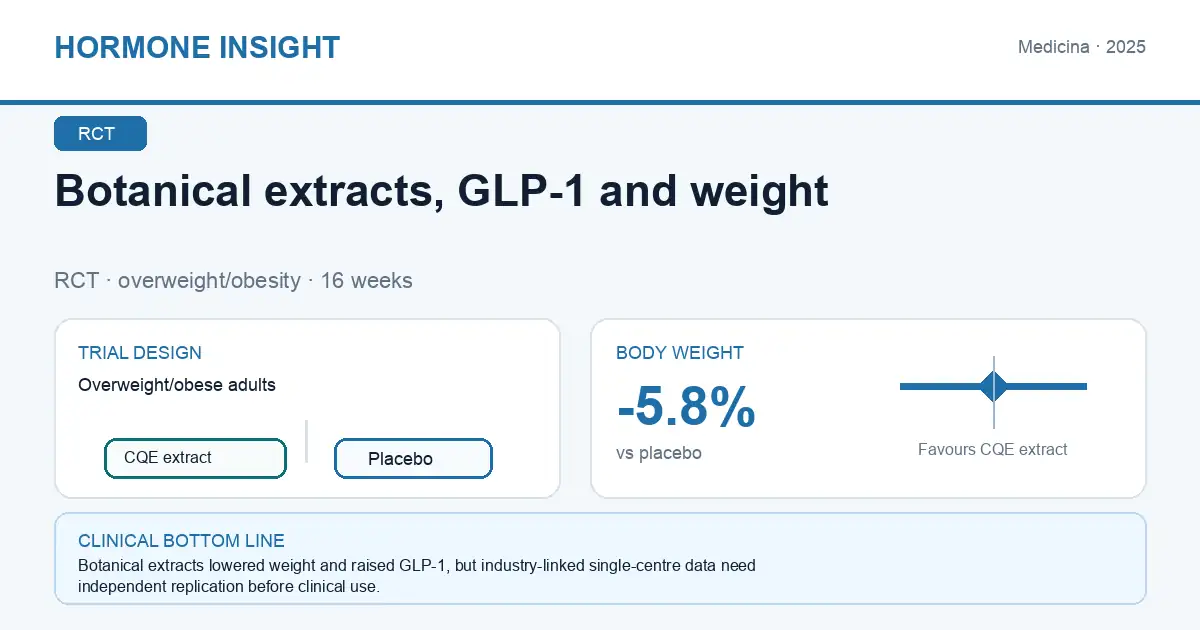
| Outcome | Both extracts raised GLP-1 (+38.6 and +42.2 pg/mL) and lowered DPP-4 activity (-15.3% and -17.8%) versus placebo (p<0.01), with weight loss (-5.2% and -5.8%), fat-mass reduction (-10.3% and -10.9%), greater satiety, and lower energy intake. The authors describe these as comparable to semaglutide, and report very strong correlations between GLP-1 rise and body fat (r = -0.91 to -0.92) and DPP-4 (r = -0.97 to -0.98). |
Botanical extracts, GLP-1 and weight
RCT · overweight/obesity · 16 weeks
Both botanical extracts lowered weight and body fat and raised GLP-1 versus placebo over 16 weeks. The semaglutide-comparable claim rests on industry-affiliated, partly open-label, single-centre data with implausibly strong correlations, so independent replication is needed before clinical use.
Expert Commentary
The premise is attractive, an affordable oral botanical that nudges the endogenous incretin system, and the reported effects are large, but several features make me read this trial with real caution rather than enthusiasm. First, the senior authorship and the research centre are affiliated with the foundation that develops these extracts, a direct commercial interest that demands independent replication before any claim of semaglutide-equivalence is taken at face value. Second, the correlations reported, with r values from -0.91 to -0.98, are extraordinarily strong for human biological data and are themselves a signal to interpret the analyses sceptically. Third, only the placebo arm was blinded, so the head-to-head against semaglutide was effectively open and prone to bias. Add a single-centre design, 16 weeks, and the general lack of regulatory standardisation for supplements, and the headline that botanicals match a potent GLP-1 agonist becomes an extraordinary claim resting on limited and conflicted evidence. Can I use this with my patients? Not as an alternative to proven therapy. I would not present these extracts as comparable to semaglutide, and where a patient asks about them I would explain that the evidence is preliminary, industry-affiliated, and not a basis for replacing lifestyle measures or, where indicated, established pharmacotherapy. Independent trials are needed.
References
Youovop J, Takuissu G, Minoue R, et al. Effects of Dichrostachys glomerata and Cissus quadrangularis extracts on GLP-1 secretion and DPP-4 activity in overweight and obese individuals: a randomized controlled trial. Medicina (Kaunas). 2025;62(1):41. doi:10.3390/medicina62010041