

Summary:
In Chinese middle-aged and elderly adults with prediabetes or early diabetes, purified anthocyanin supplementation (160, 320, and 640 mg/day for 12 weeks) showed no significant improvement compared to placebo, and it was not associated with adverse effects.
| PICO | Description |
|---|---|
| Population | Chinese middle-aged and elderly adults (n=184) with prediabetes or early-stage diabetes (dysglycemia). |
| Intervention | Daily supplementation with purified anthocyanins at doses of 160 mg, 320 mg, or 640 mg for 12 weeks. |
| Comparison | Placebo group receiving no active anthocyanin supplementation. |
| Outcome | No significant changes or dose-response effects in arterial stiffness (measured by baPWV), blood pressure, ABI, or composite cardiovascular risk indicators were observed after 12 weeks of ACN supplementation. |
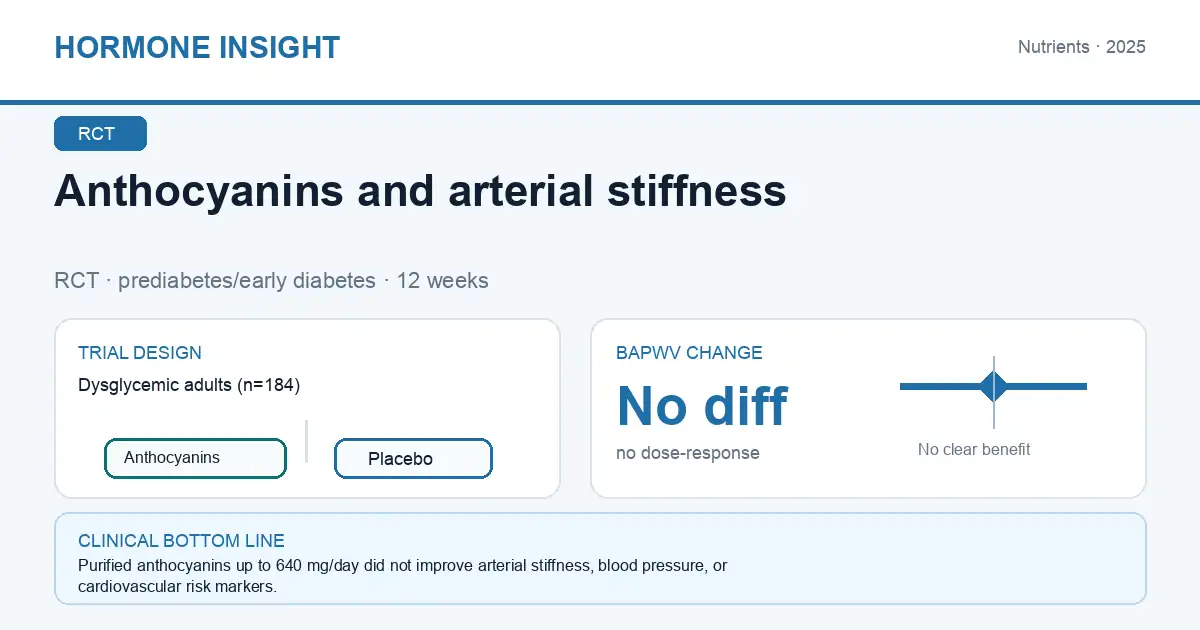
Anthocyanins and arterial stiffness
RCT · prediabetes/early diabetes · 12 weeks
Purified anthocyanins up to 640 mg/day for 12 weeks did not improve arterial stiffness, blood pressure, or cardiovascular risk markers, with no dose-response effect.
Clinical Context
Anthocyanins are water-soluble pigments responsible for the red, purple, and blue colors in many fruits and vegetables, particularly berries, grapes, and purple vegetables. These polyphenolic compounds have attracted considerable research interest due to observational studies linking higher anthocyanin intake with reduced cardiovascular disease risk. Proposed mechanisms include antioxidant activity, anti-inflammatory effects, improved endothelial function, and modulation of lipid metabolism. Individuals with prediabetes and early diabetes represent a particularly relevant target population given their elevated cardiovascular risk and the potential for preventive interventions before established disease develops. Arterial stiffness, measured by pulse wave velocity, serves as an independent predictor of cardiovascular events and mortality, making it a clinically meaningful surrogate endpoint. This dose-response trial aimed to determine whether purified anthocyanin supplementation could improve vascular health markers in a high-risk population and whether benefits increase with higher doses.Clinical Pearls
- Purified anthocyanin supplementation at doses up to 640 mg daily for 12 weeks produced no measurable improvement in arterial stiffness as measured by brachial-ankle pulse wave velocity.
- Blood pressure parameters including systolic, diastolic, and pulse pressure showed no significant changes across any anthocyanin dose compared to placebo.
- No dose-response relationship was observed, suggesting that higher anthocyanin doses do not provide incremental cardiovascular benefits in this population.
- The intervention demonstrated an acceptable safety profile with adverse event rates comparable to placebo, confirming tolerability even at higher doses.
Practical Application
Clinicians should not recommend purified anthocyanin supplements specifically for cardiovascular risk reduction in patients with prediabetes or early diabetes based on this evidence. Patients inquiring about anthocyanin supplements for heart health should be counseled that rigorous clinical trial data do not support efficacy for arterial stiffness or blood pressure outcomes. However, this finding should not discourage consumption of anthocyanin-rich whole foods, as the health benefits of fruits and vegetables extend beyond any single phytochemical and may involve synergistic effects not captured by isolated supplementation. The focus for cardiovascular risk reduction in dysglycemic patients should remain on established interventions including lifestyle modification, glycemic control, lipid management, and blood pressure treatment as indicated.Broader Evidence Context
These null findings contrast with some observational studies and smaller trials suggesting cardiovascular benefits from anthocyanins. The discrepancy may reflect differences between epidemiological associations with habitual dietary intake and the effects of supplementation, publication bias favoring positive results in smaller studies, or the possibility that whole food matrices provide benefits that isolated compounds do not replicate. The results align with a broader pattern in nutrition research where promising observational findings often fail to translate into supplement efficacy in rigorous trials. This study adds important negative evidence to the literature that should temper enthusiasm for anthocyanin supplementation.Study Limitations
- The 12-week intervention period may be insufficient to detect changes in arterial stiffness, which develops over years and may require longer treatment duration to reverse.
- The study population was limited to Chinese adults, and genetic polymorphisms affecting anthocyanin metabolism may influence responses in different ethnic groups.
- Participants had prediabetes or early diabetes without established cardiovascular disease, and effects might differ in populations with existing vascular pathology.
- Purified anthocyanin preparations may lack cofactors or matrix components present in whole foods that contribute to cardiovascular benefits.
- Compliance and absorption were not biochemically verified through plasma anthocyanin or metabolite measurements.
Bottom Line
Purified anthocyanin supplementation at doses ranging from 160 to 640 mg daily for 12 weeks does not improve arterial stiffness, blood pressure, or cardiovascular risk markers in middle-aged and elderly adults with prediabetes or early diabetes. Clinicians should not recommend anthocyanin supplements for cardiovascular protection in this population.Source: Liu, Zhaomin, et al. “Purified Anthocyanins Indicated No Significant Effect on Arterial Stiffness, Four-Limb Blood Pressures and Cardiovascular Risk—A 12-Week Dose-Response Trial in Chinese Middle-Aged and Elderly Adults with Hyperglycemia.” Nutrients. Read article here.