

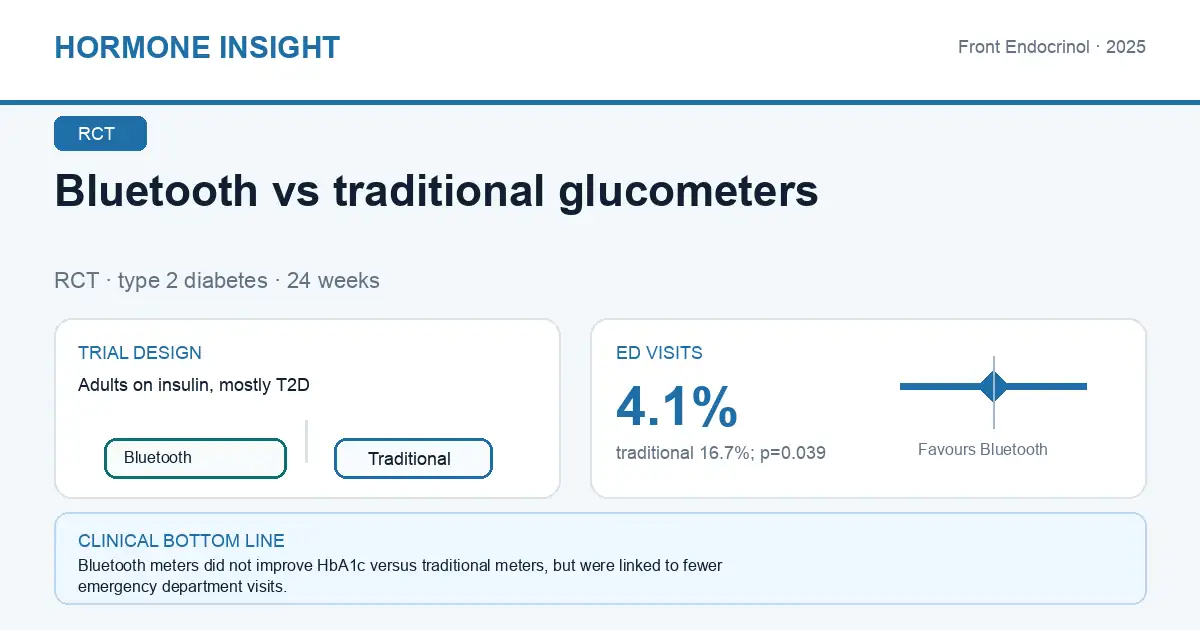
Summary: In a 24-week trial of telehealth insulin titration, Bluetooth-enabled glucometers did not improve glucose control over traditional glucometers, with both achieving large HbA1c reductions, but the Bluetooth group had significantly fewer emergency department visits.
PICO Summary
| Element | Detail |
|---|---|
| Population | 120 adults (aged 21–70) with diabetes needing insulin initiation or intensification, mostly type 2; 24-week open-label randomised controlled trial, Singapore. |
| Intervention | Bluetooth-enabled glucometers (BTG) with biweekly teleconsultations by diabetes nurse educators. |
| Comparison | Traditional glucometers (TG) with the same teleconsultation schedule. |
| Outcome | Both groups achieved significant HbA1c reductions (TG -2.8% at week 12 and -3.1% at week 24; BTG -2.23% and -2.18%; all p<0.001), with no significant between-group difference at any point. The BTG group had significantly fewer emergency department visits (4.1% vs 16.7%; p=0.039). Diabetes-related distress improved similarly in both. |
Bluetooth vs traditional glucometers in telehealth insulin titration
RCT · type 2 diabetes · 24 weeks
Bluetooth glucometers did not improve HbA1c over traditional ones, but were linked to significantly fewer emergency department visits (4.1% vs 16.7%, p=0.039).
Expert Commentary
This is a clean pragmatic trial whose pattern is increasingly familiar in digital health: the connected device did not beat the simpler one on the headline disease metric but showed a difference in healthcare utilisation. Both glucometer types delivered substantial HbA1c falls during nurse-led telehealth titration, which is itself the encouraging story, that structured remote insulin adjustment works regardless of device, so automatic data syncing alone does not guarantee better control. The intriguing finding is the lower emergency department visit rate with Bluetooth devices, plausibly through earlier detection of problematic glucose patterns enabling proactive intervention, though the mechanism was not established and the absolute numbers are small. The honest caveats the post notes include an open-label design, a population predominantly male, Chinese, and type 2 that may not generalise, no formal cost-effectiveness analysis despite the utilisation finding, and unknown durability beyond titration. Can I use this with my patients? Yes, to target the technology. For most patients undergoing telehealth titration, either glucometer suffices and engaged follow-up matters most, while for those at higher risk of acute crises a connected device may add safety value, pending cost-effectiveness confirmation, rather than expecting it to improve HbA1c per se.
References
Lian X, Liew HL, Lee YS, et al. Telehealth insulin titration in adults with diabetes: a randomized controlled trial comparing bluetooth-enabled versus traditional glucometers. Front Endocrinol (Lausanne). 2025;16:1724811. doi:10.3389/fendo.2025.1724811