

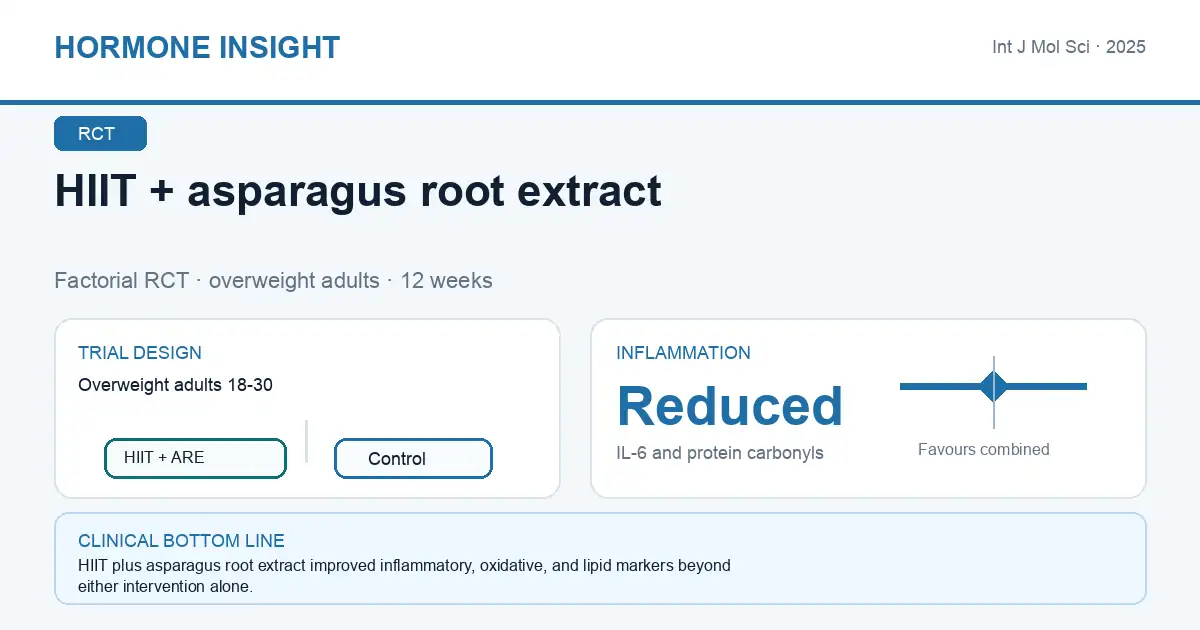
Summary: In a trial in overweight and obese young adults, combining high-intensity interval training with asparagus root extract improved oxidative-stress, inflammatory, and lipid markers more than either alone, while the extract on its own raised one oxidative-stress marker, cautioning against using it without exercise.
PICO Summary
| Element | Detail |
|---|---|
| Population | 72 overweight or obese adults aged 18–30 (BMI ≥23); randomised controlled trial, Thailand. |
| Intervention | Combined high-intensity interval training (modified Tabata, 3×/week for 12 weeks) plus asparagus root extract providing about 1.71 mg/kg/day of 20-hydroxyecdysone. |
| Comparison | Control, HIIT alone, or asparagus root extract alone. |
| Outcome | The combined group reduced protein carbonyls, interleukin-6, and the total-cholesterol/HDL ratio and increased superoxide dismutase activity (p=0.002). HIIT alone improved glucose, total cholesterol, HDL, and SOD. The extract alone increased SOD (p<0.001) but also raised malondialdehyde, a pro-oxidant marker (p=0.017). |
HIIT + asparagus root extract in overweight adults
Factorial RCT · overweight/obese adults · 12 weeks
Combining HIIT with asparagus root extract reduced interleukin-6, protein carbonyls, and the TC/HDL ratio and raised SOD activity beyond either intervention alone, while the extract used alone raised a pro-oxidant marker.
Expert Commentary
This is a well-designed factorial trial whose comparator structure lets it claim synergy more credibly than a simple combination study, and its most useful finding is also its most cautionary. The combination improved oxidative and inflammatory markers and the cholesterol ratio beyond either intervention alone, fitting the idea that exercise and a phytoecdysteroid antioxidant act complementarily. But the standout signal is that the extract by itself raised malondialdehyde even as it boosted superoxide dismutase, a paradoxical pro-oxidant effect that argues against taking the supplement without concurrent training. The honest limitations are clear: a young adult population aged 18 to 30 that may not represent older patients with established metabolic disease, only 12 weeks, an Asian BMI threshold that complicates comparison with Western criteria, uncontrolled background diet, and surrogate biomarker endpoints rather than clinical outcomes. Can I use this with my patients? Mainly as a caution and a nudge toward exercise. I would not recommend asparagus root extract as a standalone supplement given the lone-use oxidative signal, and where a motivated patient wishes to try it, only alongside regular high-intensity exercise, while emphasising that the proven and primary intervention here is the training itself.
References
Prasertsri P, Padkao T, Boonla O, et al. Synergistic effects of high-intensity interval training and Asparagus officinalis L. root extract supplementation on metabolic regulation, oxidative stress, and inflammation in overweight and obese adults. Int J Mol Sci. 2025;26(24):12054. doi:10.3390/ijms262412054