

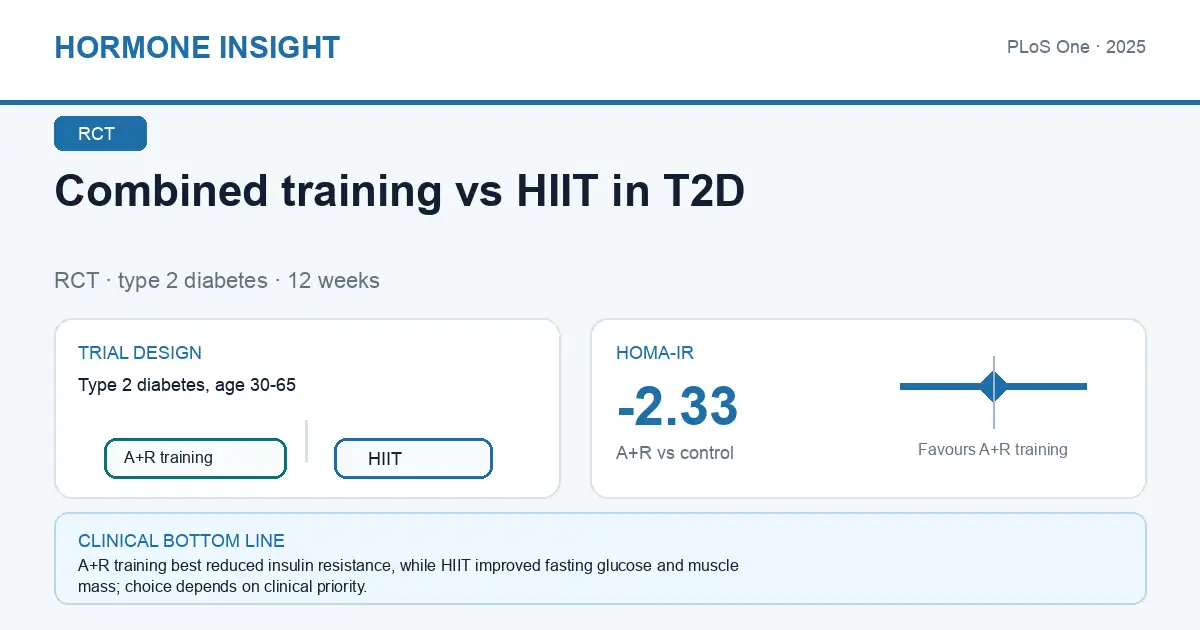
Summary: In a 12-week trial in type 2 diabetes, both combined aerobic-plus-resistance training and high-intensity interval training improved glucose control, body composition, fitness, and quality of life versus usual care, with HIIT favouring fasting glucose and muscle mass and combined training favouring insulin resistance, fat loss, and quality of life.
PICO Summary
| Element | Detail |
|---|---|
| Population | 90 adults with type 2 diabetes (aged 30–65), in three groups; 12-week single-centre randomised controlled trial, India. |
| Intervention | Combined aerobic and resistance training (A+R), or high-intensity interval training (HIIT), 3–5 times weekly for 12 weeks. |
| Comparison | Usual care without structured exercise. |
| Outcome | Both groups improved versus control. HIIT reduced fasting glucose more (MD -29.1 mg/dL) and increased fat-free mass more (+7.54 kg); A+R improved HOMA-IR (MD -2.33, significant where HIIT’s trend was not) and quality of life more. HbA1c reductions were essentially identical between the two (about -3.3 percentage points each versus control, a notably large figure that should be read with caution). Both reduced visceral and subcutaneous fat and improved 6-minute walk distance. |
Combined training vs HIIT in type 2 diabetes
RCT · type 2 diabetes · 12 weeks
Both A+R training and HIIT beat usual care. A+R was the only arm to significantly cut insulin resistance (HOMA-IR), while HIIT did more for fasting glucose and muscle mass. Choice is a matter of emphasis, not winner versus loser.
Expert Commentary
This is a useful head-to-head trial addressing a practical question, since both combined training and HIIT are recommended but rarely compared directly, and the pattern it reports is mechanistically sensible: HIIT, with its intense glycogen-depleting efforts, favoured fasting glucose and muscle mass, while combined training gave broader gains in insulin resistance, fat loss, and quality of life. The honest framing is that both clearly beat usual care and the choice is one of emphasis, not of winner versus loser, and notably the HbA1c reductions were near-identical rather than favouring one arm. One figure warrants explicit caution: an HbA1c fall of around 3.3 percentage points over 12 weeks is far larger than exercise trials typically achieve and larger than most drugs deliver, which raises the possibility of a units or reporting anomaly in the source, so I would not quote that magnitude to patients as a realistic expectation. Other limits include a single centre, results confined to adherent participants without advanced complications, 12 weeks only, and possible confounding from medication changes. Can I use this with my patients? Yes, to individualise. I would match modality to goals and preference, HIIT for time efficiency and post-meal glucose, combined training for broader metabolic and wellbeing benefit, while stressing that adherence matters most and treating the dramatic HbA1c number with scepticism.
References
Amaravadi SK, Ferreira AS, Vigário PDS. Comparative effects of combined aerobic and resistance training versus high-intensity interval training on insulin resistance, glycaemic control, body composition and quality of life in type 2 diabetes: a 12-week randomised controlled trial. PLoS One. 2025;20(12):e0336898. doi:10.1371/journal.pone.0336898