

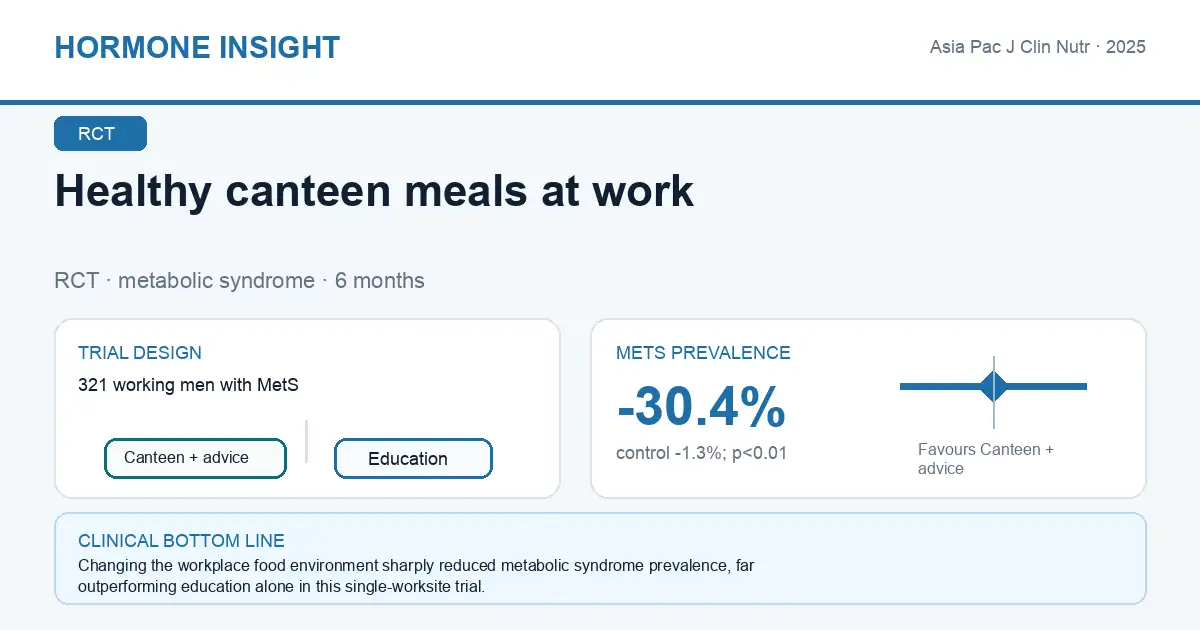
Summary: In a 6-month trial in working men with metabolic syndrome, providing healthier canteen lunches plus personalised dietary advice improved glucose, lipids, waist circumference, and BMI and cut metabolic syndrome prevalence by 30.4%, far exceeding health education alone.
PICO Summary
| Element | Detail |
|---|---|
| Population | 321 occupational men aged 25–59 with metabolic syndrome at an oilfield; randomised controlled trial, China. |
| Intervention | 6-month healthy canteen lunch plus personalised dietary advice and health education. |
| Comparison | Health education alone for 6 months, without canteen meal modification. |
| Outcome | The intervention group had significant reductions versus control in fasting glucose (β -0.72; p=0.010), total cholesterol (β -1.49), LDL-C (β -0.65), waist circumference (β -7.73), and BMI (β -2.01) (all p<0.001), with higher HDL-C (β +0.13; p<0.001). Metabolic syndrome prevalence fell 30.4% versus 1.3% in controls (p<0.01). |
Canteen Meals for Metabolic Syndrome
RCT · metabolic syndrome · 6 months
Modifying one daily canteen lunch plus advice cut metabolic syndrome prevalence by 30.4% over 6 months, versus 1.3% with health education alone. Changing the food environment outperformed educating about it.
Expert Commentary
This is a compelling demonstration of a principle that clinicians often underuse, that changing the food environment beats educating about it. The contrast is stark, a 30.4% fall in metabolic syndrome prevalence with modified canteen meals versus a negligible 1.3% with education alone, and it aligns neatly with behavioural-economics evidence that making the healthy choice the default and reducing friction outperforms trying to shift preferences through information. The improvements spanned every component, glucose, lipids, and central adiposity, with a clinically meaningful waist-circumference reduction, suggesting that modifying even one daily meal in a captive setting can yield systemic benefit. I would weigh the limitations honestly: this was a single male, single-worksite Chinese industrial cohort, the intervention could not be blinded, the specific meal changes were not detailed, and durability after the programme ended was not assessed. Can I use this with my patients? Indirectly but importantly. While I cannot prescribe a canteen, this strengthens the case for advising patients to leverage and advocate for healthier workplace food options, and supports occupational-health and employer initiatives, since environmental change is likely to outperform the dietary advice I give in clinic on its own.
References
Ma J, Zhang Y, Liu B, Du Z, Zhang X. Effectiveness of a canteen-based dietary intervention for metabolic syndrome in occupational men: a randomized controlled trial. Asia Pac J Clin Nutr. 2025;34(6):913–921. doi:10.6133/apjcn.202512_34(6).0006