

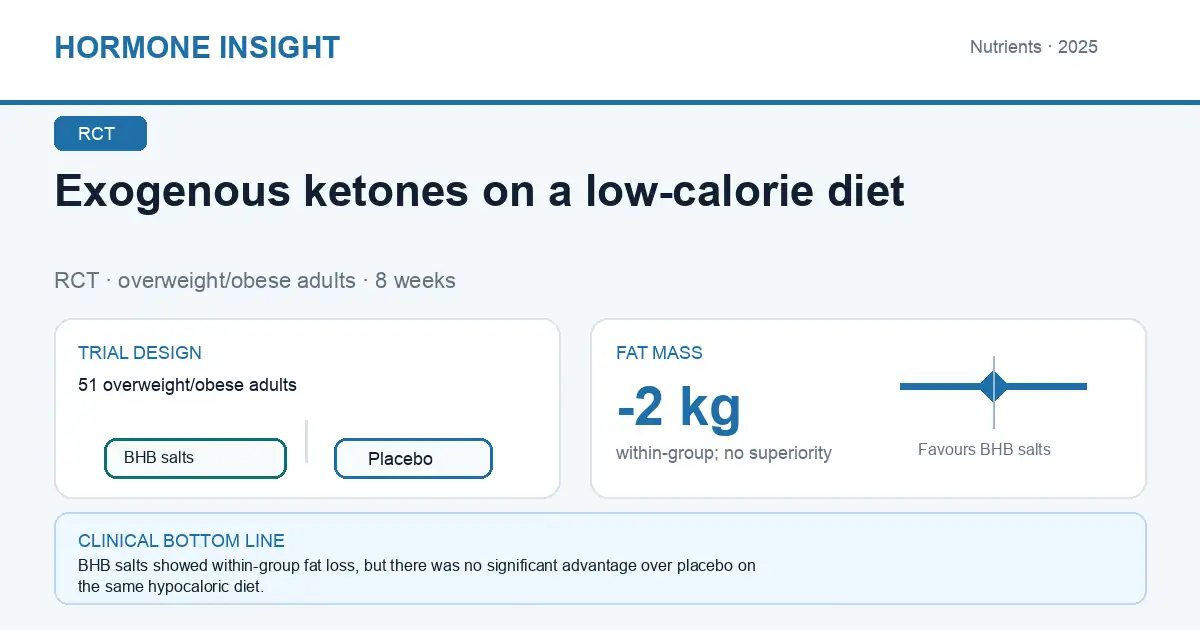
Summary: In overweight and obese adults on an 8-week hypocaloric diet, twice-daily beta-hydroxybutyrate ketone salts were associated with within-group fat loss and preserved lean mass, but showed no significant advantage over placebo, so the diet is the likely driver.
PICO Summary
| Element | Detail |
|---|---|
| Population | 51 overweight and obese adults on an 8-week modest caloric restriction. |
| Intervention | Racemic beta-hydroxybutyrate (BHB) mineral salts twice daily with the hypocaloric diet. |
| Comparison | Maltodextrin placebo twice daily with the same diet. |
| Outcome | Within the BHB group: fat mass -2 kg (p<0.05), improved body-fat percentage (p<0.01) and lean-to-fat ratio (p<0.05), preserved lean mass and resting metabolic rate, lower LDL. Group × time interactions were not significant (p>0.05), so no advantage over placebo. No adverse metabolic effects. |
Exogenous ketones on a low-calorie diet
RCT · overweight/obese adults · 8 weeks
BHB salts showed within-group fat loss, but the group by time interaction was not significant, so there was no advantage over placebo on the same hypocaloric diet.
Expert Commentary
The lean-mass-sparing pitch for exogenous ketones is biologically seductive, a fasted-but-fuelled signal that protects muscle during an energy deficit, and that is exactly why I read this trial carefully rather than charitably. The decisive number is the one the headline buries: the group by time interaction was not significant. The supplemented group did improve, losing fat and holding onto lean mass, but it did so no more than the placebo group eating the same deficit, which points squarely at the diet, not the salts. Within-group changes dressed up as a treatment effect are a recurring trap in the supplement literature, and this is a textbook example. I also note the racemic salts carry a real sodium, calcium, and magnesium load, and eight weeks says nothing about maintenance. Can I use this with my patients? No, I cannot recommend ketone salts as a weight-loss aid on this evidence, and I would gently tell a patient asking that they would be paying for what their calorie deficit is already doing. Structured restriction, adequate protein, and resistance training remain the proven levers. A placebo-beating result would change my mind; this is not one.
References
Roeth EJ, Parker G, Cooper-Leavitt EF, et al. Effect of exogenous ketones as an adjunct to low-calorie diet on metabolic markers. Nutrients. 2025;17(22):3582. doi:10.3390/nu17223582