

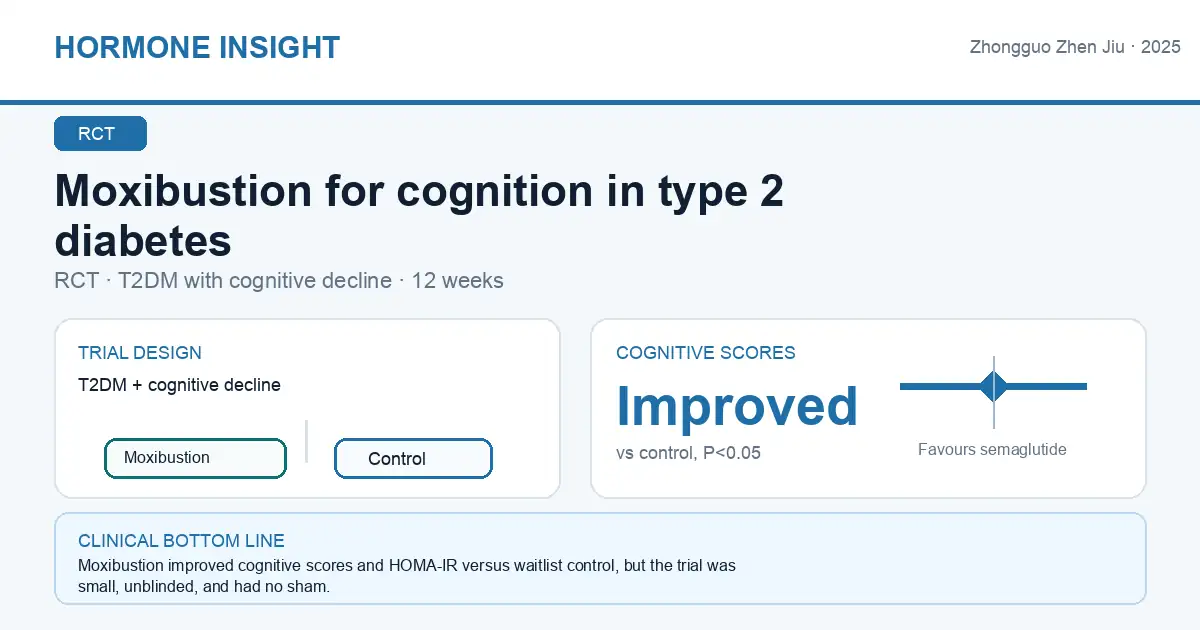
Summary: In a single-centre trial in type 2 diabetes with cognitive decline, adding Huayu Tongluo moxibustion to routine glucose-lowering therapy improved cognition, insulin resistance, and sleep over 12 weeks versus a waitlist control, though the comparison was unblinded with no sham.
PICO Summary
| Element | Detail |
|---|---|
| Population | 90 adults with type 2 diabetes and cognitive decline (single centre). |
| Intervention | Huayu Tongluo moxibustion every other day for 12 weeks at GV20, GV24, GV14, plus standard hypoglycaemic therapy. |
| Comparison | Routine hypoglycaemic treatment alone (waitlist, no sham). |
| Outcome | Significant gains in MoCA, MMSE, ACE-III (attention, memory, language fluency), and SDMT (P<0.05 or P<0.01), with reduced AIS insomnia scores and HOMA-IR, sustained at 12-week follow-up and superior to control. No side effects reported. |
Moxibustion for cognition in type 2 diabetes
RCT · T2DM with cognitive decline · 12 weeks
Adding moxibustion to usual care improved cognitive scores and lowered HOMA-IR versus waitlist control over 12 weeks. The trial was small, single-centre, and unblinded with no sham, so placebo effects are not excluded.
Expert Commentary
Cognitive decline in diabetes is a real and underserved problem, and insulin resistance is a plausible lever, so I am sympathetic to any low-cost idea that might help. My verdict here is cautious, and the methodology is why. The benefit is measured against a waitlist control that received no sham, and moxibustion, applying visible, sensible heat, cannot be blinded, so expectation and placebo effects have wide scope to inflate psychometric scores in particular. The endpoints are surrogate cognitive tests over a short twelve weeks, not functional outcomes or dementia risk, and the improvements in sleep, attention, and metabolic control cannot be disentangled from any direct neural effect. This also remains a small single-centre trial in a field where systematic reviews have repeatedly urged caution. Can I use this with my patients? Not as a recommended treatment. If an interested patient wants to try it I would not obstruct them, while flagging burn risk in those with neuropathy or impaired sensation, but it must layer onto optimised glycaemic and cardiovascular care, never replace it. A larger, sham-controlled, multicentre trial would change my assessment.
References
Ye M, Yuan A, Zhang L, et al. Effects of Huayu Tongluo moxibustion on cognitive function and insulin resistance in patients with type 2 diabetes mellitus and cognitive decline: a randomized controlled trial. Zhongguo Zhen Jiu. 2025;45(11):1541–1548. doi:10.13703/j.0255-2930.20241001-k0003