

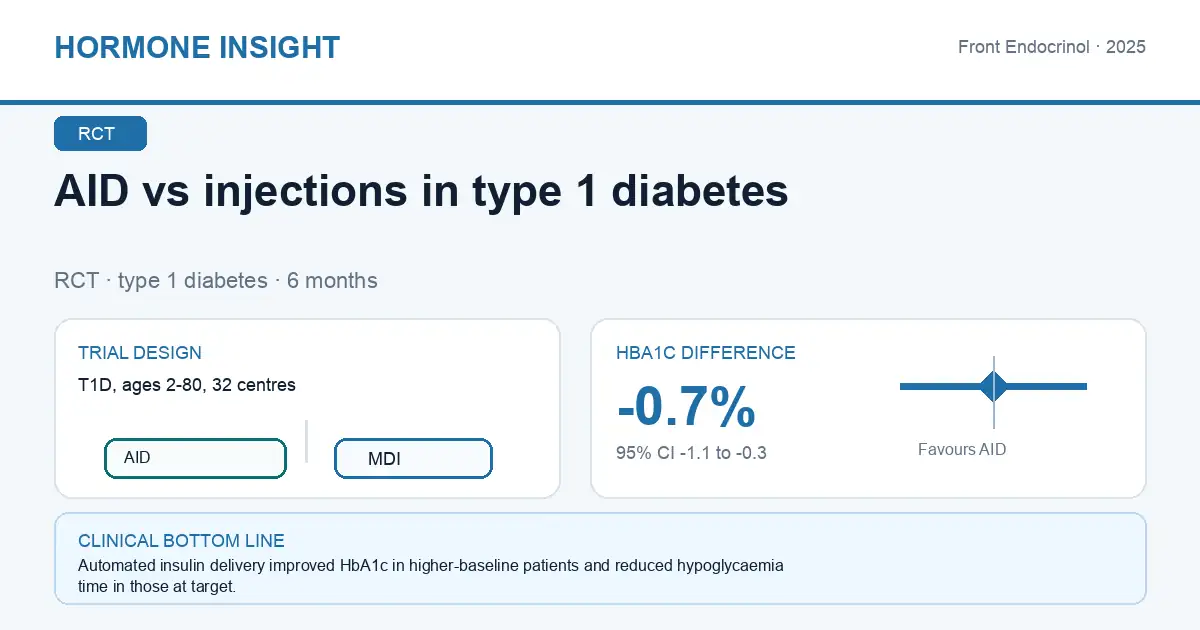
Summary: In a large international trial in type 1 diabetes spanning ages 2 to 80, automated insulin delivery with the MiniMed 670G/770G improved HbA1c in those starting above 8% and reduced time in hypoglycaemia in those already at or below 8%, compared with multiple daily injections, while meeting safety criteria.
PICO Summary
| Element | Detail |
|---|---|
| Population | People with type 1 diabetes aged 2–80 across 32 international centres, split by baseline HbA1c (>8% as Group 1; ≤8% as Group 2); randomised parallel controlled trial. |
| Intervention | Automated insulin delivery (MiniMed 670G or 770G) over 6 months (Group 1 n=56; Group 2 n=73). |
| Comparison | Multiple daily injections with or without continuous glucose monitoring (Group 1 n=54; Group 2 n=69). |
| Outcome | In Group 1, AID lowered HbA1c by a mean of 0.7% versus MDI (95% CI -1.1 to -0.3; p=0.0002). In Group 2, AID reduced time below 70 mg/dL by 4.8% (95% CI -6.4 to -3.1; p<0.001). Severe hypoglycaemia (AID 1.82/100 patient-years) and DKA (MDI 3.52/100 patient-years) were low and met prespecified safety criteria. |
AID vs MDI in type 1 diabetes
RCT · type 1 diabetes · 6 months
Versus multiple daily injections, automated insulin delivery cut HbA1c by 0.7% in those above 8% and reduced time in hypoglycaemia by 4.8% in those at target, with low severe-event rates.
Expert Commentary
This is an important trial because it does something most automated-insulin-delivery studies have not, comparing the technology directly against multiple daily injections rather than against sensor-augmented pumps, which is the comparison that matters for the many patients worldwide still injecting. The design is clever in matching the primary endpoint to the problem: for those entering with higher HbA1c the gain was glycaemic, a clinically meaningful 0.7% reduction, while for those already well controlled the benefit was a substantial cut in hypoglycaemia exposure, so the system improved whichever dimension was most at risk. Reassuringly, severe hypoglycaemia and ketoacidosis stayed low and within safety targets, and the inclusion of children from age two extends relevance to paediatrics. The limitations the post rightly flags temper the enthusiasm: a six-month horizon that cannot speak to durability, unavoidable lack of blinding given visible pump therapy, a heterogeneous MDI comparator with and without CGM, and manufacturer sponsorship. Can I use this with my patients? Yes, and it reinforces current direction. It supports offering automated insulin delivery across ages and baseline control, for HbA1c improvement in those above target and hypoglycaemia protection in those at target, while I remain mindful of access barriers, the need for thorough training, and the industry-sponsored, shorter-term nature of the evidence.
References
Jendle JH, Garg SK, Thivolet C, et al. Automated basal insulin delivery versus multiple daily injections in type 1 diabetes: results from a randomized parallel controlled trial. Front Endocrinol (Lausanne). 2025;16:1716587. doi:10.3389/fendo.2025.1716587