

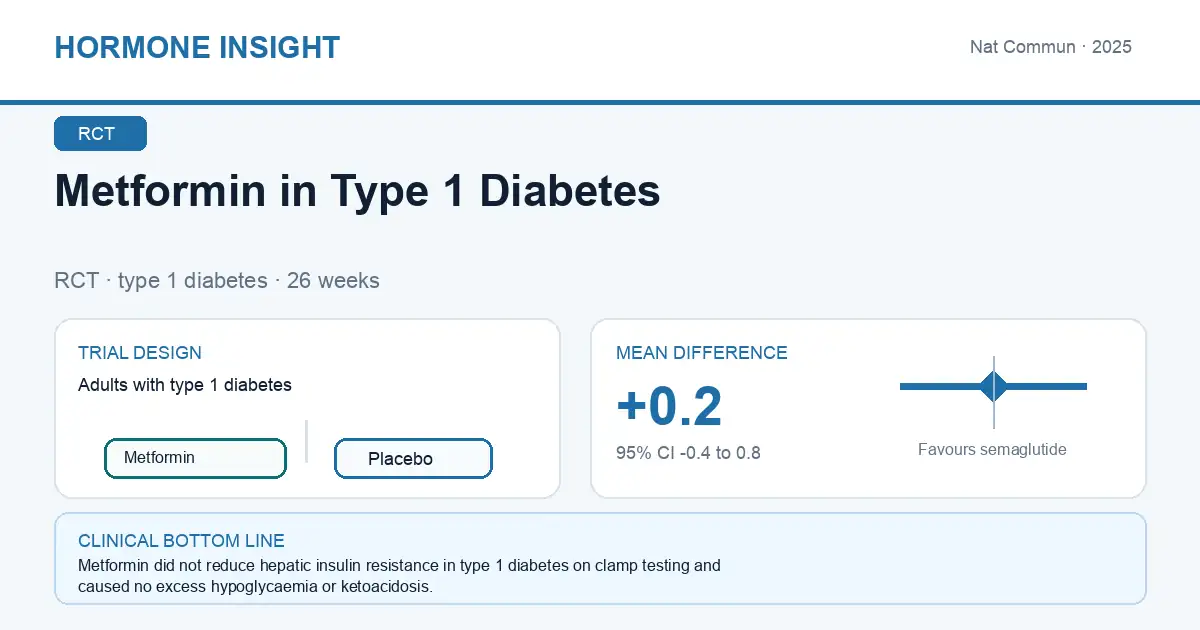
Summary: In adults with type 1 diabetes, 26 weeks of metformin 1500 mg daily did not reduce hepatic insulin resistance versus placebo, measured by the gold-standard clamp, although it caused no excess hypoglycaemia or ketoacidosis.
PICO Summary
| Element | Detail |
|---|---|
| Population | 40 adults with type 1 diabetes (37 completed the randomised phase); 20 adults without diabetes for the baseline clamp comparison. |
| Intervention | Metformin 1500 mg daily for 26 weeks, insulin resistance measured by two-step hyperinsulinaemic-euglycaemic clamp. |
| Comparison | Placebo over 26 weeks. |
| Outcome | No difference in change in endogenous glucose production (mean difference 0.2 µmol/kg FFM/min; 95% CI -0.4 to 0.8; p=0.53). No increase in hypoglycaemia or ketoacidosis. (Baseline: type 1 patients had 64% higher EGP, 29% lower glucose infusion rate.) |
Metformin in Type 1 Diabetes
RCT · type 1 diabetes · 26 weeks
Metformin did not reduce hepatic insulin resistance in type 1 diabetes on gold-standard clamp testing, with a tight confidence interval around the null. It is not an insulin-sensitiser in this setting, though it caused no excess hypoglycaemia or ketoacidosis.
Expert Commentary
Insulin resistance in type 1 diabetes, the so-called double diabetes, is real and clinically irritating, driving up insulin needs and cardiovascular risk, so the instinct to reach for metformin is understandable. This trial deserves credit for testing that instinct properly, and the verdict is honestly negative. Using the hyperinsulinaemic-euglycaemic clamp, the gold standard, metformin did nothing to hepatic glucose production, and the confidence interval is narrow enough that I read this as a real absence of effect rather than an underpowered shrug. That matters, because it means any benefit clinicians have seen from metformin in type 1 patients, and REMOVAL suggested modest weight and lipid effects, does not come from fixing the insulin-resistant state itself. The sample is small and the dose fixed at 1500 mg, which I weigh as a genuine limitation, but the precision around the null is persuasive. Can I use this with my patients? Yes, as a deprescribing signal: I will not add metformin to a type 1 patient expecting it to improve insulin sensitivity. If I use it at all it will be for selective weight or lipid reasons, openly off-label, with insulin remaining the foundation. I would welcome a larger trial, but I doubt it overturns this.
References
Snaith JR, Olsen N, Evans J, et al. Effect of metformin on insulin resistance in adults with type 1 diabetes: a 26-week randomized double-blind clinical trial. Nat Commun. 2025;16(1):9884. doi:10.1038/s41467-025-65951-1