

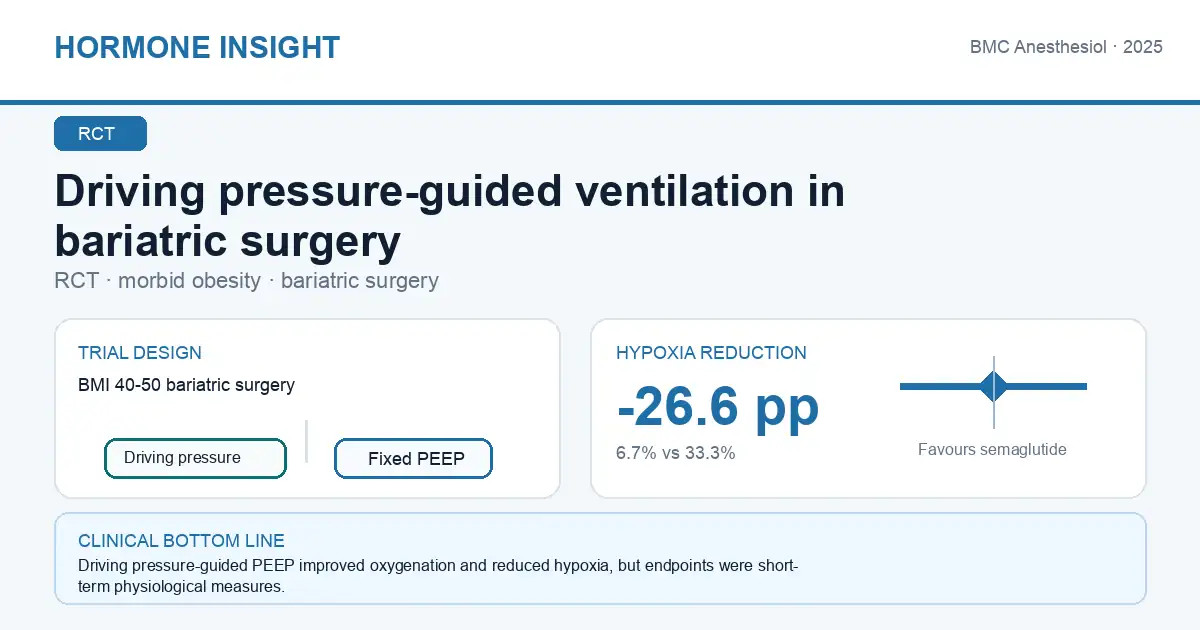
Summary: In morbidly obese patients undergoing laparoscopic bariatric surgery, individualising PEEP to the lowest driving pressure improved oxygenation and lung mechanics and sharply reduced intraoperative hypoxia (6.7% vs 33.3%) versus fixed PEEP, though the outcomes were physiological and short-term rather than major complications.
PICO Summary
| Element | Detail |
|---|---|
| Population | 60 adults with BMI 40–50 undergoing elective laparoscopic bariatric surgery (30 per arm). |
| Intervention | Driving pressure-guided ventilation: PEEP individually titrated to the lowest driving pressure after a recruitment manoeuvre. |
| Comparison | Conventional lung-protective ventilation with fixed PEEP 5 cmH₂O after the same recruitment manoeuvre. |
| Outcome | Higher PaO₂/FiO₂ before extubation and postoperatively (P<0.001), better compliance, lower plateau and driving pressures. Intraoperative hypoxia 6.7% vs 33.3%; postoperative hypoxia 0% vs 23.3%. No major adverse effects. |
Driving pressure-guided ventilation in bariatric surgery
RCT · morbid obesity · laparoscopic bariatric surgery
Titrating PEEP to the lowest driving pressure improved oxygenation and lung mechanics and cut intraoperative hypoxia from 33.3% to 6.7%. Endpoints were physiological and short-term, not major complications.
Expert Commentary
This sits a little outside my own clinic, but it matters to anyone sending patients with obesity to theatre, and the rationale is sound: a single fixed PEEP cannot suit every patient’s mechanics, and driving pressure is a well-validated marker of the strain placed on aerated lung. Titrating PEEP to minimise it after recruitment is mechanically sensible, and the oxygenation and compliance gains here, with intraoperative hypoxia cut from a third of patients to under one in fourteen, are clinically meaningful in a population that desaturates easily. My reservation is the one this literature keeps running into: improved physiology does not reliably become fewer hard outcomes. The endpoints are oxygenation, compliance, and hypoxic episodes, not pulmonary complications or length of stay, the trial is single-centre with 60 patients, and larger high-versus-low PEEP trials have given mixed results on what patients actually care about. Can I use this with my patients? Not directly as an endocrinologist, but I would happily support anaesthetic colleagues adopting it as a refinement of lung-protective ventilation, since it needs only routine ventilator data. I would await a multicentre trial powered for postoperative complications before calling it definitive.
References
Elbehairy MS, Eid GM, Elzeftawy AE, Elsheikh NA, Messbah WE. Driving pressure guided ventilation versus conventional lung protective strategy in morbid obese patients undergoing laparoscopic bariatric surgery: a prospective randomized controlled study. BMC Anesthesiol. 2025;25(1):577. doi:10.1186/s12871-025-03431-1