

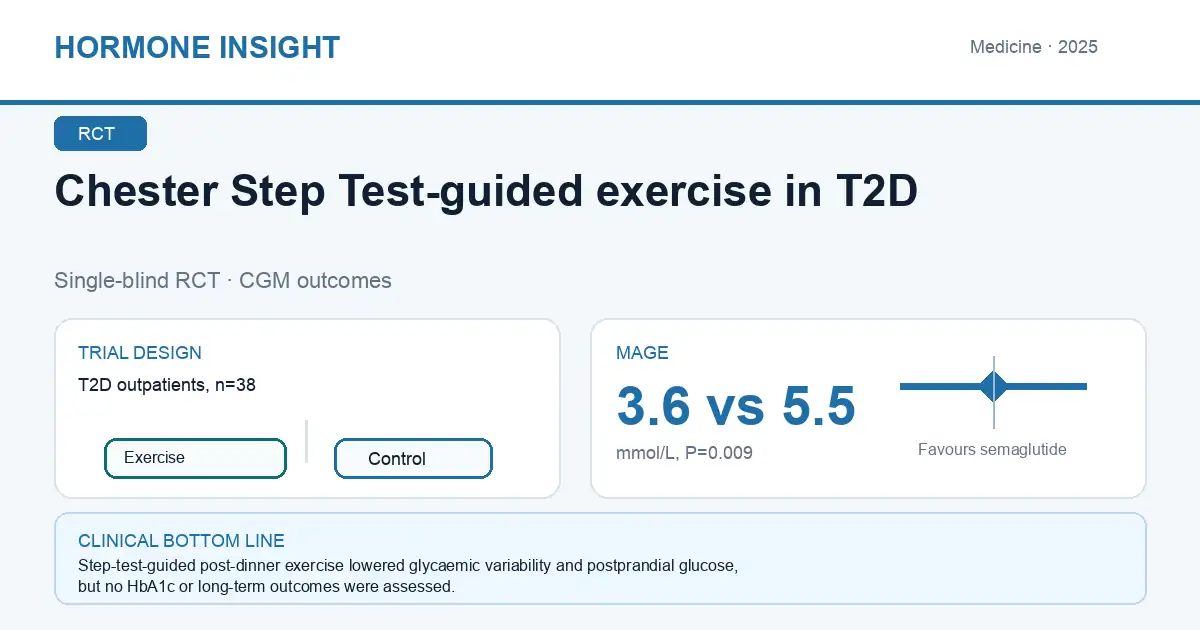
Summary: In adults with type 2 diabetes, personalised post-dinner exercise prescribed from Chester Step Test-derived VO2 max lowered postprandial glucose and glycaemic variability on exercise days versus usual activity, with no notable adverse events, though no HbA1c or long-term outcomes were assessed.
PICO Summary
| Element | Detail |
|---|---|
| Population | 38 outpatients with type 2 diabetes (single-blind RCT). |
| Intervention | Personalised exercise at 50–75% of Chester Step Test-derived VO2 max, ~45 min after dinner, 30–60 min (n=19). |
| Comparison | Usual activity without vigorous exercise (n=19). |
| Outcome | On exercise days: lower postprandial nadir glucose (4.5 vs 5.4 mmol/L; P=0.016), lower glucose SD (1.5 vs 2.0; P=0.027), lower mean amplitude of glycaemic excursions (3.6 vs 5.5; P=0.009). No HbA1c endpoint. No adverse events. |
Chester Step Test-guided exercise in type 2 diabetes
Single-blind RCT · type 2 diabetes · CGM outcomes
On exercise days, Chester Step Test-guided post-dinner exercise lowered glycaemic variability and postprandial glucose versus usual activity. No HbA1c or long-term outcomes were measured.
Expert Commentary
I like the practicality of this idea, because the gap between telling a patient to exercise and giving them a measured intensity target is real, and a cheap submaximal step test that estimates VO2 max in an ordinary clinic is a sensible way to bridge it. The physiology is also well established: post-meal exercise blunts the postprandial rise more than the same activity at other times, so the direction of these results is exactly what I would expect. My caution is about what the trial does and does not show. The benefits were measured on exercise days, which says nothing about day-to-day consistency, the endpoints are CGM-derived surrogates rather than HbA1c or complications, and with 38 people and a usual-activity control there is room for attention effects. The step-test VO2 max is also an estimate that can misclassify fitness. Can I use this with my patients? Yes, fairly readily, as a low-cost way to individualise exercise intensity and to time activity after the evening meal, while screening for cardiovascular risk, hypoglycaemia, and joint limits first. I would frame the benefit as better post-meal control on the days they actually exercise, and await HbA1c-level evidence.
References
Wang C, Yang H, Zhou H, et al. Clinical application of Chester Step Test in developing personalized exercise prescription in patients with type 2 diabetes: a single-blind, randomized controlled trial. Medicine (Baltimore). 2025;104(44):e45615. doi:10.1097/MD.0000000000045615