

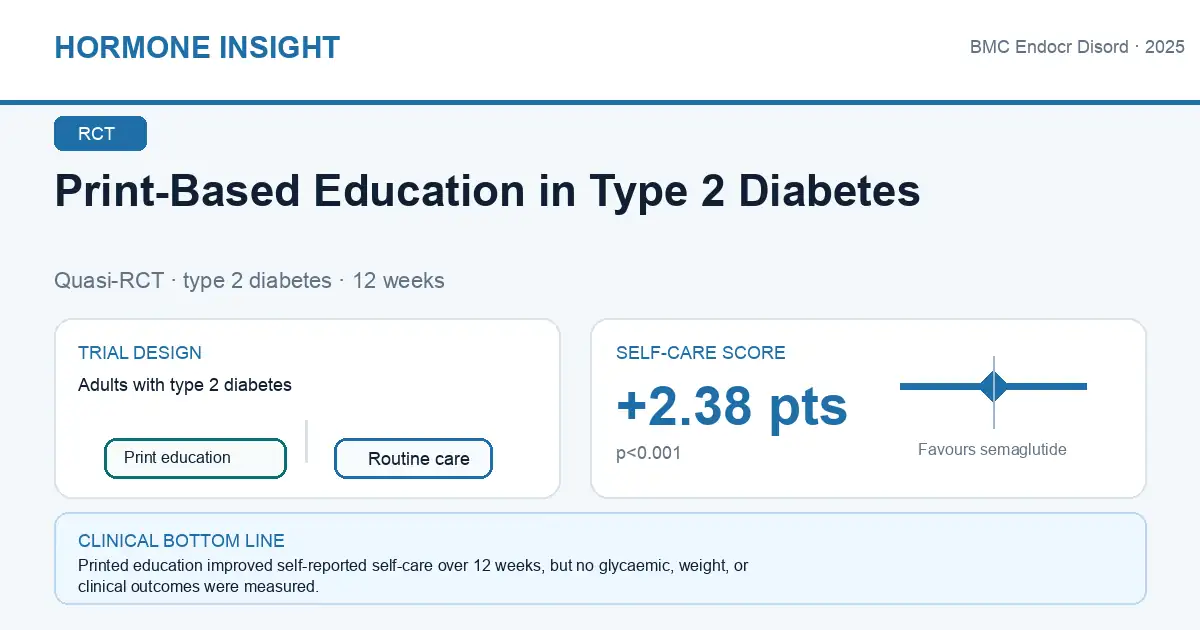
Summary: In type 2 diabetes patients at tertiary hospitals in Southwest Nigeria, a 12-week print-based educational programme significantly improved self-reported self-care practices while routine care produced no change, though no glycaemic or clinical endpoints were measured.
PICO Summary
| Element | Detail |
|---|---|
| Population | 192 adults with type 2 diabetes at endocrinology clinics in Southwest Nigeria (quasi-experimental, 96 per arm). |
| Intervention | 12-week print-based programme: presentation sessions, take-home leaflets, and weekly reminder messages. |
| Comparison | Routine care with no additional educational intervention. |
| Outcome | Self-care scores rose 10.57 to 12.96 in the intervention group (z=-6.845; p<0.001); no significant change in control (z=-0.160; p=0.873). 90.4% reached good self-care practice. No clinical endpoints. No adverse effects. |
Print-Based Education in Type 2 Diabetes
Quasi-RCT · type 2 diabetes · 12 weeks
A 12-week printed education programme improved self-reported self-care scores versus no change with routine care. No glycaemic or clinical outcomes were measured.
Expert Commentary
There is real value in showing that something cheap and low-tech works where digital tools are impractical, and durable printed leaflets backed by reminders fit a resource-limited setting well. The behavioural signal is clear, with the intervention group improving while the control did not, which I find believable for structured, reinforced education. I temper it with the usual honesty about design and endpoints. This was quasi-experimental rather than a clean randomised trial, the outcome was self-reported self-care behaviour, which is prone to social-desirability bias after an education programme, and there is no HbA1c, weight, or complication data, so the downstream clinical benefit remains unproven, which is precisely the open question across this whole literature. Twelve weeks also says nothing about whether the habits stick. Can I use this with my patients? Yes, in principle: it supports investing in structured, culturally adapted printed education as a complement to clinical care, paired with objective monitoring rather than relied on alone. I would want a trial linking the behaviour change to glycaemic outcomes before claiming more than improved self-care scores.
References
Howells BB, Nwozichi CU, Monehin S, Ogunmuyiwa AO, Abaribe C. Assessing the effectiveness of print-based educational intervention on self-care practices among type 2 diabetes patients in selected tertiary hospitals in Southwest, Nigeria. BMC Endocr Disord. 2025;25(1):268. doi:10.1186/s12902-025-02065-1