

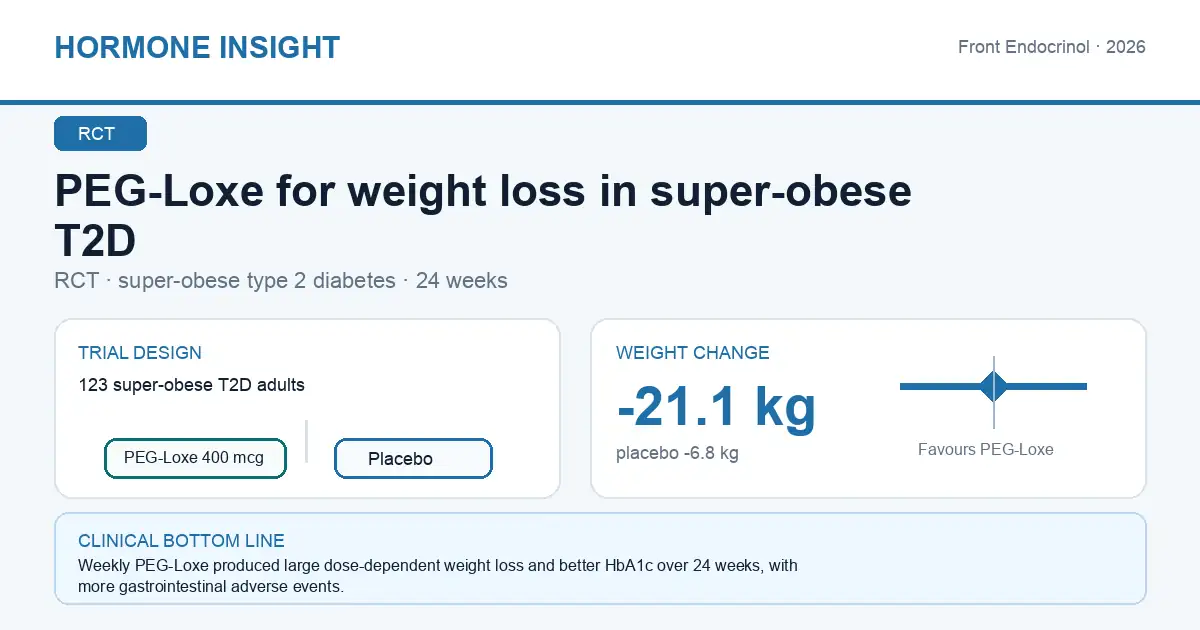
Summary: In a trial in super-obese patients with type 2 diabetes, weekly polyethylene glycol loxenatide produced large dose-dependent weight loss (up to 21 kg) and better glycaemic control than placebo over 24 weeks, with more gastrointestinal side effects.
PICO Summary
| Element | Detail |
|---|---|
| Population | 123 super-obese adults with type 2 diabetes (105 completed; single centre, single-blind). |
| Intervention | Polyethylene glycol loxenatide (PEG-Loxe), a weekly GLP-1 receptor agonist, 300 or 400 µg/week for 24 weeks. |
| Comparison | Weekly placebo injections over 24 weeks. |
| Outcome | Weight change -16.34 kg (300 µg) and -21.14 kg (400 µg) vs -6.75 kg placebo (p<0.001). HbA1c fell 1.02% and 1.34% vs 0.50%. Waist circumference and HDL improved. Adverse drug reactions 25.0% and 36.1% vs 11.4%, predominantly gastrointestinal. |
PEG-Loxe for weight loss in super-obese T2D
RCT · super-obese type 2 diabetes · 24 weeks
Weekly PEG-Loxe gave large dose-dependent weight loss (up to 21 kg) and better glycaemic control than placebo over 24 weeks, with more gastrointestinal adverse events at higher doses.
Expert Commentary
This is a positive trial that fits comfortably into what we now firmly expect from GLP-1 receptor agonists, so my verdict is favourable, with the magnitude doing the persuading: weight loss of sixteen to twenty-one kilograms against under seven on placebo, a clean dose-response, and HbA1c falling in step. The gastrointestinal adverse-event rate rising with dose is entirely characteristic of the class and reassures me the drug is behaving as a GLP-1 agonist should rather than producing anything unexpected. The honest limitations are scale and design, not direction: a single-centre, single-blind trial of 123 patients over 24 weeks, with placebo injections that single-blinding makes imperfect, and no long-term durability or cardiovascular-outcome data for this particular agent. Can I use this with my patients? In settings where PEG-Loxe is available, yes, it is a reasonable GLP-1 option for super-obese patients with type 2 diabetes, titrated with the usual gastrointestinal counselling and dose escalation. Where the better-studied agents in the class are available I would still favour those for their larger evidence base. I would want longer outcome data before treating PEG-Loxe as interchangeable with them.
References
Liu Z, Song C, Cai Y, Li Z, Hu S. Effect of polyethylene glycol loxenatide on weight loss in super-obese patients with type 2 diabetes: a randomized controlled trial. Front Endocrinol (Lausanne). 2026;17:1689040. doi:10.3389/fendo.2026.1689040