

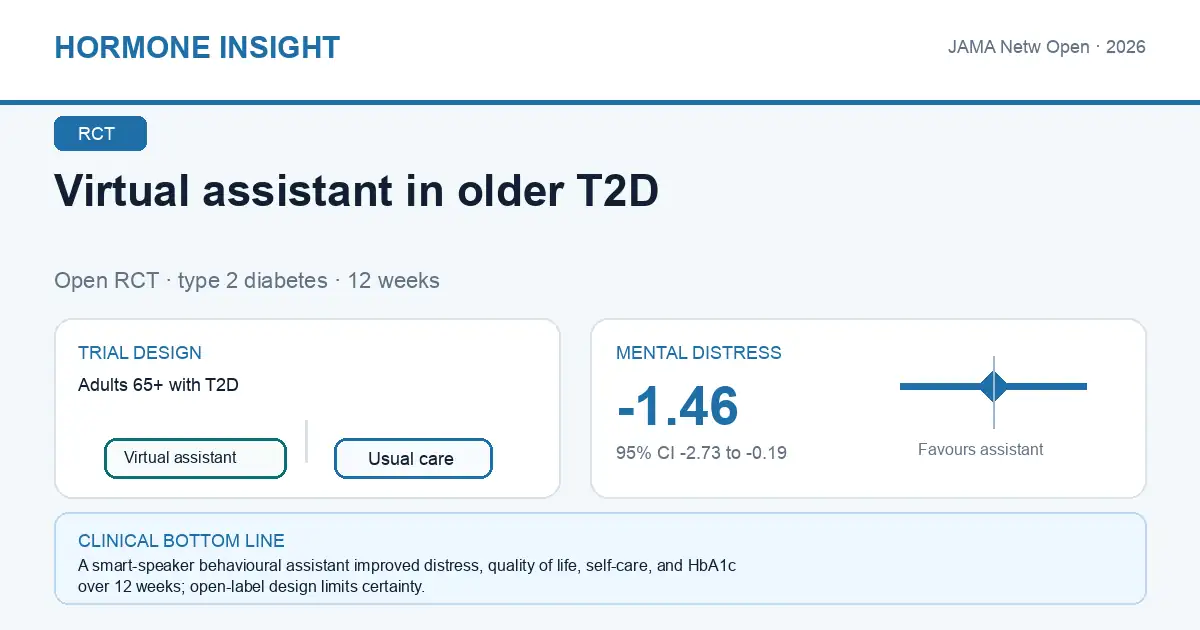
Summary: In a trial in older adults with type 2 diabetes, a smart-speaker virtual assistant programmed with a behavioural intervention reduced mental distress and improved quality of life, self-care, and HbA1c over 12 weeks compared with usual care, with no adverse events.
PICO Summary
| Element | Detail |
|---|---|
| Population | 112 adults aged 65 or older with type 2 diabetes at an academic medical centre; open randomised clinical trial (IVAM-ED), Brazil. |
| Intervention | An interactive virtual assistant device (Amazon Echo Dot, 3rd generation) programmed with a behavioural intervention model for home use over 12 weeks. |
| Comparison | Usual diabetes care without the device. |
| Outcome | The intervention reduced mental distress (adjusted mean difference -1.46; 95% CI -2.73 to -0.19; p=.02) and improved quality of life (+9.46; p=.001), diabetes self-care (+3.40; p<.001), and HbA1c (-0.48%; p=.01). Perceived stress did not differ significantly (p=.07). No participant withdrew due to adverse events. |
Virtual assistant in older T2D (IVAM-ED)
Open RCT · type 2 diabetes · 12 weeks
A smart-speaker virtual assistant with a behavioural programme lowered mental distress and improved quality of life, self-care, and HbA1c over 12 weeks versus usual care, with no adverse withdrawals. Open-label, single-centre, and short, so interpret the size cautiously.
Expert Commentary
This is an appealing and pragmatic trial that repurposes inexpensive consumer technology to address a real and often neglected problem, the mental distress that frequently accompanies diabetes in older adults and complicates self-management. The breadth of benefit is notable, spanning psychological distress, quality of life, self-care behaviour, and a modest but real HbA1c improvement, and the intervention was well accepted with no adverse withdrawals, which matters for an older population sometimes assumed to struggle with new technology. I would read it with the design in mind. It was open-label, so participants and assessors knew who had the device, which can inflate self-reported outcomes such as distress, quality of life, and self-care, and the non-significant result for perceived stress is a useful internal check that the effects were not uniformly positive. It was also single-centre, modest at 112 participants, and short at 12 weeks, leaving durability and scalability open. Can I use this with my patients? Yes, as a promising and low-cost adjunct. For older patients comfortable with a smart speaker, a behaviourally programmed virtual assistant is a reasonable supportive tool alongside standard care, while I interpret the magnitude cautiously given the open-label design and await longer, multi-site confirmation.
References
Matzenbacher LS, da Costa FL, de Barros LGB, et al. Interactive virtual assistant for health promotion among older adults with type 2 diabetes: the IVAM-ED randomized clinical trial. JAMA Netw Open. 2026;9(1):e2553508. doi:10.1001/jamanetworkopen.2025.53508