

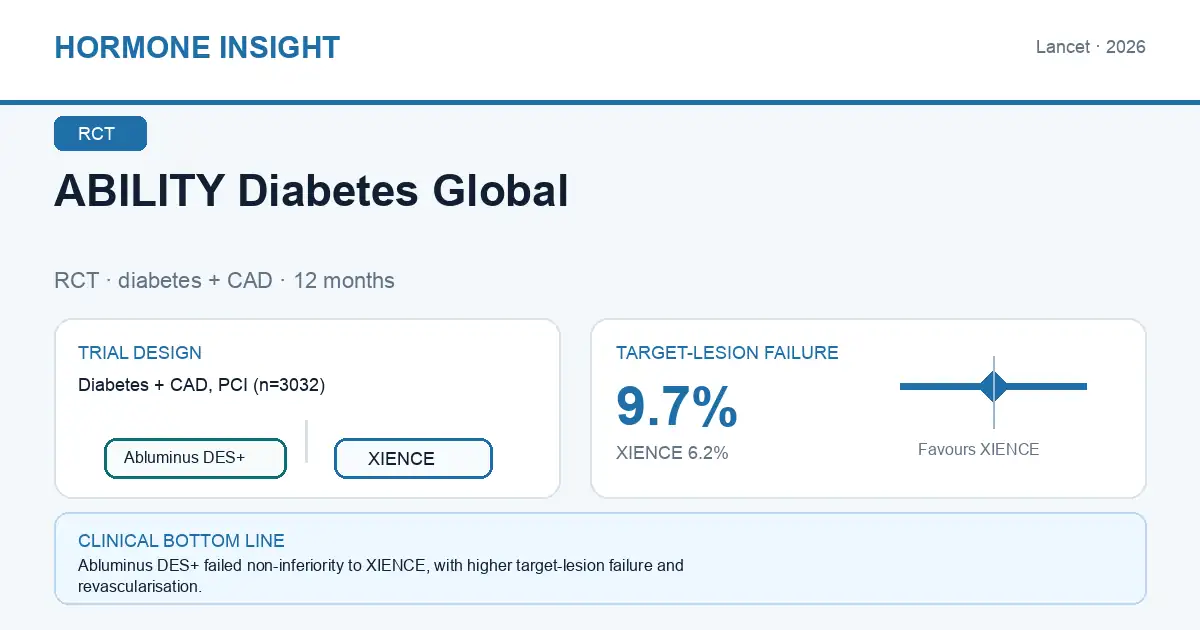
Summary: In the large ABILITY Diabetes Global trial in patients with diabetes and coronary artery disease, the Abluminus DES+ sirolimus-eluting stent failed to prove non-inferiority to the XIENCE everolimus-eluting stent, with higher rates of repeat revascularisation and target-lesion failure at 12 months.
PICO Summary
| Element | Detail |
|---|---|
| Population | 3032 patients with type 1 or type 2 diabetes and coronary artery disease undergoing PCI; multicentre, open-label randomised controlled trial at 74 sites in 16 countries. |
| Intervention | Abluminus DES+ thin-strut cobalt-chromium sirolimus-eluting stent with abluminal and balloon-surface coating (n=1514). |
| Comparison | XIENCE durable-polymer everolimus-eluting stent (n=1518). |
| Outcome | At 12 months (per-protocol), Abluminus DES+ did NOT meet non-inferiority. Ischaemia-driven target-lesion revascularisation was higher with Abluminus (4.8% vs 2.1%; absolute risk difference 2.7%; p=0.44 for non-inferiority), as was target-lesion failure (9.7% vs 6.2%; difference 3.5%; p=0.68); for both, the lower confidence bound excluded zero. Target-vessel myocardial infarction was more frequent with Abluminus (5.2% vs 3.1%), with no significant differences in cardiovascular or all-cause death. Results were consistent at 24 months. |
ABILITY Diabetes Global
RCT · diabetes + CAD · 12 months
Abluminus DES+ failed non-inferiority to XIENCE in diabetic patients undergoing PCI, with higher target-lesion failure and revascularisation. XIENCE remains the preferred stent.
Expert Commentary
This is a major trial with an unambiguous and clinically important result, and it must be reported exactly as it fell: the newer Abluminus DES+ stent did not prove non-inferior to the established XIENCE everolimus-eluting stent in patients with diabetes, and in fact performed worse, with higher rates of ischaemia-driven target-lesion revascularisation and target-lesion failure and more target-vessel myocardial infarction, the lower confidence bounds excluding zero so that XIENCE was statistically superior on these measures. Reassuringly there was no difference in cardiovascular or all-cause death, and the findings held at 24 months. The honest interpretation is that this is a negative trial for the new device, not a success, and any suggestion that Abluminus reduced restenosis would be the reverse of the truth. The limitations are secondary to that headline: an open-label design for stent assignment, follow-up that may miss very late events, non-mandated angiographic follow-up, and a diabetic population that cannot capture every severity. Can I use this with my patients? Yes, clearly. For patients with diabetes undergoing PCI, this supports continuing to favour the XIENCE everolimus-eluting stent over the Abluminus DES+, and it underlines that optimising outcomes in diabetic coronary disease remains an unmet challenge requiring further innovation rather than adoption of this device.
References
Abizaid A, Mehran R, Oliva A, et al. Abluminus DES+ sirolimus-eluting stent versus everolimus-eluting stent in patients with diabetes and coronary artery disease (ABILITY Diabetes Global): results from a multicentre, randomised controlled trial. Lancet. 2026;407(10525):227–236. doi:10.1016/S0140-6736(25)02157-9