

| PICO | Description |
|---|---|
| Population | Pregnant women diagnosed with gestational diabetes mellitus (GDM) in Switzerland; 156 assigned to real-time CGM and 143 to SMBG. |
| Intervention | Use of real-time continuous glucose monitoring (CGM) for glucose tracking during pregnancy. |
| Comparison | Standard self-monitoring of blood glucose (SMBG) through intermittent finger-prick testing. |
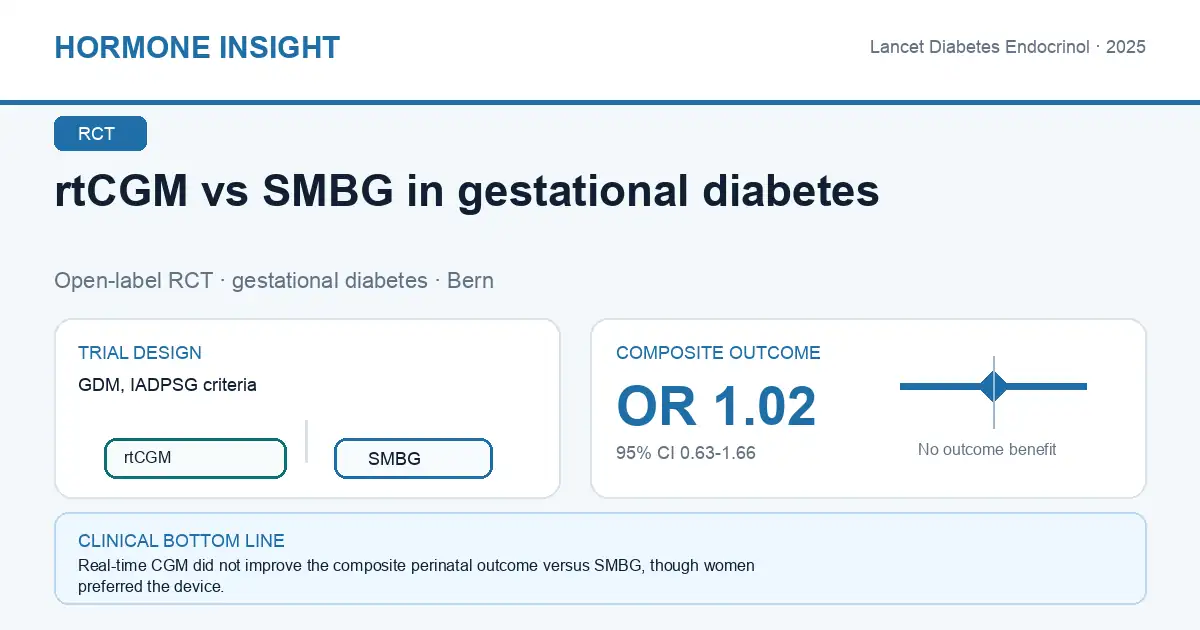
| Outcome | The primary composite perinatal outcome (large for gestational age, macrosomia, polyhydramnios, neonatal hypoglycaemia, or stillbirth) did not differ between groups: odds ratio 1.02 (95% CI 0.63 to 1.66), not statistically significant. The only differences were a higher patient preference for the CGM device and more skin changes with CGM (4% versus under 1%). The authors concluded that real-time CGM did not improve outcomes but could be offered to simplify management. |
RCT
Lancet Diabetes Endocrinol · 2025
rtCGM vs SMBG in gestational diabetes (DipGluMo)
Open-label RCT · gestational diabetes · single-centre, Bern
Trial design
Between-group effect (95% CI)
Composite outcome
OR 1.02
95% CI 0.63-1.66
Statistical result
Not significant
CI crosses 1.0
Randomised
302
156 rtCGM / 143 SMBG
Skin changes
4% vs <1%
rtCGM vs SMBG
⬡ Bottom Line
In this first adequately powered RCT, real-time CGM did not improve the composite perinatal outcome over SMBG (OR 1.02, 95% CI 0.63-1.66). Women preferred the CGM device, so it may be offered to simplify management rather than to improve outcomes.
P
Population
Pregnant women aged 18-45 with gestational diabetes (IADPSG criteria), Bern, Switzerland
I
Intervention
Real-time continuous glucose monitoring (rtCGM)
C
Comparator
Self-monitoring of blood glucose (SMBG) by finger-prick
O
Outcome
Composite perinatal outcome: no significant difference (OR 1.02, 95% CI 0.63-1.66)