

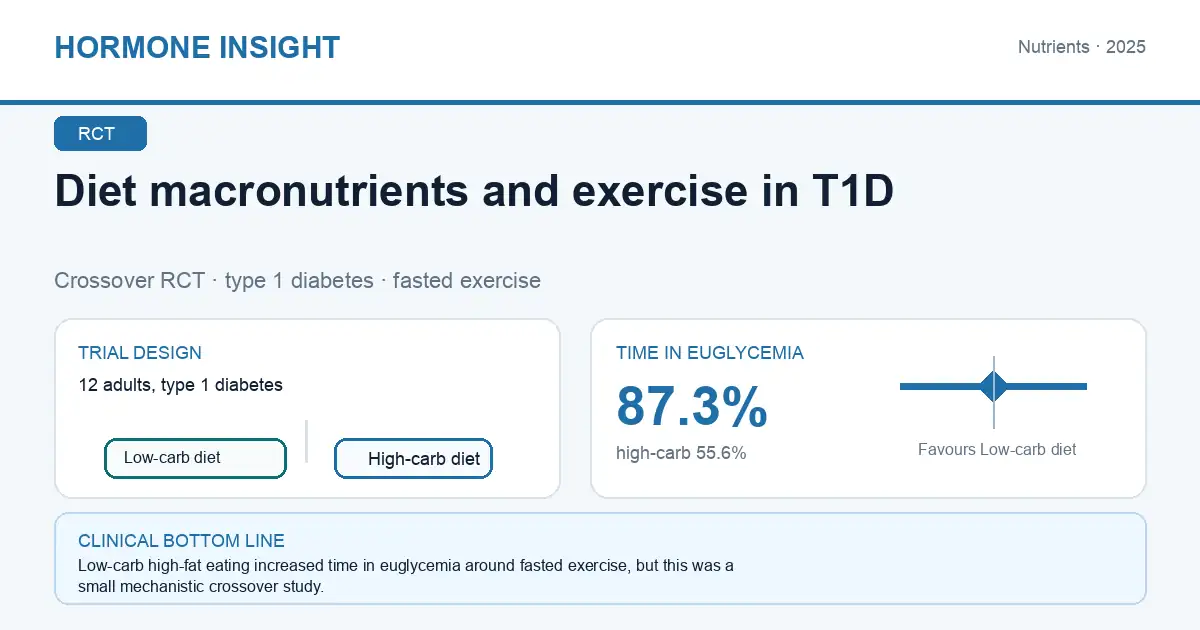
Summary: In a small crossover study in adults with type 1 diabetes, one week of a high-carbohydrate diet shifted exercise fuel use toward carbohydrate, while the two low-carbohydrate diets produced more time in target glucose range and less hyperglycaemia during and around fasted submaximal exercise.
PICO Summary
| Element | Detail |
|---|---|
| Population | 12 adults with type 1 diabetes (4 female; mean age 46; HbA1c 55.9 mmol/mol); randomised crossover trial, Denmark/UK. |
| Intervention | Seven days of each of three isocaloric diets: high-carbohydrate/low-fat/low-protein (HCLFLP), low-carbohydrate/high-fat (LCHFLP), and low-carbohydrate/low-fat/high-protein (LCLFHP), then 45 minutes of fasted cycling at ~60% VO2. |
| Comparison | The three diets compared against each other (within-subject crossover). |
| Outcome | During exercise, lipid oxidation was higher (1.2-fold) and carbohydrate oxidation lower (0.8-fold) on LCHFLP versus HCLFLP (p=0.030), with higher post-exercise free fatty acids. Time in euglycaemia was higher on both low-carbohydrate diets (HCLFLP 55.6%, LCHFLP 87.3%, LCLFHP 95.2%; p=0.003) and hyperglycaemia lower, with no differences between the two low-carbohydrate diets. |
Diet macronutrients and exercise metabolism in type 1 diabetes
Randomised crossover RCT · type 1 diabetes · 7-day diets, fasted exercise
After a week of each diet, a low-carbohydrate, high-fat pattern gave more time in euglycaemia (87.3% vs 55.6%) and less hyperglycaemia around fasted exercise than a high-carbohydrate diet, while the high-carbohydrate diet shifted exercise fuel toward carbohydrate. Small mechanistic crossover (n=12).
Expert Commentary
This is a neat mechanistic crossover, and getting its direction right matters, because the headline is the opposite of what one might assume from sports-nutrition dogma. The high-carbohydrate diet did what carbohydrate loading does, shifting exercise substrate use toward carbohydrate oxidation, but it was the two low-carbohydrate diets that delivered better glycaemic outcomes around fasted exercise, with markedly more time in euglycaemia and less hyperglycaemia, and no meaningful difference between the high-fat and high-protein low-carbohydrate variants. So the metabolic-fuel finding and the glucose-control finding point in different directions, and for a person with type 1 diabetes exercising fasted, the lower-carbohydrate patterns produced steadier glucose here. The limitations are substantial and temper any prescription: only 12 participants, a seven-day adaptation that cannot capture longer-term effects, a single fasted submaximal cycling protocol that may not extend to high-intensity or prolonged or fed exercise, and undetailed insulin adjustments. Can I use this with my patients? As nuanced counselling rather than a rule. It cautions against assuming athletes with type 1 diabetes always need high pre-exercise carbohydrate for glycaemic stability, and supports individualised, possibly periodised, carbohydrate strategies developed with a dietitian, while larger and more varied exercise studies are needed.
References
McCarthy OM, Kristensen KB, Ranjan AG, et al. Influence of diets differing in macronutrient composition on metabolic regulation during exercise in adults with type 1 diabetes. Nutrients. 2025;17(23):3637. doi:10.3390/nu17233637