

Summary:
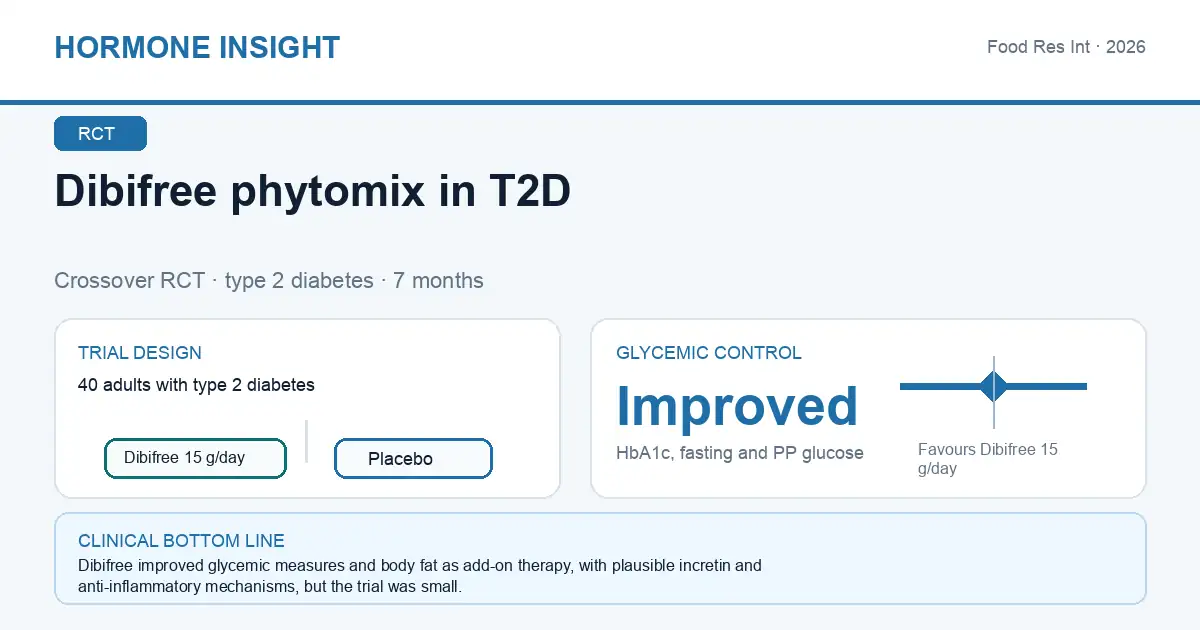
In adults with type 2 diabetes (n=40), Dibifree dietary phytomix (15 g/day) as add-on therapy significantly reduced HbA1c, fasting/postprandial glucose, and body fat percentage compared to placebo, with mechanistic evidence of GLP-1 enhancement, DPP-4 inhibition, and anti-inflammatory effects.
| PICO | Description |
|---|---|
| Population | Adults with type 2 diabetes (n=40) enrolled in a 7-month randomized, double-blind, placebo-controlled crossover trial in Taiwan. |
| Intervention | Dibifree dietary phytomix (15 g/day) as add-on therapy for two 3-month sessions separated by 1-month washout, with placebo recipients switched to Dibifree in second session. |
| Comparison | Placebo add-on therapy in crossover design. |
| Outcome | Significant reduction in HbA1c, fasting glucose, postprandial glucose, and body fat percentage. Effects sustained after washout and re-challenge. Mechanistic studies showed multi-target effects on incretin, glycation, adipogenesis, and immune pathways. |
Dibifree dietary phytomix in type 2 diabetes
RCT crossover · type 2 diabetes · 3-month sessions
Dibifree as add-on therapy significantly lowered HbA1c and fasting/postprandial glucose versus placebo, with effects sustained after washout and re-challenge and a parallel fall in body fat percentage.
Clinical Context
Dietary interventions and functional foods represent an attractive complementary approach to pharmacotherapy in type 2 diabetes management. While lifestyle modification remains foundational, many patients struggle to achieve glycemic targets with diet and exercise alone, and pharmacological agents carry costs, side effects, and adherence challenges. Food-derived bioactives that can enhance glucose metabolism through multiple mechanisms offer potential as adjunctive therapy.
The gut-pancreas-adipose-immune axis has emerged as a critical integrator of metabolic homeostasis. Disruptions in this axis—including impaired incretin secretion, pancreatic β-cell dysfunction, adipose tissue inflammation, and immune dysregulation—contribute to the pathophysiology of type 2 diabetes. Interventions targeting multiple nodes of this axis may provide synergistic benefits beyond single-target approaches.
Dibifree was developed as a dietary phytomix specifically formulated with food-derived compounds possessing anti-diabetic bioactivities. This trial employed a rigorous crossover design to evaluate its add-on efficacy while simultaneously investigating mechanistic underpinnings through integrated transcriptomic profiling and functional assays.
Clinical Pearls
1. Robust Glycemic Improvements: Dibifree significantly reduced HbA1c, fasting glucose, and postprandial glucose compared to placebo. The crossover design with washout and re-challenge strengthens causal inference—effects returned when the intervention was reintroduced after washout, demonstrating reproducibility.
2. Body Composition Benefits: Reduction in body fat percentage suggests effects beyond glycemic control, potentially addressing the adiposity-insulin resistance connection. This positions Dibifree as addressing metabolic syndrome broadly rather than glucose alone.
3. Multi-Target Mechanistic Profile: Functional assays demonstrated enhanced GLP-1 secretion, DPP-4 inhibition, and α-glucosidase inhibition—mimicking mechanisms of established diabetes drugs. Additional effects on AGE formation, adipogenesis suppression, and M2 macrophage polarization suggest anti-inflammatory and tissue-protective properties.
4. Transcriptomic Validation: Gene expression profiling revealed reversal of diabetic gene signatures and enrichment of therapeutically relevant pathways (cAMP/GLP-1, insulin secretion, AGE-RAGE, IL-10). This integrated approach provides molecular evidence supporting clinical observations.
Practical Application
Dibifree represents a potential functional food intervention for patients with type 2 diabetes seeking complementary approaches to standard pharmacotherapy. The 15 g/day dosing is practical and the crossover trial design with sustained effects after re-challenge supports real-world utility.
For patients interested in dietary supplements or those experiencing side effects from standard agents, food-derived interventions with demonstrated efficacy may improve adherence and outcomes. However, Dibifree should be positioned as add-on therapy rather than replacement for proven pharmacological treatments.
The multi-target mechanism suggests potential benefits for patients with features beyond hyperglycemia, including obesity, inflammation, or early complications. Availability may currently be limited to research settings pending commercialization.
Broader Evidence Context
This study exemplifies the trend toward functional foods with demonstrated mechanisms and clinical efficacy. Previous phytochemical interventions have shown promise but often lacked rigorous trial designs or mechanistic characterization. The integration of clinical outcomes with transcriptomic and functional validation represents a higher evidence standard for dietary interventions.
The demonstrated GLP-1 enhancement and DPP-4 inhibition align with the success of incretin-based pharmacotherapy, suggesting food-derived compounds can engage similar pathways at clinically meaningful levels.
Study Limitations
Modest sample size (n=40) limits statistical power for subgroup analyses. The 3-month treatment periods may not capture long-term durability or safety. Specific composition of Dibifree and individual bioactive contributions not detailed. Single-country (Taiwan) population may limit generalizability. Mechanistic studies in cell lines and mice may not fully translate to human physiology.
Bottom Line
Dibifree dietary phytomix as add-on therapy significantly improves glycemic control and reduces body fat in type 2 diabetes through multi-target mechanisms including GLP-1 enhancement, DPP-4 inhibition, and immune modulation, demonstrating the therapeutic potential of food-derived interventions.
Source: Huang TY, et al. “Dibifree, a dietary phytomix, improves glycemic control and adiposity via modulation of the gut-pancreas-adipose-immune axis in type 2 diabetes.” Food Res Int. 2026;223(Pt 1):117820. Read article