

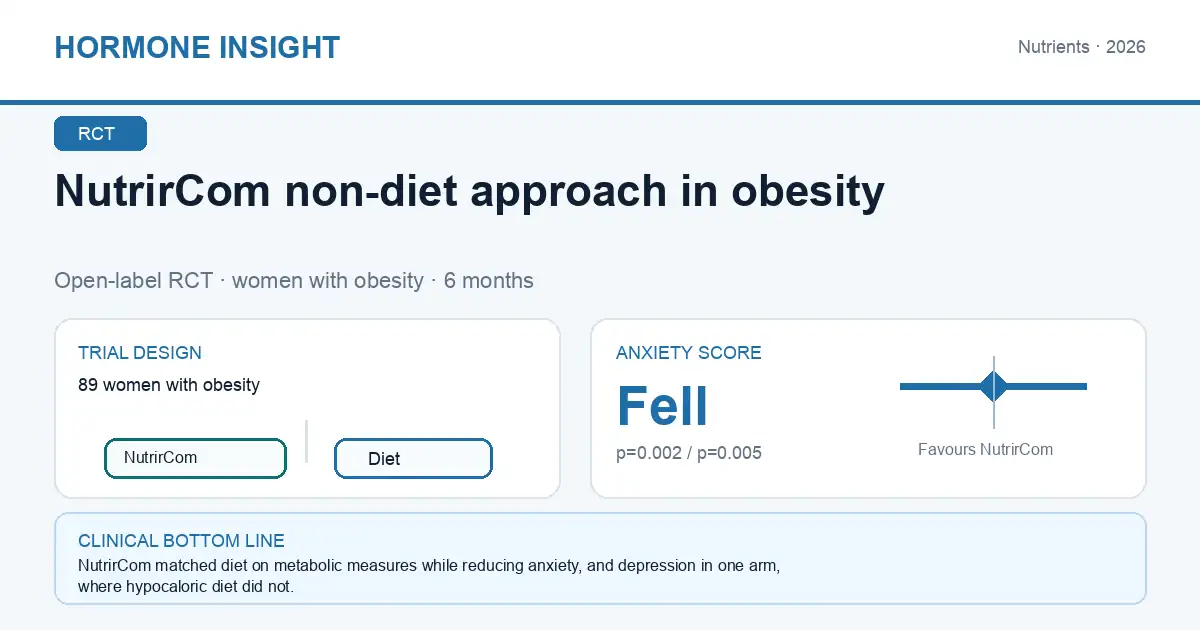
Summary: In a three-arm trial of women with obesity in primary care, a non-diet, person-centred nutritional approach (NutrirCom) improved psychoemotional outcomes (anxiety, depression, self-compassion) more than a conventional hypocaloric diet, while all groups showed similar anthropometric and metabolic gains.
PICO Summary
| Element | Detail |
|---|---|
| Population | 89 women with obesity from primary care in Viçosa, Brazil (open-label, BMI-stratified). |
| Intervention | NutrirCom, a multicomponent non-caloric-restriction approach: Group 2, 10 individual sessions; Group 3, individual sessions plus monthly group social support. |
| Comparison | Group 1, personalised hypocaloric diet (500–1000 kcal/day). |
| Outcome | All groups reduced waist circumference, fasting glucose, and body fat and gained lean mass. Anxiety fell significantly in Groups 2 (p=0.002) and 3 (p=0.005); depression fell only in Group 2 (p=0.023); self-compassion improved in Groups 2 and 3. No adverse effects. |
NutrirCom non-diet approach in women with obesity
Open-label RCT · women with obesity · 6 months
The non-diet NutrirCom approach matched a hypocaloric diet on waist, glucose, body fat and lean mass, while significantly reducing anxiety (and depression in the individual-session arm) where the diet did not.
Expert Commentary
The premise here is one I have real sympathy for: conventional calorie-restriction often fails to last and can deepen shame and disordered eating, particularly in women carrying weight-related stigma, so a person-centred approach attending to the emotional and social dimensions is a thoughtful alternative. The honest and rather elegant finding is that the non-diet arms matched the hypocaloric diet on the body measures, waist, glucose, body fat, and lean mass all moved similarly across groups, while doing better on anxiety, depression, and self-compassion. That is a genuinely useful message: you do not have to prescribe a punishing deficit to achieve comparable metabolic change, and you may spare psychological harm. My caveats are the design ones, an open-label trial of 89 women with self-reported psychoemotional endpoints prone to expectation effects, and short follow-up that cannot speak to durability. Can I use this with my patients? Yes, in principle: it supports a less restrictive, more compassionate framing of obesity care, especially for women with high psychoemotional burden, delivered with behavioural and social support. I would want a larger, longer trial confirming the mental-health benefit and its persistence.
References
Gonçalves IDSA, Campos TDN, Freitas DMO, et al. Multicomponent nutritional approach (NutrirCom) and its effects on anthropometric, metabolic, and psychoemotional outcomes in women with obesity: a three-arm randomized clinical trial. Nutrients. 2026;18(3):414. doi:10.3390/nu18030414